Commission recommends tougher per-unit penalties, higher caps for unpermitted demolition to Board of Supervisors
October 19, 2022 | San Francisco City, San Francisco County, California
This article was created by AI summarizing key points discussed. AI makes mistakes, so for full details and context, please refer to the video of the full meeting. Please report any errors so we can fix them. Report an error »
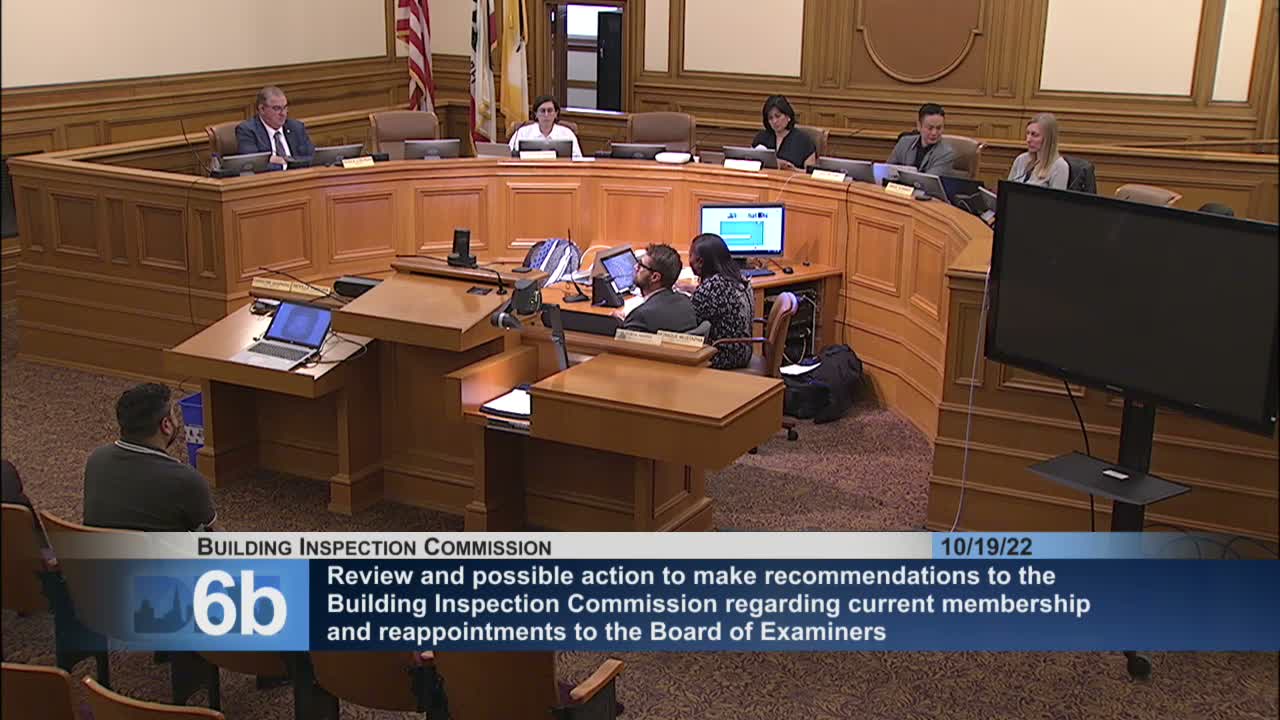
The San Francisco Building Inspection Commission on Oct. 19 recommended that the Board of Supervisors adopt changes to the planning and building codes that would stiffen penalties for code violations and unpermitted demolition.
Santiago Lerma, a legislative aide to Supervisor Hillary Ronan, told commissioners the ordinance (Board file 220878) is “intended to hurt bad actors where it hurts in their finances,” describing three core changes: raising the daily maximum planning‑code penalty from $250 to $1,000; clarifying that each residential unit within a single address may be counted as a separate violation; and creating caps for civil penalties tied to demolition — up to $250,000 for unpermitted demolition and up to $500,000 for demolition of historic buildings.
Commissioners pressed staff on how the new penalties would be applied. John Henchin, Acting Chief Building Inspector and head of code enforcement, said the measure is aimed at addresses referred to the city attorney for civil enforcement, and does not change DBI’s existing administrative processes for notice‑of‑violation and monitoring fees. “This entirely relates to addresses that are referred to the city attorney,” Henchin said.
Deputy City Attorney Rob Kaplan clarified that the ordinance sets maximum civil‑penalty caps that a city attorney could seek in court, and that courts ultimately determine final penalty amounts after weighing statutory criteria and due process. “These would be civil penalties that we brought in civil court,” Kaplan said, adding that the ordinance also lists factors a court would consider when assessing a penalty.
Commissioners asked about discretion in applying fines and how the department determines whether a property is an egregious case. Director Patrick O'Rearden told the commission that DBI maintains an internal rubric and discretion remains with the department for administrative responses; the ordinance would not alter that internal rubric but would raise caps available when litigation is pursued.
During public comment, callers raised longstanding concerns about a specific project on San Bruno Avenue and urged more aggressive enforcement. Francisco Da Costa, a caller who identified himself as a San Bruno resident, said there has been “no adjudication” on some properties and urged a stronger ordinance; his remarks included allegations of corruption tied to the project. Those allegations were repeated in the public record but were not corroborated at the meeting and remain unresolved.
The commission moved to recommend the ordinance and, after a roll‑call vote, the motion carried unanimously. The recommendation will be transmitted to the Board of Supervisors for further consideration and any legislative changes required to implement the code amendments.
Next steps: the full Board of Supervisors is scheduled to consider related code updates; DBI staff said the planning and building code changes will be presented in its hearings and that the city attorney's office would be the enforcing authority in civil actions.
Santiago Lerma, a legislative aide to Supervisor Hillary Ronan, told commissioners the ordinance (Board file 220878) is “intended to hurt bad actors where it hurts in their finances,” describing three core changes: raising the daily maximum planning‑code penalty from $250 to $1,000; clarifying that each residential unit within a single address may be counted as a separate violation; and creating caps for civil penalties tied to demolition — up to $250,000 for unpermitted demolition and up to $500,000 for demolition of historic buildings.
Commissioners pressed staff on how the new penalties would be applied. John Henchin, Acting Chief Building Inspector and head of code enforcement, said the measure is aimed at addresses referred to the city attorney for civil enforcement, and does not change DBI’s existing administrative processes for notice‑of‑violation and monitoring fees. “This entirely relates to addresses that are referred to the city attorney,” Henchin said.
Deputy City Attorney Rob Kaplan clarified that the ordinance sets maximum civil‑penalty caps that a city attorney could seek in court, and that courts ultimately determine final penalty amounts after weighing statutory criteria and due process. “These would be civil penalties that we brought in civil court,” Kaplan said, adding that the ordinance also lists factors a court would consider when assessing a penalty.
Commissioners asked about discretion in applying fines and how the department determines whether a property is an egregious case. Director Patrick O'Rearden told the commission that DBI maintains an internal rubric and discretion remains with the department for administrative responses; the ordinance would not alter that internal rubric but would raise caps available when litigation is pursued.
During public comment, callers raised longstanding concerns about a specific project on San Bruno Avenue and urged more aggressive enforcement. Francisco Da Costa, a caller who identified himself as a San Bruno resident, said there has been “no adjudication” on some properties and urged a stronger ordinance; his remarks included allegations of corruption tied to the project. Those allegations were repeated in the public record but were not corroborated at the meeting and remain unresolved.
The commission moved to recommend the ordinance and, after a roll‑call vote, the motion carried unanimously. The recommendation will be transmitted to the Board of Supervisors for further consideration and any legislative changes required to implement the code amendments.
Next steps: the full Board of Supervisors is scheduled to consider related code updates; DBI staff said the planning and building code changes will be presented in its hearings and that the city attorney's office would be the enforcing authority in civil actions.
View the Full Meeting & All Its Details
This article offers just a summary. Unlock complete video, transcripts, and insights as a Founder Member.
✓
Watch full, unedited meeting videos
✓
Search every word spoken in unlimited transcripts
✓
AI summaries & real-time alerts (all government levels)
✓
Permanent access to expanding government content
30-day money-back guarantee
