Building Inspection Commission backs ordinance to increase per-unit civil penalties for code violations
January 18, 2023 | San Francisco City, San Francisco County, California
This article was created by AI summarizing key points discussed. AI makes mistakes, so for full details and context, please refer to the video of the full meeting. Please report any errors so we can fix them. Report an error »
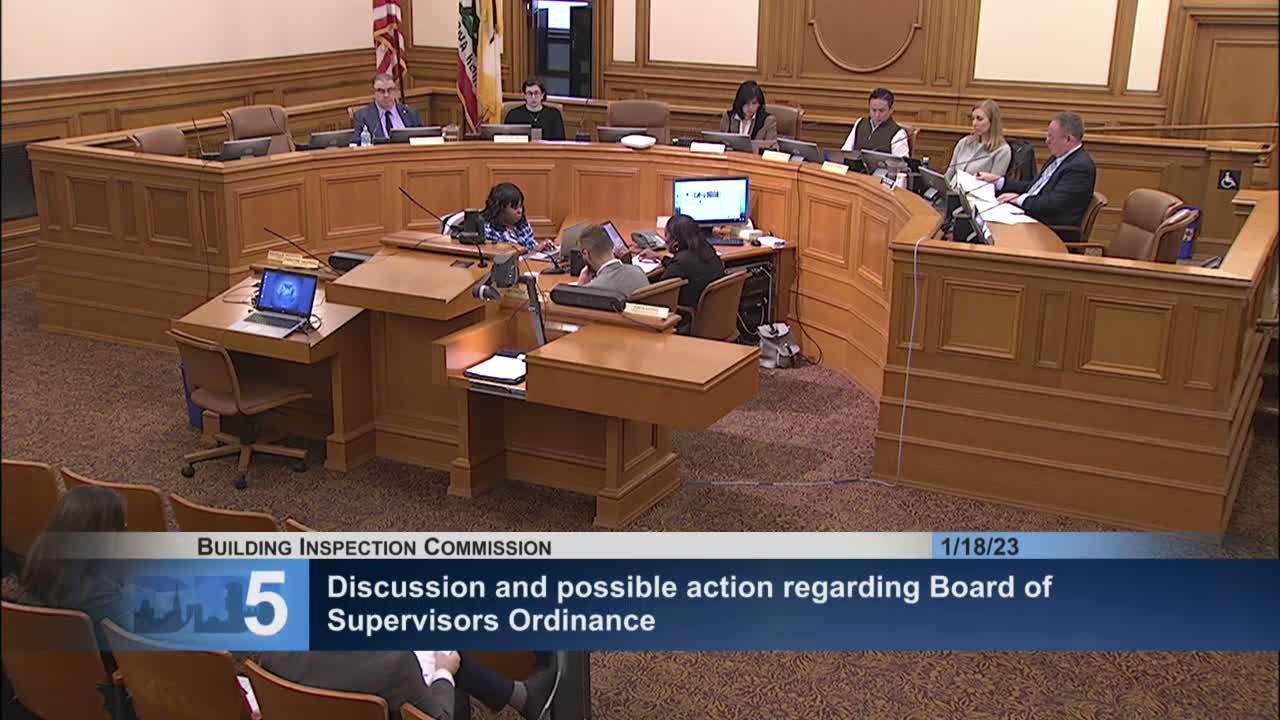
The San Francisco Building Inspection Commission on Jan. 18 unanimously recommended approval of a Board of Supervisors ordinance to raise civil penalties for planning and building-code violations and to treat each residential or commercial unit at a single address as a distinct violation. The commission voted to forward the item after staff and public discussion of substantive changes to the proposal.
DBI legislative affairs staff introduced the ordinance and said the building-code language was amended to incorporate a planning-code provision that restricts permits for five years after an unlawful demolition, except where replacement construction provides the same or greater number of residential units and a like-or-higher proportion of residential to nonresidential space. In qualifying replacement cases, the ordinance requires that replacement units “will be sold or rented at below market rates,” a substantive change that prompted additional commission questions and public comment.
Carl Necita, identified in the meeting as DBI’s legislative affairs manager, summarized the earlier hearings on the measure and explained the per-unit penalty language. “Civil penalties for all violations of the code would not be less than $200 and would not exceed $1,000,” he said, noting that the current building-code cap is $500.
Tenant advocates urged the commission to support stronger, per-unit penalties. Sarah Fred Sherpa Zimmer of the Housing Rights Committee of San Francisco said enforcement that aggregates multiple unit violations into a single fine allows developers to avoid accountability. “A $500 cap means nothing in this economy,” she said, and called for fines that reflect the scale of harm to tenants and neighbors.
The Residential Builders Association’s Sean Caitlin supported penalties for deliberate illegal activity but urged clearer criteria to distinguish bad actors from contractors who make honest mistakes, noting the complexity of demolition and permitting processes for many small and immigrant contractors.
Commissioners asked how far liability would travel along the chain of project participants and whether the ordinance would capture architects, inspectors or others who knowingly sign off on unlawful work. DBI staff said the provision is intended to hold individuals “in the web of construction” liable if they knowingly deceive the city and described existing checks — plan review, initial inspections and correction notices — and escalation paths that can include notices of violation and referral to the city attorney for egregious cases.
Commissioner Newman moved to approve the Board of Supervisors ordinance; President (chair) seconded the motion. The commission completed a roll-call vote and the motion carried unanimously.
The ordinance was recorded in the meeting as a Board of Supervisors item (file language read aloud during the hearing). The commission’s recommendation will be part of the legislative record forwarded to the Board of Supervisors for any required ordinance adoption and code changes.
DBI legislative affairs staff introduced the ordinance and said the building-code language was amended to incorporate a planning-code provision that restricts permits for five years after an unlawful demolition, except where replacement construction provides the same or greater number of residential units and a like-or-higher proportion of residential to nonresidential space. In qualifying replacement cases, the ordinance requires that replacement units “will be sold or rented at below market rates,” a substantive change that prompted additional commission questions and public comment.
Carl Necita, identified in the meeting as DBI’s legislative affairs manager, summarized the earlier hearings on the measure and explained the per-unit penalty language. “Civil penalties for all violations of the code would not be less than $200 and would not exceed $1,000,” he said, noting that the current building-code cap is $500.
Tenant advocates urged the commission to support stronger, per-unit penalties. Sarah Fred Sherpa Zimmer of the Housing Rights Committee of San Francisco said enforcement that aggregates multiple unit violations into a single fine allows developers to avoid accountability. “A $500 cap means nothing in this economy,” she said, and called for fines that reflect the scale of harm to tenants and neighbors.
The Residential Builders Association’s Sean Caitlin supported penalties for deliberate illegal activity but urged clearer criteria to distinguish bad actors from contractors who make honest mistakes, noting the complexity of demolition and permitting processes for many small and immigrant contractors.
Commissioners asked how far liability would travel along the chain of project participants and whether the ordinance would capture architects, inspectors or others who knowingly sign off on unlawful work. DBI staff said the provision is intended to hold individuals “in the web of construction” liable if they knowingly deceive the city and described existing checks — plan review, initial inspections and correction notices — and escalation paths that can include notices of violation and referral to the city attorney for egregious cases.
Commissioner Newman moved to approve the Board of Supervisors ordinance; President (chair) seconded the motion. The commission completed a roll-call vote and the motion carried unanimously.
The ordinance was recorded in the meeting as a Board of Supervisors item (file language read aloud during the hearing). The commission’s recommendation will be part of the legislative record forwarded to the Board of Supervisors for any required ordinance adoption and code changes.
Don't Miss a Word: See the Full Meeting!
Go beyond summaries. Unlock every video, transcript, and key insight with a Founder Membership.
✓
Get instant access to full meeting videos
✓
Search and clip any phrase from complete transcripts
✓
Receive AI-powered summaries & custom alerts
✓
Enjoy lifetime, unrestricted access to government data
30-day money-back guarantee
