Building Inspection Commission recommends clarifying site-permit ordinance, urges AB 32 reference
June 13, 2023 | San Francisco City, San Francisco County, California
This article was created by AI summarizing key points discussed. AI makes mistakes, so for full details and context, please refer to the video of the full meeting. Please report any errors so we can fix them. Report an error »
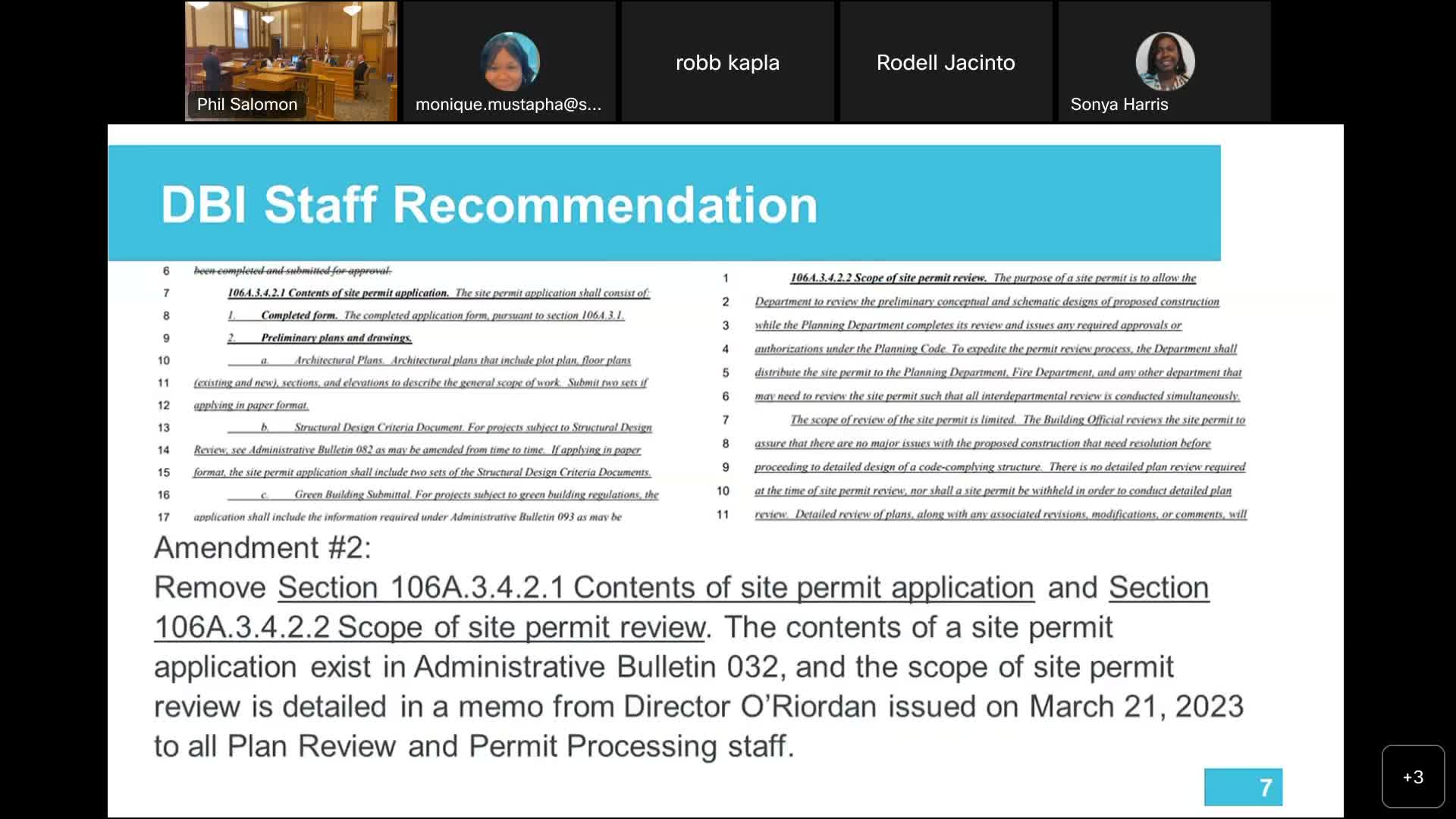
The San Francisco Building Inspection Commission on Tuesday voted unanimously to recommend that the Board of Supervisors consider specific amendments to proposed site-permit legislation, including referencing Administrative Bulletin 32 to define minimum standards and clarifying that technical reviews occur concurrently with planning review rather than after planning completes its review.
Commissioners heard presentations from staff and from Jeff Buckley, who represented the ordinance sponsor, who said the site permit is meant to be a preliminary, conceptual approval that provides vesting while more detailed drawings are completed during the addendum phase. Buckley also said the Code Advisory Committee (CAC) largely supported retaining site-permit elements in the code to provide certainty for project sponsors.
During public comment, Jerry Dratler said the proposed ordinance was ‘‘ambiguous’’ about the scope and limits of preliminary review and urged that administrative bulletins and minimum standards be referenced in the ordinance so applicants have clear guidance. Georgia Shudish told the commission that demolition calculations are critical to planning review for many projects and urged that demo calcs be included in simultaneous-review submittals to avoid delays. Avi of the Chinatown Community Development Center said budget cuts to COOP and SRO collaborator programs have reduced tenant outreach services and urged the commission to convene a special meeting on the cuts.
Commissioners probed several CAC recommendations. One point of contention was CAC Recommendation 5, which proposed replacing the phrase ‘‘meets minimum standards’’ with ‘‘is generally consistent with code requirements.’’ Staff advised keeping the building-code language ‘‘minimum code standards,’’ warning that ‘‘generally consistent’’ could be read as imprecise. Commissioner Newman and others asked that the ordinance explicitly reference Administrative Bulletin 32 (AB 32) so schematic-design thresholds are clear; staff agreed that referencing AB 32 would provide guidance and said the administrative bulletin could be amended to align with any codified changes.
Another debate focused on whether the ordinance should require an ‘‘accessible path of travel from public transit’’ to a building entrance. A commissioner objected that such a requirement would extend project scope beyond the property line and risk ‘‘scope creep’’ into the public right-of-way, noting that the distance to transit could vary widely. Commissioners said that details about work in the public realm are typically negotiated with Public Works rather than embedded in the building-code language.
Commissioners also sought clarity on amendment 1, which addresses concurrent review. Several commissioners said technical reviews (DBI, Public Works, Fire, et al.) should proceed concurrently with planning review rather than waiting for planning to complete its review; staff said the intent of the amendment is concurrent technical review during the planning process and agreed to revise language that could be read as sequencing reviews.
A commissioner moved that, as the ordinance advances to the Board of Supervisors’ Transportation and Land Use Committee, the commission recommend removing the CAC’s item that expands the required travel path to public transit, amend the CAC’s item 5 to read ‘‘meets minimum code standards as outlined in AB 32,’’ and revise DBI’s amendment 1 to make explicit that technical review happens concurrently with planning review. After a roll-call vote, the recommendation carried unanimously.
Deputy City Attorney Peter Millian clarified that the Building Inspection Commission’s role was to make a recommendation to the Board of Supervisors (to approve, disapprove, or approve with modifications) and that the commission had not taken a final approval or disapproval of the ordinance itself. The ordinance is expected to move next to the Land Use Committee of the Board of Supervisors in July for further consideration.
Next steps: Commissioners asked staff to refine the recommended language (including the AB 32 reference and concurrent-review wording) before the bill is considered by the Land Use Committee. The commission adjourned at 4:43 p.m.
Commissioners heard presentations from staff and from Jeff Buckley, who represented the ordinance sponsor, who said the site permit is meant to be a preliminary, conceptual approval that provides vesting while more detailed drawings are completed during the addendum phase. Buckley also said the Code Advisory Committee (CAC) largely supported retaining site-permit elements in the code to provide certainty for project sponsors.
During public comment, Jerry Dratler said the proposed ordinance was ‘‘ambiguous’’ about the scope and limits of preliminary review and urged that administrative bulletins and minimum standards be referenced in the ordinance so applicants have clear guidance. Georgia Shudish told the commission that demolition calculations are critical to planning review for many projects and urged that demo calcs be included in simultaneous-review submittals to avoid delays. Avi of the Chinatown Community Development Center said budget cuts to COOP and SRO collaborator programs have reduced tenant outreach services and urged the commission to convene a special meeting on the cuts.
Commissioners probed several CAC recommendations. One point of contention was CAC Recommendation 5, which proposed replacing the phrase ‘‘meets minimum standards’’ with ‘‘is generally consistent with code requirements.’’ Staff advised keeping the building-code language ‘‘minimum code standards,’’ warning that ‘‘generally consistent’’ could be read as imprecise. Commissioner Newman and others asked that the ordinance explicitly reference Administrative Bulletin 32 (AB 32) so schematic-design thresholds are clear; staff agreed that referencing AB 32 would provide guidance and said the administrative bulletin could be amended to align with any codified changes.
Another debate focused on whether the ordinance should require an ‘‘accessible path of travel from public transit’’ to a building entrance. A commissioner objected that such a requirement would extend project scope beyond the property line and risk ‘‘scope creep’’ into the public right-of-way, noting that the distance to transit could vary widely. Commissioners said that details about work in the public realm are typically negotiated with Public Works rather than embedded in the building-code language.
Commissioners also sought clarity on amendment 1, which addresses concurrent review. Several commissioners said technical reviews (DBI, Public Works, Fire, et al.) should proceed concurrently with planning review rather than waiting for planning to complete its review; staff said the intent of the amendment is concurrent technical review during the planning process and agreed to revise language that could be read as sequencing reviews.
A commissioner moved that, as the ordinance advances to the Board of Supervisors’ Transportation and Land Use Committee, the commission recommend removing the CAC’s item that expands the required travel path to public transit, amend the CAC’s item 5 to read ‘‘meets minimum code standards as outlined in AB 32,’’ and revise DBI’s amendment 1 to make explicit that technical review happens concurrently with planning review. After a roll-call vote, the recommendation carried unanimously.
Deputy City Attorney Peter Millian clarified that the Building Inspection Commission’s role was to make a recommendation to the Board of Supervisors (to approve, disapprove, or approve with modifications) and that the commission had not taken a final approval or disapproval of the ordinance itself. The ordinance is expected to move next to the Land Use Committee of the Board of Supervisors in July for further consideration.
Next steps: Commissioners asked staff to refine the recommended language (including the AB 32 reference and concurrent-review wording) before the bill is considered by the Land Use Committee. The commission adjourned at 4:43 p.m.
Don't Miss a Word: See the Full Meeting!
Go beyond summaries. Unlock every video, transcript, and key insight with a Founder Membership.
✓
Get instant access to full meeting videos
✓
Search and clip any phrase from complete transcripts
✓
Receive AI-powered summaries & custom alerts
✓
Enjoy lifetime, unrestricted access to government data
30-day money-back guarantee
