Building Inspection Commission backs 15% DBI fee increase and asks Board to consider up to 20%
June 21, 2023 | San Francisco City, San Francisco County, California
This article was created by AI summarizing key points discussed. AI makes mistakes, so for full details and context, please refer to the video of the full meeting. Please report any errors so we can fix them. Report an error »
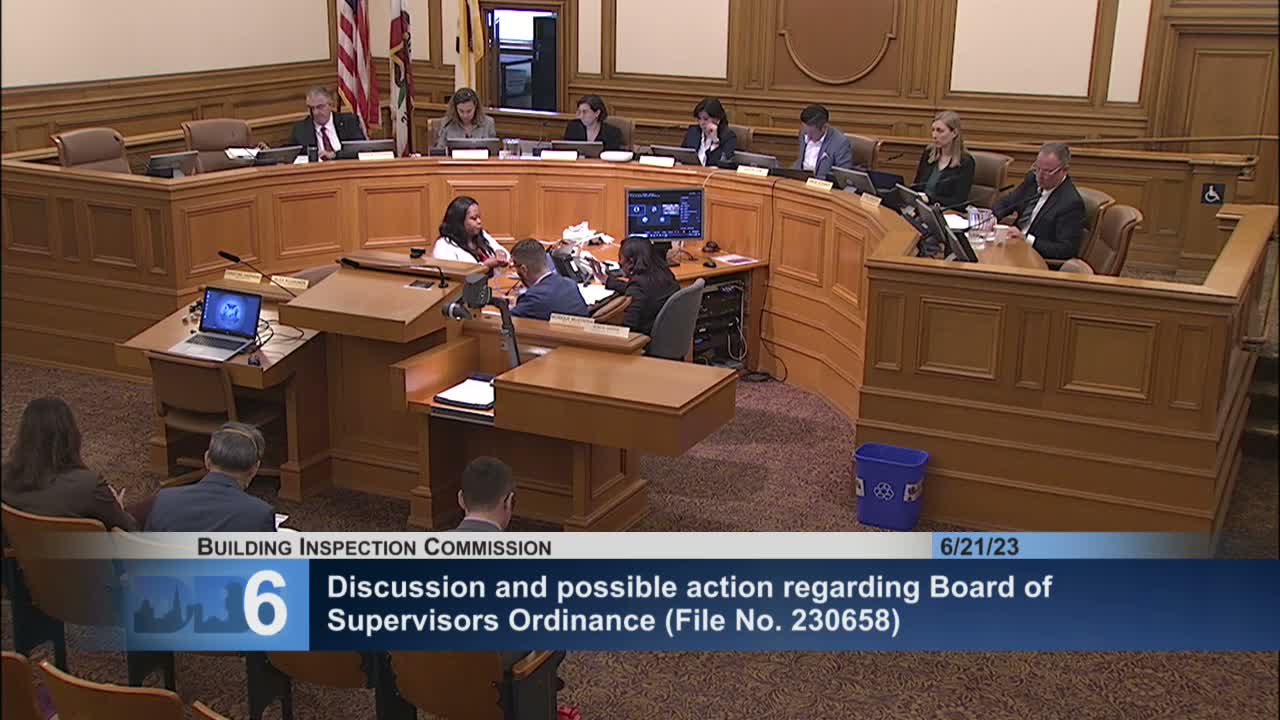
The Building Inspection Commission voted June 21 to recommend that the Board of Supervisors approve an ordinance to raise fees charged by the Department of Building Inspection by 15% across the board and to consider additional increases up to 20% to address DBI's projected structural deficit.
"This ordinance would increase fees charged by DBI by 15% across the board," said Carl Necida, legislative affairs manager for the Department of Building Inspection, introducing Board File 230,658 as part of the mayor's proposed budget. He told commissioners the department last adjusted fees in 2009 and that a 2015 reduction left current levels below cost; the city's cost to provide services rose roughly 32% since 2015, Necida said.
Commissioners debated the size and allocation of the fee increase at length. Commissioner Alexander Toot moved to recommend a 25% increase, arguing that a 15% raise would not cover a 32% rise in costs: "If the increase to staff cost has been 32%, it's hard for me to understand why we would increase our fees for less." That motion was seconded but failed on a 3-3 tie.
Other commissioners argued for a more cautious approach, calling the 15% proposal a stopgap until a comprehensive fee study is completed in the fall and winter. Deputy City Attorney Rob Capla and DBI staff said the commission cannot make appropriations; legal limits restrict which fee revenues could legally be used to fund community-based organizations (CBOs), and some specific fees (for example, the apartment license fee) would be the only likely candidates to fund outside programs.
After further discussion, the commission adopted a compromise recommendation by roll call: recommend approval of the ordinance as drafted (15% across the board) and advise the Board of Supervisors to consider additional increases up to 20% if necessary to address DBI's budget and to fund priorities discussed at the meeting. The motion carried, 4 to 3.
Votes at a glance: a motion to recommend a 25% increase failed on a tie; the final compromise motion recommending a minimum 15% and consideration up to 20% carried 4-3.
Why it matters: DBI officials said fees were last set at higher effective levels in 2009 (a 2015 reduction lowered them) and that without revenue adjustments DBI faces a structural shortfall that could affect inspections, permit review and other core services. The commission and speakers also discussed the possibility of using targeted fee changes to restore funding to CBOs that provide tenant outreach and language access, but staff cautioned that legal constraints limit which fee revenues could finance those programs.
Next steps: The Commission's recommendation goes to the Board of Supervisors' Budget and Appropriations Committee and then to the full board. DBI officials told the commission they expect a consultant-led fee study to be completed in the fall and winter, which could inform longer-term, line-by-line fee adjustments.
"This ordinance would increase fees charged by DBI by 15% across the board," said Carl Necida, legislative affairs manager for the Department of Building Inspection, introducing Board File 230,658 as part of the mayor's proposed budget. He told commissioners the department last adjusted fees in 2009 and that a 2015 reduction left current levels below cost; the city's cost to provide services rose roughly 32% since 2015, Necida said.
Commissioners debated the size and allocation of the fee increase at length. Commissioner Alexander Toot moved to recommend a 25% increase, arguing that a 15% raise would not cover a 32% rise in costs: "If the increase to staff cost has been 32%, it's hard for me to understand why we would increase our fees for less." That motion was seconded but failed on a 3-3 tie.
Other commissioners argued for a more cautious approach, calling the 15% proposal a stopgap until a comprehensive fee study is completed in the fall and winter. Deputy City Attorney Rob Capla and DBI staff said the commission cannot make appropriations; legal limits restrict which fee revenues could legally be used to fund community-based organizations (CBOs), and some specific fees (for example, the apartment license fee) would be the only likely candidates to fund outside programs.
After further discussion, the commission adopted a compromise recommendation by roll call: recommend approval of the ordinance as drafted (15% across the board) and advise the Board of Supervisors to consider additional increases up to 20% if necessary to address DBI's budget and to fund priorities discussed at the meeting. The motion carried, 4 to 3.
Votes at a glance: a motion to recommend a 25% increase failed on a tie; the final compromise motion recommending a minimum 15% and consideration up to 20% carried 4-3.
Why it matters: DBI officials said fees were last set at higher effective levels in 2009 (a 2015 reduction lowered them) and that without revenue adjustments DBI faces a structural shortfall that could affect inspections, permit review and other core services. The commission and speakers also discussed the possibility of using targeted fee changes to restore funding to CBOs that provide tenant outreach and language access, but staff cautioned that legal constraints limit which fee revenues could finance those programs.
Next steps: The Commission's recommendation goes to the Board of Supervisors' Budget and Appropriations Committee and then to the full board. DBI officials told the commission they expect a consultant-led fee study to be completed in the fall and winter, which could inform longer-term, line-by-line fee adjustments.
View the Full Meeting & All Its Details
This article offers just a summary. Unlock complete video, transcripts, and insights as a Founder Member.
✓
Watch full, unedited meeting videos
✓
Search every word spoken in unlimited transcripts
✓
AI summaries & real-time alerts (all government levels)
✓
Permanent access to expanding government content
30-day money-back guarantee
