Investigators find maintenance and several failure modes behind March glass blowouts; DBI recommends five‑year visual inspections
September 20, 2023 | San Francisco City, San Francisco County, California
This article was created by AI summarizing key points discussed. AI makes mistakes, so for full details and context, please refer to the video of the full meeting. Please report any errors so we can fix them. Report an error »
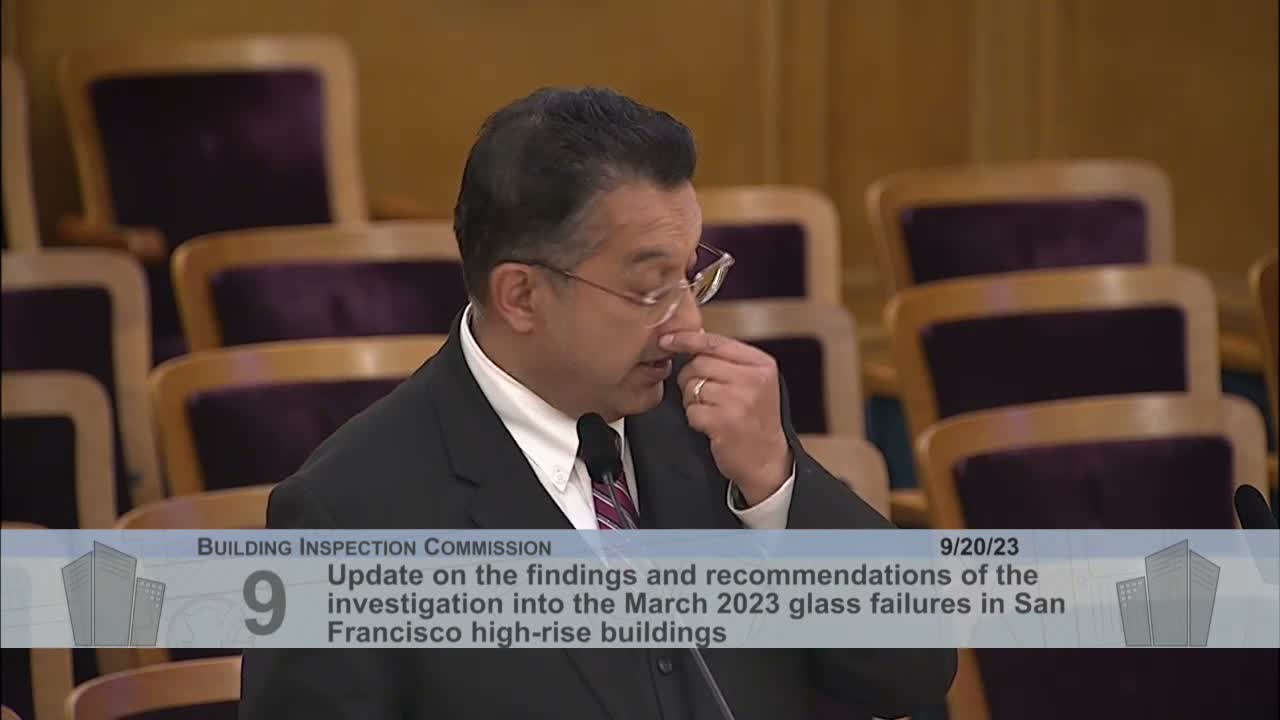
A consultant hired by the City of San Francisco concluded that building maintenance issues — not a single systemic design defect — were the primary contributors to multiple facade glass failures during March storms, and recommended changes to the city's facade inspection program.
Neville Perera, deputy director of DBI’s permit services division, summarized the WJE Engineering investigation on Sept. 20. WJE reviewed seven buildings that together lost about 31 panes during severe windstorms. The firm attributed breakages to several causes depending on the building: thermal stress (including preexisting breaks that were dislodged by wind), debris impact, window‑hardware (stay‑arm) failures, spandrel‑glass heat differentials often caused by insulation contact, and in at least one case glass contamination (nickel sulfide) that can cause spontaneous breakage.
Perera said the investigation showed that, in multiple cases, the physical pane damage predated the storms and inadequate maintenance or inspection practices allowed those flaws to persist until the wind events exposed them. "Building maintenance issues were the root cause of these failures," DBI Director Patrick O'Riordan had said earlier when previewing the report.
WJE recommended steps for building owners and for code changes. DBI staff said they will publish an information sheet to guide owners of buildings 15 stories and taller (post‑1998) on how to prepare the report already required by emergency legislation and to standardize those responses. The department also plans to revise the facade‑inspection administrative bulletin and explore code amendments to require a visual glass inspection every five years for qualifying high‑rise buildings, with a tiered 10‑year in‑depth evaluation continuing for other façade elements.
The commission asked staff about owner compliance and how the information and new inspection cadence will be enforced; Perera said owner responses were inconsistent during the inquiry and emphasized the value of maintenance logs (for example, records generated whenever window‑washing or swing‑stage access occurs) to demonstrate ongoing care. Staff said they will follow the six‑month reporting window established after the March storms and pursue code language changes to make the new glass inspection expectations more prescriptive.
Next steps include publishing the information sheet for owners, collecting the six‑month reports, and proposing code amendments to the facade inspection program for future commission and legislative review.
Neville Perera, deputy director of DBI’s permit services division, summarized the WJE Engineering investigation on Sept. 20. WJE reviewed seven buildings that together lost about 31 panes during severe windstorms. The firm attributed breakages to several causes depending on the building: thermal stress (including preexisting breaks that were dislodged by wind), debris impact, window‑hardware (stay‑arm) failures, spandrel‑glass heat differentials often caused by insulation contact, and in at least one case glass contamination (nickel sulfide) that can cause spontaneous breakage.
Perera said the investigation showed that, in multiple cases, the physical pane damage predated the storms and inadequate maintenance or inspection practices allowed those flaws to persist until the wind events exposed them. "Building maintenance issues were the root cause of these failures," DBI Director Patrick O'Riordan had said earlier when previewing the report.
WJE recommended steps for building owners and for code changes. DBI staff said they will publish an information sheet to guide owners of buildings 15 stories and taller (post‑1998) on how to prepare the report already required by emergency legislation and to standardize those responses. The department also plans to revise the facade‑inspection administrative bulletin and explore code amendments to require a visual glass inspection every five years for qualifying high‑rise buildings, with a tiered 10‑year in‑depth evaluation continuing for other façade elements.
The commission asked staff about owner compliance and how the information and new inspection cadence will be enforced; Perera said owner responses were inconsistent during the inquiry and emphasized the value of maintenance logs (for example, records generated whenever window‑washing or swing‑stage access occurs) to demonstrate ongoing care. Staff said they will follow the six‑month reporting window established after the March storms and pursue code language changes to make the new glass inspection expectations more prescriptive.
Next steps include publishing the information sheet for owners, collecting the six‑month reports, and proposing code amendments to the facade inspection program for future commission and legislative review.
View the Full Meeting & All Its Details
This article offers just a summary. Unlock complete video, transcripts, and insights as a Founder Member.
✓
Watch full, unedited meeting videos
✓
Search every word spoken in unlimited transcripts
✓
AI summaries & real-time alerts (all government levels)
✓
Permanent access to expanding government content
30-day money-back guarantee
