Building Inspection Commission recommends approval of fire‑code changes requiring 5‑foot access and inspection filing
January 17, 2024 | San Francisco City, San Francisco County, California
This article was created by AI summarizing key points discussed. AI makes mistakes, so for full details and context, please refer to the video of the full meeting. Please report any errors so we can fix them. Report an error »
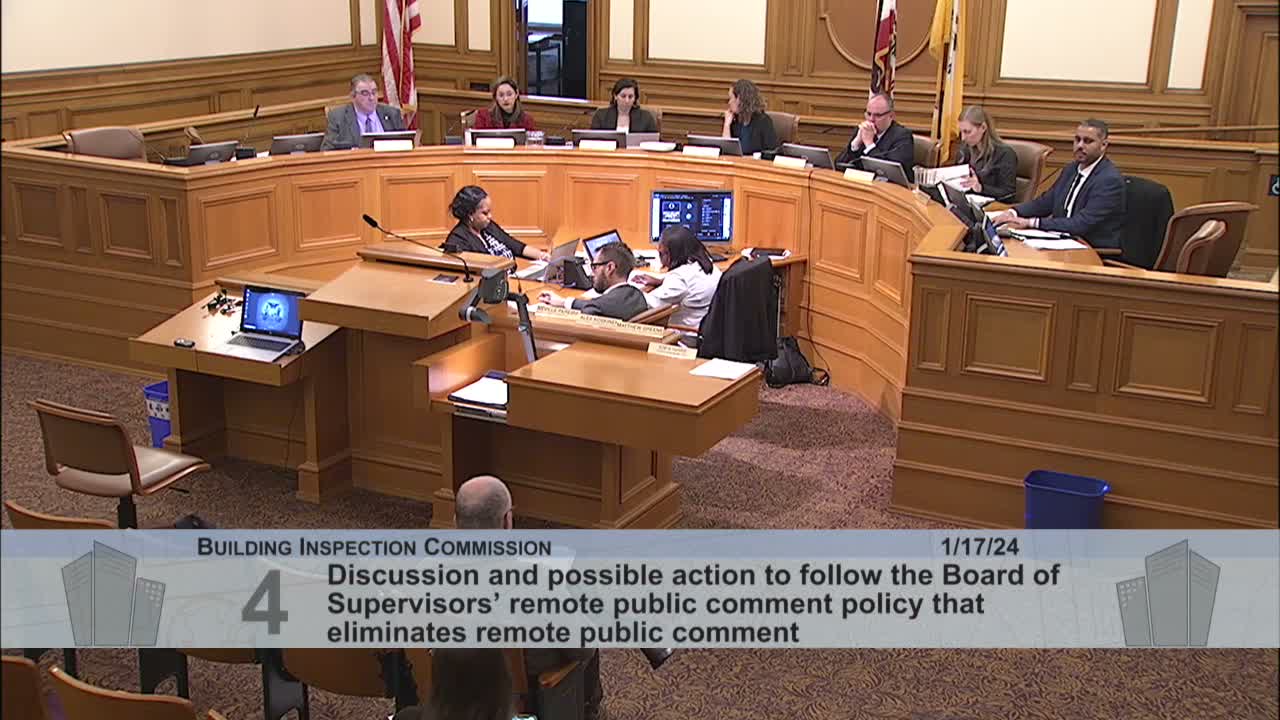
The Building Inspection Commission on Jan. 17 recommended approval of Board of Supervisors Ordinance File 23116, which would (1) require building owners to file five‑year sprinkler inspection records and annual fire‑alarm/detection inspection records with the Fire Department and (2) require a minimum five‑foot clear access from the public right of way to residential structures on newly subdivided lots.
The ordinance, sponsored by Supervisor Connie Chan and presented to the commission by DBI legislative affairs manager Carl Necida and Frances Shea of Supervisor Chan’s office, is intended to improve compliance with life‑safety requirements and ensure firefighters can access rear units created by subdivisions under SB 9. Fire Marshal Ken Coughlin and Deputy Chief Darius Ledger described operational testing and a recent multi‑alarm fire (cited in the presentation) that they said showed three‑foot tradesman entrances are inadequate for carrying ladders, charged hose and moving patients; Coughlin said the department’s field tests led it to request a five‑foot minimum.
Commissioners debated how a five‑foot objective standard would interact with SB 9 ministerial review and the state baseline (usually four feet). Deputy city attorney Rob Caplat and DBI staff explained that SB 9 requires objective standards for ministerial approval and that a local standard becomes the ministerial threshold: if a project meets the local objective minimum, the project proceeds without discretionary review; if it does not, the project may be considered under local equivalency or discretionary processes.
After discussion and public comment that included design and housing‑production concerns, the commission voted 4–2 to recommend approval to the Board of Supervisors. Interim President Alexander Toot, Commissioner Shattucks, Commissioner Summer and Commissioner Williams voted yes; Commissioners Chavez and Newman voted no.
The ordinance also includes a fee to recover DBI’s cost to accept and track filing records; DBI staff said those filings would be enforced by the Fire Department and paired with administrative bulletins and a local‑equivalency process to address unusual site conditions.
The ordinance, sponsored by Supervisor Connie Chan and presented to the commission by DBI legislative affairs manager Carl Necida and Frances Shea of Supervisor Chan’s office, is intended to improve compliance with life‑safety requirements and ensure firefighters can access rear units created by subdivisions under SB 9. Fire Marshal Ken Coughlin and Deputy Chief Darius Ledger described operational testing and a recent multi‑alarm fire (cited in the presentation) that they said showed three‑foot tradesman entrances are inadequate for carrying ladders, charged hose and moving patients; Coughlin said the department’s field tests led it to request a five‑foot minimum.
Commissioners debated how a five‑foot objective standard would interact with SB 9 ministerial review and the state baseline (usually four feet). Deputy city attorney Rob Caplat and DBI staff explained that SB 9 requires objective standards for ministerial approval and that a local standard becomes the ministerial threshold: if a project meets the local objective minimum, the project proceeds without discretionary review; if it does not, the project may be considered under local equivalency or discretionary processes.
After discussion and public comment that included design and housing‑production concerns, the commission voted 4–2 to recommend approval to the Board of Supervisors. Interim President Alexander Toot, Commissioner Shattucks, Commissioner Summer and Commissioner Williams voted yes; Commissioners Chavez and Newman voted no.
The ordinance also includes a fee to recover DBI’s cost to accept and track filing records; DBI staff said those filings would be enforced by the Fire Department and paired with administrative bulletins and a local‑equivalency process to address unusual site conditions.
View the Full Meeting & All Its Details
This article offers just a summary. Unlock complete video, transcripts, and insights as a Founder Member.
✓
Watch full, unedited meeting videos
✓
Search every word spoken in unlimited transcripts
✓
AI summaries & real-time alerts (all government levels)
✓
Permanent access to expanding government content
30-day money-back guarantee
