San Francisco panel approves DBI two‑year budget after heated debate over community outreach funding
February 14, 2024 | San Francisco City, San Francisco County, California
This article was created by AI summarizing key points discussed. AI makes mistakes, so for full details and context, please refer to the video of the full meeting. Please report any errors so we can fix them. Report an error »
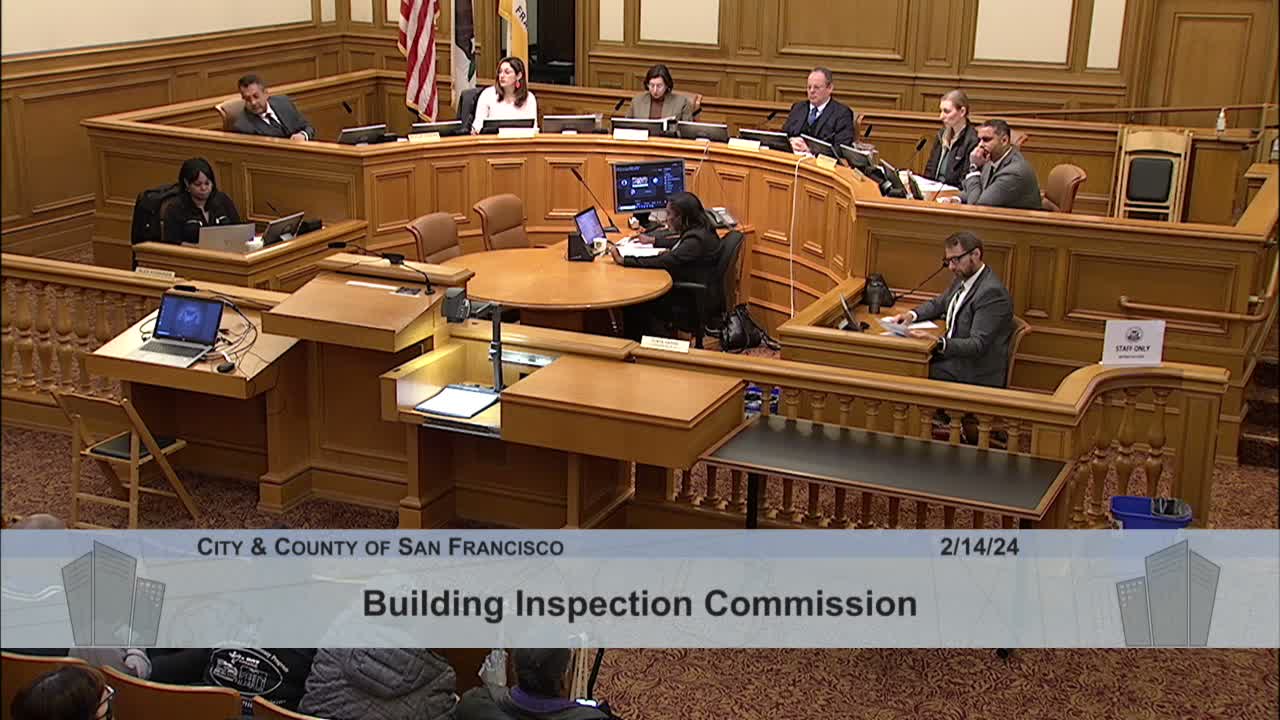
The San Francisco Building Inspection Commission on Feb. 14 approved the Department of Building Inspection’s proposed budget for fiscal years 2024–25 and 2025–26, after extended public comment and a contentious commission debate over how code‑enforcement outreach programs should be funded.
The commission voted to send DBI’s proposed submission to the mayor with a formal recommendation that the mayor’s office and forthcoming fee‑setting legislation re‑examine the department’s fee‑revenue assumptions. The final motion passed on a roll‑call vote after an earlier motion to guarantee CBO funding failed to achieve the five‑vote threshold required to submit a budget to the mayor.
DBI Deputy Director for Administration Alex Koskinen presented the two‑year plan, saying the department faces a multi‑year shortfall and must phase in fee increases to avoid depleting reserves. Koskinen told commissioners the department projects approximately $35.9 million in available fund balance at the end of the current fiscal year and proposes using about $18.4 million of fund balance in the first year of the two‑year plan while phasing in fee increases to reach full cost recovery by fiscal year 2027.
Koskinen said the proposed submission reflects updated revenue assumptions from a fee study: lower demand for services (about $2.5 million) is being offset by roughly $10.1 million in fee increases now under consideration, producing a net revenue improvement of about $7.6 million. He also described modest new expenditures — including safety gear, supervisory training and one new permit technician and an SF Fellow — and explained that some funds (about $140,000) are special revenue restricted to seismic and strong‑motion uses.
On the question of community‑based organizations that perform code‑enforcement outreach, Koskinen said, “DBI’s position is that the grants should be funded by the general fund,” and that the proposed budget reduces the CBO line by about $510,000 (roughly a 10% reduction) but would keep funding at the level of last year’s actual spending (about $4.3 million).
That proposal drew dozens of in‑person speakers and coalition testimony from tenant organizers, neighborhood CBOs and housing advocates, who said outreach groups reduce inspector workload, provide multilingual access, and prevent displacement and unsafe conditions. “Please do not cut SROFU’s funding,” said Junhua Chen of SRO Families United Collaborative, reflecting multiple pleas from tenant advocates to restore or preserve the CBO budgets. Maria Samullo, interim executive director of the Housing Rights Committee of San Francisco, urged commissioners to delay any vote until there is “a plan to bring us back into the DBI funds,” stressing the programs’ decades‑long role in habitability and tenant support.
Commissioner debate centered on two tensions: (1) fiscal transparency and whether commissioners had enough line‑item detail to approve a budget showing an $18 million operating deficit without seeing the full technical budget document, and (2) how to preserve CBO services without risking the department’s solvency. Commissioner Williams said, “I cannot in good conscience approve a budget with an $18,000,000 deficit without looking at it first,” and pressed for an alternative, more aggressive fee‑recovery scenario to be provided for comparison.
Two competing motions were brought to the floor. The first, by Commissioner Shattucks and seconded by Commissioner Chavez, would have passed the budget while explicitly guaranteeing CBO funding and directing commissioners to send a letter to the mayor supporting that guarantee; the roll call (Chavez yes, Newman yes, Shattuck yes, Summer yes, Williams no) fell short of the five favorable votes required under the commission’s procedural rules and therefore failed. A second motion, made by Commissioner Williams and seconded by Commissioner Newman, approved DBI’s proposed submission and asked that the mayor’s office and the fee‑setting legislation take into account alternative fee‑revenue scenarios; that motion carried unanimously.
Deputy City Attorney Rob Capela reminded commissioners that the authority to set and amend fees will be a separate legislative action and that a vote today to forward the budget does not bind future fee decisions. DBI staff said they will submit the department’s proposed budget to the mayor and controller on Feb. 21 and that draft building‑code legislation to codify fee changes will be provided to the commission in the coming weeks.
What the commission approved was the department’s two‑year fiscal plan as presented, with language asking the mayor and future fee legislation to reevaluate revenue assumptions. Commissioners also discussed follow‑up steps: receive the full line‑item budget documentation, review a more aggressive fee‑recovery projection, and consider formal recommendations or letters to the mayor asking that general‑fund support for CBOs be maintained.
The meeting adjourned at 1:06 p.m. after the vote. The DBI will proceed with submission to the mayor and continue work on fee‑study legislation that will come back to the commission for review.
The commission voted to send DBI’s proposed submission to the mayor with a formal recommendation that the mayor’s office and forthcoming fee‑setting legislation re‑examine the department’s fee‑revenue assumptions. The final motion passed on a roll‑call vote after an earlier motion to guarantee CBO funding failed to achieve the five‑vote threshold required to submit a budget to the mayor.
DBI Deputy Director for Administration Alex Koskinen presented the two‑year plan, saying the department faces a multi‑year shortfall and must phase in fee increases to avoid depleting reserves. Koskinen told commissioners the department projects approximately $35.9 million in available fund balance at the end of the current fiscal year and proposes using about $18.4 million of fund balance in the first year of the two‑year plan while phasing in fee increases to reach full cost recovery by fiscal year 2027.
Koskinen said the proposed submission reflects updated revenue assumptions from a fee study: lower demand for services (about $2.5 million) is being offset by roughly $10.1 million in fee increases now under consideration, producing a net revenue improvement of about $7.6 million. He also described modest new expenditures — including safety gear, supervisory training and one new permit technician and an SF Fellow — and explained that some funds (about $140,000) are special revenue restricted to seismic and strong‑motion uses.
On the question of community‑based organizations that perform code‑enforcement outreach, Koskinen said, “DBI’s position is that the grants should be funded by the general fund,” and that the proposed budget reduces the CBO line by about $510,000 (roughly a 10% reduction) but would keep funding at the level of last year’s actual spending (about $4.3 million).
That proposal drew dozens of in‑person speakers and coalition testimony from tenant organizers, neighborhood CBOs and housing advocates, who said outreach groups reduce inspector workload, provide multilingual access, and prevent displacement and unsafe conditions. “Please do not cut SROFU’s funding,” said Junhua Chen of SRO Families United Collaborative, reflecting multiple pleas from tenant advocates to restore or preserve the CBO budgets. Maria Samullo, interim executive director of the Housing Rights Committee of San Francisco, urged commissioners to delay any vote until there is “a plan to bring us back into the DBI funds,” stressing the programs’ decades‑long role in habitability and tenant support.
Commissioner debate centered on two tensions: (1) fiscal transparency and whether commissioners had enough line‑item detail to approve a budget showing an $18 million operating deficit without seeing the full technical budget document, and (2) how to preserve CBO services without risking the department’s solvency. Commissioner Williams said, “I cannot in good conscience approve a budget with an $18,000,000 deficit without looking at it first,” and pressed for an alternative, more aggressive fee‑recovery scenario to be provided for comparison.
Two competing motions were brought to the floor. The first, by Commissioner Shattucks and seconded by Commissioner Chavez, would have passed the budget while explicitly guaranteeing CBO funding and directing commissioners to send a letter to the mayor supporting that guarantee; the roll call (Chavez yes, Newman yes, Shattuck yes, Summer yes, Williams no) fell short of the five favorable votes required under the commission’s procedural rules and therefore failed. A second motion, made by Commissioner Williams and seconded by Commissioner Newman, approved DBI’s proposed submission and asked that the mayor’s office and the fee‑setting legislation take into account alternative fee‑revenue scenarios; that motion carried unanimously.
Deputy City Attorney Rob Capela reminded commissioners that the authority to set and amend fees will be a separate legislative action and that a vote today to forward the budget does not bind future fee decisions. DBI staff said they will submit the department’s proposed budget to the mayor and controller on Feb. 21 and that draft building‑code legislation to codify fee changes will be provided to the commission in the coming weeks.
What the commission approved was the department’s two‑year fiscal plan as presented, with language asking the mayor and future fee legislation to reevaluate revenue assumptions. Commissioners also discussed follow‑up steps: receive the full line‑item budget documentation, review a more aggressive fee‑recovery projection, and consider formal recommendations or letters to the mayor asking that general‑fund support for CBOs be maintained.
The meeting adjourned at 1:06 p.m. after the vote. The DBI will proceed with submission to the mayor and continue work on fee‑study legislation that will come back to the commission for review.
View the Full Meeting & All Its Details
This article offers just a summary. Unlock complete video, transcripts, and insights as a Founder Member.
✓
Watch full, unedited meeting videos
✓
Search every word spoken in unlimited transcripts
✓
AI summaries & real-time alerts (all government levels)
✓
Permanent access to expanding government content
30-day money-back guarantee
