San Francisco Fire Department reports Omicron-driven staffing strain, accelerates paramedic training
January 12, 2022 | San Francisco City, San Francisco County, California
This article was created by AI summarizing key points discussed. AI makes mistakes, so for full details and context, please refer to the video of the full meeting. Please report any errors so we can fix them. Report an error »
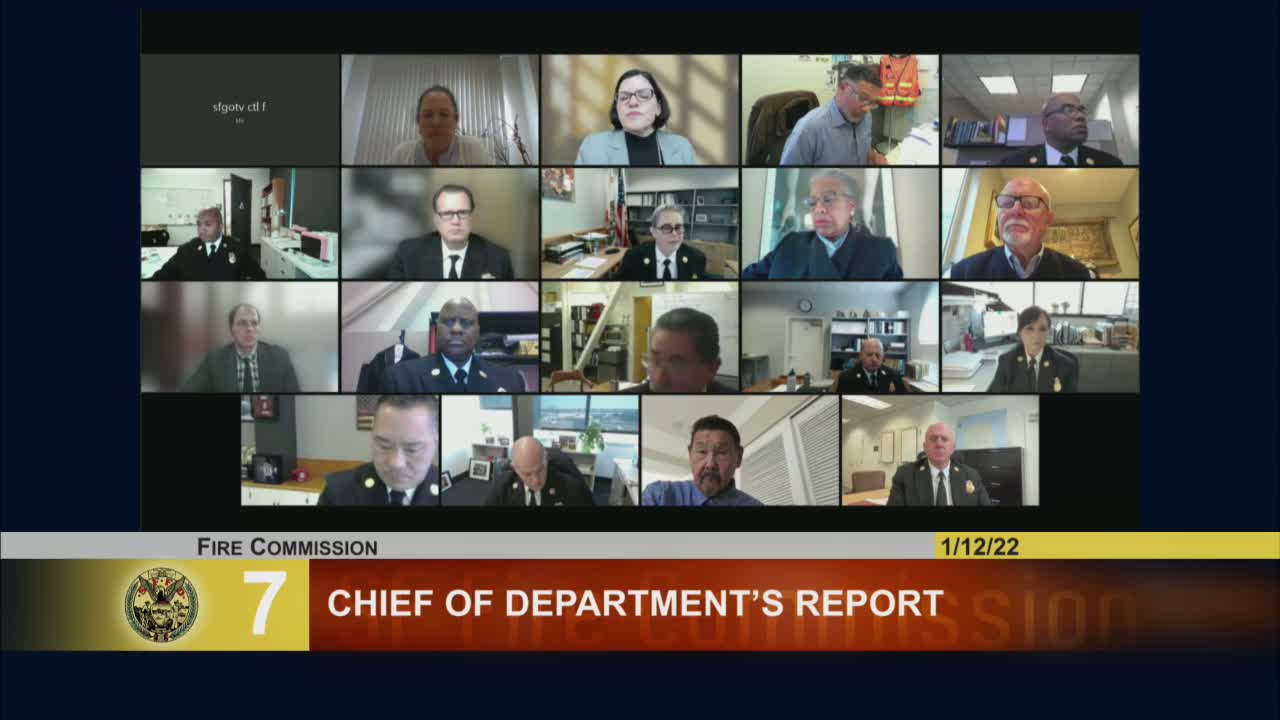
The San Francisco Fire Department told the Fire Commission on Jan. 12 that the Omicron wave has strained staffing and driven an uptick in emergency calls.
Chief Janine Nicholson said the department currently has "what looks to be just over 100 members out with COVID right now," down from a recent high of about 140 to 150, and that the department has relied on mandatory overtime to cover shifts. "Typically, we'll see about 330, 340, maybe 350 calls a day," she said, "we've been seeing over 400 on, 3 separate days, within the past week." The department asked residents to "please avoid calling 911 unless you really have a life threatening emergency."
To cope, the department is expanding training and recruitment. Nicholson outlined booster clinics for members and multiple academy cohorts. Assistant Deputy Chief Sandy Tong told commissioners the current H3 level 1 academy began with 44 recruits and has 39 remaining; a level 2 academy is scheduled to start Feb. 22 and the bump-up classes for EMTs who hold paramedic licenses run about three weeks. "We probably have about 30 more or so folks that we can bump up right now," Tong said. The department also plans further H3 academies through March.
Commissioners pressed for detail about who will be eligible to advance and how frequently classes will run. Nicholson said the department is offering every eligible EMT the opportunity to take the bump-up class but noted candidates must pass the course. Tong said class size and cadence depend on staffing and operational needs.
The commission also heard that some EMS-focused programs will change. The department said community paramedic staffing at a shelter-isolation site (identified in the report as Site 42) has ended after a health-department model change: the Health Department plans to hire behavioral technicians in place of city community paramedics. Chief Peng and other chiefs said the department had achieved a large drop in EMS utilization at that site while staffed; Postel said the program had decreased utilization "by over 90%" while it operated. The department said it will monitor outcomes after the change.
On broader system constraints, fire leaders told the commission that COVID-related staffing shortages are not limited to the department. Nicholson said hospitals have had similar gaps and that staffing pressures across agencies are affecting system capacity. Commissioners requested additional data on call-location patterns and delays; department staff said they can provide time-of-day and overdose-location breakdowns on request and are hiring a CQI analyst and policy analyst to reduce administrative burdens on field crews.
What happens next: commissioners asked the department to supply further data on surge days, the number of EMTs eligible for bump-up training and post-transition outcomes at Site 42. The commission did not take any policy votes on EMS programs during the meeting.
Chief Janine Nicholson said the department currently has "what looks to be just over 100 members out with COVID right now," down from a recent high of about 140 to 150, and that the department has relied on mandatory overtime to cover shifts. "Typically, we'll see about 330, 340, maybe 350 calls a day," she said, "we've been seeing over 400 on, 3 separate days, within the past week." The department asked residents to "please avoid calling 911 unless you really have a life threatening emergency."
To cope, the department is expanding training and recruitment. Nicholson outlined booster clinics for members and multiple academy cohorts. Assistant Deputy Chief Sandy Tong told commissioners the current H3 level 1 academy began with 44 recruits and has 39 remaining; a level 2 academy is scheduled to start Feb. 22 and the bump-up classes for EMTs who hold paramedic licenses run about three weeks. "We probably have about 30 more or so folks that we can bump up right now," Tong said. The department also plans further H3 academies through March.
Commissioners pressed for detail about who will be eligible to advance and how frequently classes will run. Nicholson said the department is offering every eligible EMT the opportunity to take the bump-up class but noted candidates must pass the course. Tong said class size and cadence depend on staffing and operational needs.
The commission also heard that some EMS-focused programs will change. The department said community paramedic staffing at a shelter-isolation site (identified in the report as Site 42) has ended after a health-department model change: the Health Department plans to hire behavioral technicians in place of city community paramedics. Chief Peng and other chiefs said the department had achieved a large drop in EMS utilization at that site while staffed; Postel said the program had decreased utilization "by over 90%" while it operated. The department said it will monitor outcomes after the change.
On broader system constraints, fire leaders told the commission that COVID-related staffing shortages are not limited to the department. Nicholson said hospitals have had similar gaps and that staffing pressures across agencies are affecting system capacity. Commissioners requested additional data on call-location patterns and delays; department staff said they can provide time-of-day and overdose-location breakdowns on request and are hiring a CQI analyst and policy analyst to reduce administrative burdens on field crews.
What happens next: commissioners asked the department to supply further data on surge days, the number of EMTs eligible for bump-up training and post-transition outcomes at Site 42. The commission did not take any policy votes on EMS programs during the meeting.
Don't Miss a Word: See the Full Meeting!
Go beyond summaries. Unlock every video, transcript, and key insight with a Founder Membership.
✓
Get instant access to full meeting videos
✓
Search and clip any phrase from complete transcripts
✓
Receive AI-powered summaries & custom alerts
✓
Enjoy lifetime, unrestricted access to government data
30-day money-back guarantee
