Fire Marshal flags firefighter access concerns as San Francisco weighs making outdoor dining and slow streets permanent
January 12, 2022 | San Francisco City, San Francisco County, California
This article was created by AI summarizing key points discussed. AI makes mistakes, so for full details and context, please refer to the video of the full meeting. Please report any errors so we can fix them. Report an error »
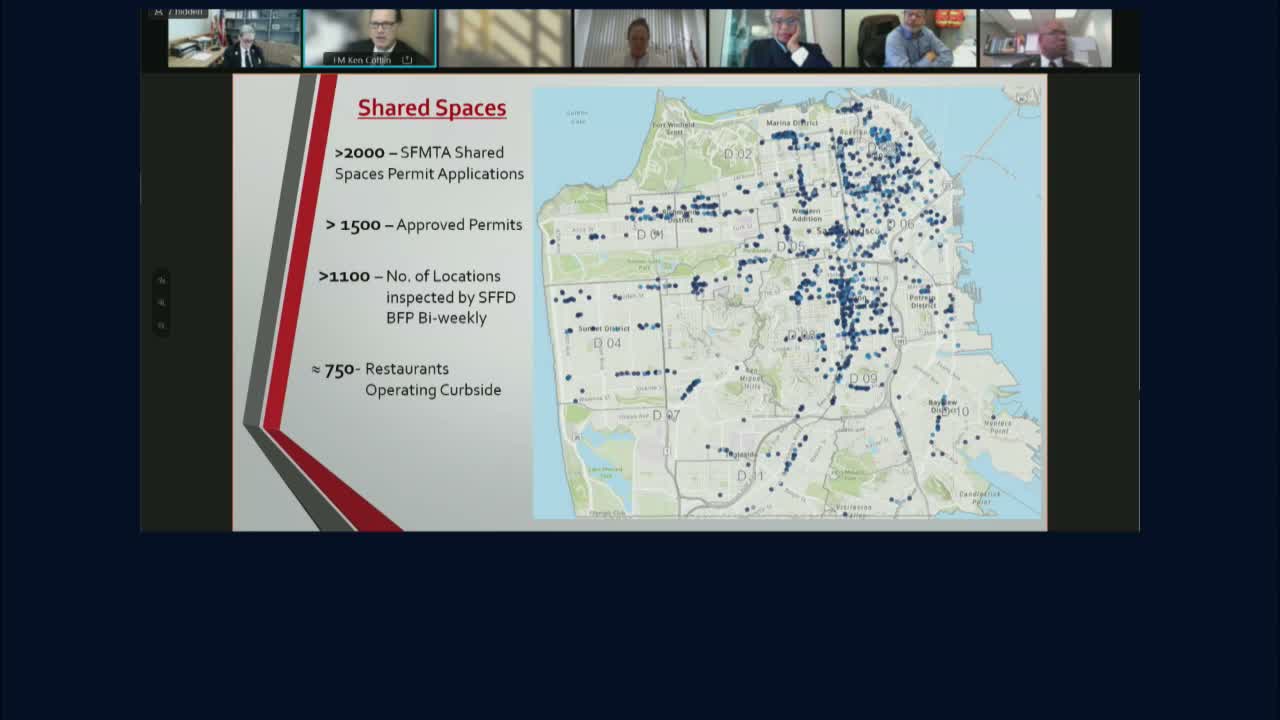
Fire Marshal Marshall Coughlin told the Fire Commission on Jan. 12 that the department has been tracking and inspecting shared outdoor dining and slow-streets installations that grew during the COVID pandemic and that safety guidance has been added to MTA permitting.
"SFMTA has received approximately a little over 2,000 I think it's 20 28 shared spaces applications," Coughlin said, and the Bureau of Fire Prevention had visited about 1,100 of those locations on a biweekly basis. He said roughly 750 restaurants were actively operating curbside installations at the time of his presentation. The bureau described required design features such as removable three-foot gaps to allow ladder placement, limits on rooftop heights where wires exist, and restrictions on placing LPG heaters under roofs.
Coughlin framed the two programs separately: shared spaces (sidewalks, parking-lane parklets and occasional road closures) are administered by SFMTA, while Slow Streets began as a pandemic measure to prioritize walking and biking. He noted that many pandemic elements are slated to be temporary but that a handful of slow-street projects are being considered for permanence by SFMTA and the Board of Supervisors.
Multiple commissioners expressed concern about the programs' effect on emergency response. Commissioner Francie Covington said closures such as Page Street have increased traffic on adjacent Oak Street and "the emergency vehicles are having difficulty getting down the streets." Fire leadership confirmed a measurable increase in response times but said causation is not established. Coughlin and Chief Nicholson announced a joint study with SFMTA and a third party to analyze GPS and response-time data; they expect preliminary results approximately 90 days after kickoff and plan to focus on specific areas including the Great Highway, Tenderloin and the Mission.
Commissioners also asked about enforcement and equity: why some businesses can occupy multiple parking spaces while others have only a narrow storefront. Coughlin said MTA sets length-of-space limits for the permanent program, but acknowledged the temporary pandemic program had produced uneven outcomes and will be subject to revised rules under the permanent conversion schedule now before the Board of Supervisors.
What happens next: the department and SFMTA will run the joint study, monitor response times in identified areas, and use findings to recommend targeted design or operational fixes to reduce any adverse impacts on emergency response.
"SFMTA has received approximately a little over 2,000 I think it's 20 28 shared spaces applications," Coughlin said, and the Bureau of Fire Prevention had visited about 1,100 of those locations on a biweekly basis. He said roughly 750 restaurants were actively operating curbside installations at the time of his presentation. The bureau described required design features such as removable three-foot gaps to allow ladder placement, limits on rooftop heights where wires exist, and restrictions on placing LPG heaters under roofs.
Coughlin framed the two programs separately: shared spaces (sidewalks, parking-lane parklets and occasional road closures) are administered by SFMTA, while Slow Streets began as a pandemic measure to prioritize walking and biking. He noted that many pandemic elements are slated to be temporary but that a handful of slow-street projects are being considered for permanence by SFMTA and the Board of Supervisors.
Multiple commissioners expressed concern about the programs' effect on emergency response. Commissioner Francie Covington said closures such as Page Street have increased traffic on adjacent Oak Street and "the emergency vehicles are having difficulty getting down the streets." Fire leadership confirmed a measurable increase in response times but said causation is not established. Coughlin and Chief Nicholson announced a joint study with SFMTA and a third party to analyze GPS and response-time data; they expect preliminary results approximately 90 days after kickoff and plan to focus on specific areas including the Great Highway, Tenderloin and the Mission.
Commissioners also asked about enforcement and equity: why some businesses can occupy multiple parking spaces while others have only a narrow storefront. Coughlin said MTA sets length-of-space limits for the permanent program, but acknowledged the temporary pandemic program had produced uneven outcomes and will be subject to revised rules under the permanent conversion schedule now before the Board of Supervisors.
What happens next: the department and SFMTA will run the joint study, monitor response times in identified areas, and use findings to recommend targeted design or operational fixes to reduce any adverse impacts on emergency response.
View the Full Meeting & All Its Details
This article offers just a summary. Unlock complete video, transcripts, and insights as a Founder Member.
✓
Watch full, unedited meeting videos
✓
Search every word spoken in unlimited transcripts
✓
AI summaries & real-time alerts (all government levels)
✓
Permanent access to expanding government content
30-day money-back guarantee
