Fire Department outlines expansion of community paramedicine teams and shelter coordination
March 09, 2022 | San Francisco City, San Francisco County, California
This article was created by AI summarizing key points discussed. AI makes mistakes, so for full details and context, please refer to the video of the full meeting. Please report any errors so we can fix them. Report an error »
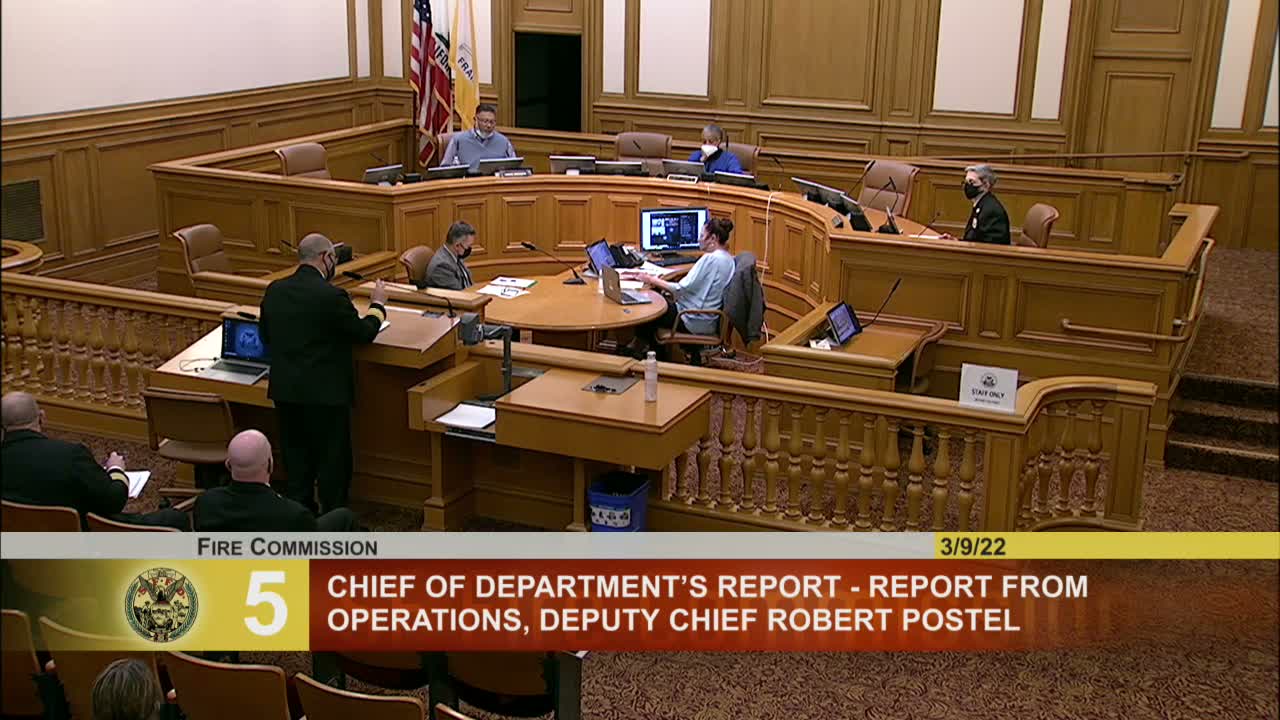
Simon Pang, assistant deputy chief for community paramedicine, updated the Fire Commission on March 9 about the department's community paramedicine programs and plans to expand services.
Pang said the department now runs four specialized community-paramedic programs: EMS 6 (high-frequency 911 users), street crisis response, street overdose response, and street wellness response. He described "on-views" (instances when teams encounter someone who needs help while on foot) as a primary source of activity, and cited recent performance metrics: one team averaged about 12 encounters per day, roughly 25% of encounters resulted in nonemergency van transports to shelter or treatment, and approximately 5% resulted in ambulance transports.
Pang outlined a phased rollout: a training cohort is scheduled to begin in April (targeting roughly 25 students across funded positions and vacancies), and the department anticipates implementing four additional teams to reach a total of five community-paramedic teams operational by late June (Pang referenced June 24 as an implementation date). He emphasized staff structure (two section chiefs, captains overseeing teams) and said the department will avoid staffing new paramedic programs until ambulance ranks are sufficiently filled.
Commissioners questioned shelter availability, supervision, and national partnerships; Pang noted coordination with the city's Department of Homelessness and Supportive Housing and said the city had recently approved 24/7 intake to improve shelter placements. Commissioners also asked about national peer organizations; Pang said the department participates in networks such as the National Co-Responders Consortium and others that have used SFFD teams as templates.
Pang said the department now runs four specialized community-paramedic programs: EMS 6 (high-frequency 911 users), street crisis response, street overdose response, and street wellness response. He described "on-views" (instances when teams encounter someone who needs help while on foot) as a primary source of activity, and cited recent performance metrics: one team averaged about 12 encounters per day, roughly 25% of encounters resulted in nonemergency van transports to shelter or treatment, and approximately 5% resulted in ambulance transports.
Pang outlined a phased rollout: a training cohort is scheduled to begin in April (targeting roughly 25 students across funded positions and vacancies), and the department anticipates implementing four additional teams to reach a total of five community-paramedic teams operational by late June (Pang referenced June 24 as an implementation date). He emphasized staff structure (two section chiefs, captains overseeing teams) and said the department will avoid staffing new paramedic programs until ambulance ranks are sufficiently filled.
Commissioners questioned shelter availability, supervision, and national partnerships; Pang noted coordination with the city's Department of Homelessness and Supportive Housing and said the city had recently approved 24/7 intake to improve shelter placements. Commissioners also asked about national peer organizations; Pang said the department participates in networks such as the National Co-Responders Consortium and others that have used SFFD teams as templates.
Don't Miss a Word: See the Full Meeting!
Go beyond summaries. Unlock every video, transcript, and key insight with a Founder Membership.
✓
Get instant access to full meeting videos
✓
Search and clip any phrase from complete transcripts
✓
Receive AI-powered summaries & custom alerts
✓
Enjoy lifetime, unrestricted access to government data
30-day money-back guarantee
