Fire Commission backs Sprinkler Retrofit for Existing High-Rise Residential Buildings
March 23, 2022 | San Francisco City, San Francisco County, California
This article was created by AI summarizing key points discussed. AI makes mistakes, so for full details and context, please refer to the video of the full meeting. Please report any errors so we can fix them. Report an error »
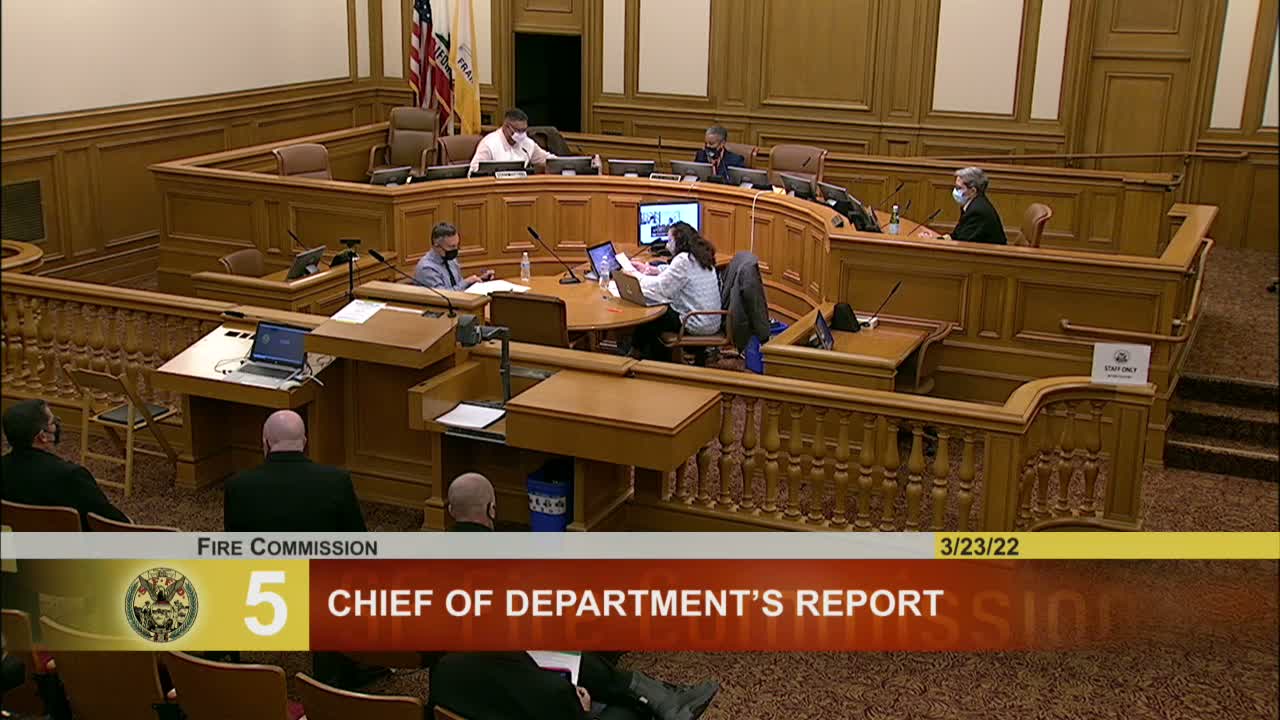
The San Francisco Fire Commission on March 20 unanimously recommended city legislation to require automatic sprinkler systems in existing high-rise residential buildings.
The fire marshal told commissioners the proposal, being put forward with Supervisor Aaron Peskin's office, would close a long-standing gap left by a 1993 ordinance that required retrofits for many commercial high-rises but exempted pre-1974 residential buildings. "The fire marshal's office recommends approval of this legislation for the safety of our city's residents, our guests, and our firefighters," the fire marshal said during the presentation.
Under the proposal buildings classified as high-rise (more than about 75 feet above the lowest level of human occupancy) would follow a phased compliance schedule: two years from the effective date to submit professionally designed drawings and a permit application to the Department of Building Inspection, another two years to connect to an approved city water supply, and a final two years to finish installation and electrical monitoring, with the commission noting an expected completion target of 2028.
The fire marshal described how many affected buildings already have partial systems such as wet or dry standpipes that could be integrated into a retrofit, reducing the need to start from scratch. He gave cost guidance to commissioners: "On the average, it's, I believe, around $683 on average per sprinkler head. That includes the head, the piping, the labor to put it in," and added that a fire pump installation could cost about $100,000, so "for a very, well, decent size high rise, you could be talking a few million dollars to install a sprinkler system." The marshal also cited recent unsprinkled high-rise fires to illustrate risks, saying sprinklers usually activate at about 150 degrees and can suppress a fire in its incipient stage.
Commissioners asked about the number of buildings affected and funding. The marshal described roughly 400 high-rise buildings in the city and said about 130 residential high-rises would be in scope, with roughly 10 expected to receive historical exemptions. He said the legislation itself does not include grant funding to assist building owners and that cost will be a capital responsibility for property owners.
Commissioner Arnie Morgan moved that the commission recommend the legislation; Commissioner Francie Covington seconded. The commission approved the recommendation by unanimous roll-call vote.
Next steps cited in the meeting: the recommendation will be forwarded to the Board of Supervisors and the Department of Building Inspection will be involved in plan review as building owners move toward compliance.
The fire marshal told commissioners the proposal, being put forward with Supervisor Aaron Peskin's office, would close a long-standing gap left by a 1993 ordinance that required retrofits for many commercial high-rises but exempted pre-1974 residential buildings. "The fire marshal's office recommends approval of this legislation for the safety of our city's residents, our guests, and our firefighters," the fire marshal said during the presentation.
Under the proposal buildings classified as high-rise (more than about 75 feet above the lowest level of human occupancy) would follow a phased compliance schedule: two years from the effective date to submit professionally designed drawings and a permit application to the Department of Building Inspection, another two years to connect to an approved city water supply, and a final two years to finish installation and electrical monitoring, with the commission noting an expected completion target of 2028.
The fire marshal described how many affected buildings already have partial systems such as wet or dry standpipes that could be integrated into a retrofit, reducing the need to start from scratch. He gave cost guidance to commissioners: "On the average, it's, I believe, around $683 on average per sprinkler head. That includes the head, the piping, the labor to put it in," and added that a fire pump installation could cost about $100,000, so "for a very, well, decent size high rise, you could be talking a few million dollars to install a sprinkler system." The marshal also cited recent unsprinkled high-rise fires to illustrate risks, saying sprinklers usually activate at about 150 degrees and can suppress a fire in its incipient stage.
Commissioners asked about the number of buildings affected and funding. The marshal described roughly 400 high-rise buildings in the city and said about 130 residential high-rises would be in scope, with roughly 10 expected to receive historical exemptions. He said the legislation itself does not include grant funding to assist building owners and that cost will be a capital responsibility for property owners.
Commissioner Arnie Morgan moved that the commission recommend the legislation; Commissioner Francie Covington seconded. The commission approved the recommendation by unanimous roll-call vote.
Next steps cited in the meeting: the recommendation will be forwarded to the Board of Supervisors and the Department of Building Inspection will be involved in plan review as building owners move toward compliance.
Don't Miss a Word: See the Full Meeting!
Go beyond summaries. Unlock every video, transcript, and key insight with a Founder Membership.
✓
Get instant access to full meeting videos
✓
Search and clip any phrase from complete transcripts
✓
Receive AI-powered summaries & custom alerts
✓
Enjoy lifetime, unrestricted access to government data
30-day money-back guarantee
