San Francisco Fire Department reports staffing gains, new EMS programs and community-paramedicine expansions
February 09, 2022 | San Francisco City, San Francisco County, California
This article was created by AI summarizing key points discussed. AI makes mistakes, so for full details and context, please refer to the video of the full meeting. Please report any errors so we can fix them. Report an error »
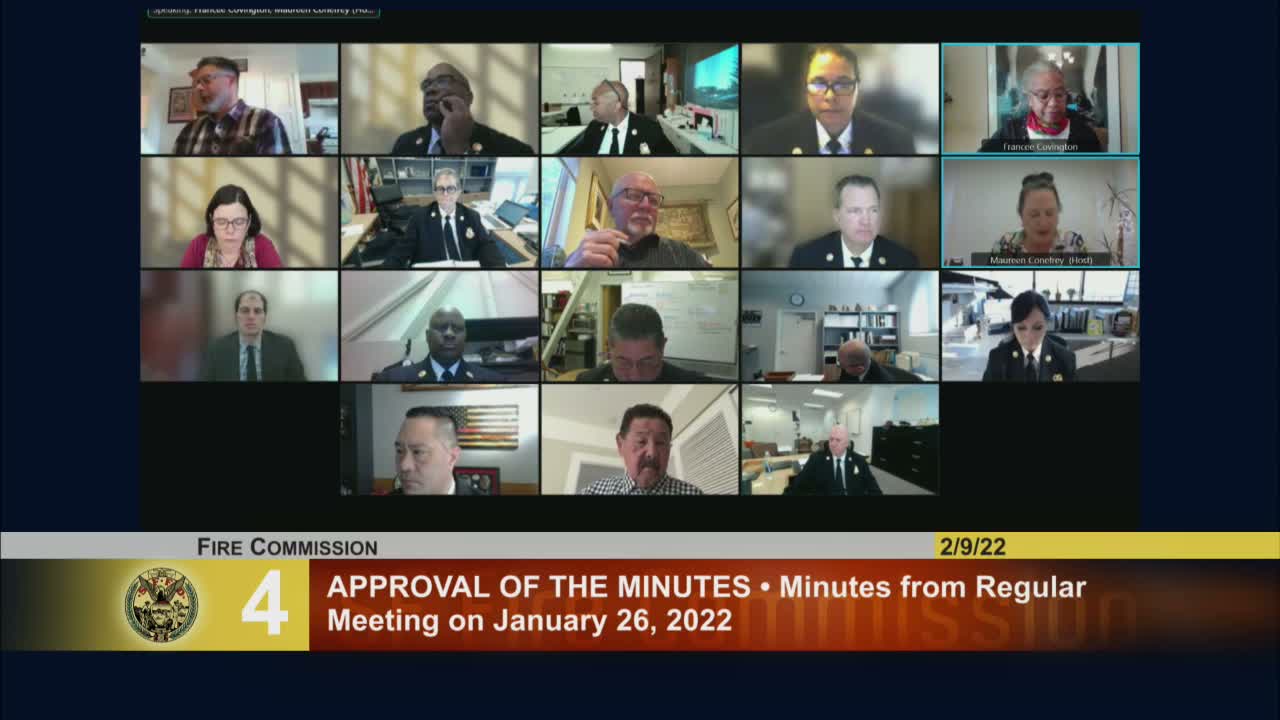
The San Francisco Fire Department reported a mix of operational metrics and program expansions at the commission meeting, highlighting improvements in COVID-related staffing, growth in community-paramedicine efforts and ongoing training and equipment needs.
Chief of Department Janine Nicholson told commissioners COVID-related absences have fallen significantly from highs of about 160 to 29 members off at the time of the meeting; nine employees have been out longer than 30 days. Nicholson and operations staff described ongoing hiring and academy activity, including EMS advancement and recruit academies scheduled through the fiscal year.
Deputy Chief Robert Postel reported 14 working fires in January and 14,003 total incidents for the month, with response breakdowns of roughly 45% combined suppression/EMS, 26% suppression-only and 27% EMS-only. Postel also outlined recent operational responses (including tsunami-warning outreach with no reported injuries), promotions and new assignments: Pat Hartman was promoted to a Healthy Streets Operations Center role and Captain assignments were made for the Tenderloin Emergency Initiative. The HSOC facilitated housing connections for 59 individuals in January, Postel said.
Commissioners focused on the department's community-paramedicine and crisis response work. Assistant Deputy Chief Sandy Tong described planned training so community-paramedic rescue captains can initiate 5150 involuntary psychiatric holds when appropriate; that training is being developed with the Department of Public Health. Tong and others discussed Narcan distribution: EMS crews carry Narcan kits and may distribute to patients or family members at the scene; Project FRIEND (clinician-led) and other city programs also help community distribution. When asked whether all 202 street-overdose encounters had resulted in resuscitation, the department said it would confirm the count and indicated many encounters involve Narcan administration with varied outcomes.
The commission also discussed special operations: the airport bike medic program (three active medics, budgeted for five) and training at the Treasure Island facility. Commissioners raised cliff rescues at Fort Funston; Postel said many of those are dog rescues and the department does not charge owners. Chiefs noted ongoing collaboration with SFMTA and a six-month study funded by MTA to assess how street design changes affect response times.
No formal policy changes were adopted in the discussion; commissioners requested follow-up material on 5150 training, Narcan distribution and specific budget tracking for HSOC/Tenderloin positions.
Chief of Department Janine Nicholson told commissioners COVID-related absences have fallen significantly from highs of about 160 to 29 members off at the time of the meeting; nine employees have been out longer than 30 days. Nicholson and operations staff described ongoing hiring and academy activity, including EMS advancement and recruit academies scheduled through the fiscal year.
Deputy Chief Robert Postel reported 14 working fires in January and 14,003 total incidents for the month, with response breakdowns of roughly 45% combined suppression/EMS, 26% suppression-only and 27% EMS-only. Postel also outlined recent operational responses (including tsunami-warning outreach with no reported injuries), promotions and new assignments: Pat Hartman was promoted to a Healthy Streets Operations Center role and Captain assignments were made for the Tenderloin Emergency Initiative. The HSOC facilitated housing connections for 59 individuals in January, Postel said.
Commissioners focused on the department's community-paramedicine and crisis response work. Assistant Deputy Chief Sandy Tong described planned training so community-paramedic rescue captains can initiate 5150 involuntary psychiatric holds when appropriate; that training is being developed with the Department of Public Health. Tong and others discussed Narcan distribution: EMS crews carry Narcan kits and may distribute to patients or family members at the scene; Project FRIEND (clinician-led) and other city programs also help community distribution. When asked whether all 202 street-overdose encounters had resulted in resuscitation, the department said it would confirm the count and indicated many encounters involve Narcan administration with varied outcomes.
The commission also discussed special operations: the airport bike medic program (three active medics, budgeted for five) and training at the Treasure Island facility. Commissioners raised cliff rescues at Fort Funston; Postel said many of those are dog rescues and the department does not charge owners. Chiefs noted ongoing collaboration with SFMTA and a six-month study funded by MTA to assess how street design changes affect response times.
No formal policy changes were adopted in the discussion; commissioners requested follow-up material on 5150 training, Narcan distribution and specific budget tracking for HSOC/Tenderloin positions.
View the Full Meeting & All Its Details
This article offers just a summary. Unlock complete video, transcripts, and insights as a Founder Member.
✓
Watch full, unedited meeting videos
✓
Search every word spoken in unlimited transcripts
✓
AI summaries & real-time alerts (all government levels)
✓
Permanent access to expanding government content
30-day money-back guarantee
