San Francisco Fire Department highlights community paramedicine expansion, ET3 reimbursement and training plans
April 13, 2022 | San Francisco City, San Francisco County, California
This article was created by AI summarizing key points discussed. AI makes mistakes, so for full details and context, please refer to the video of the full meeting. Please report any errors so we can fix them. Report an error »
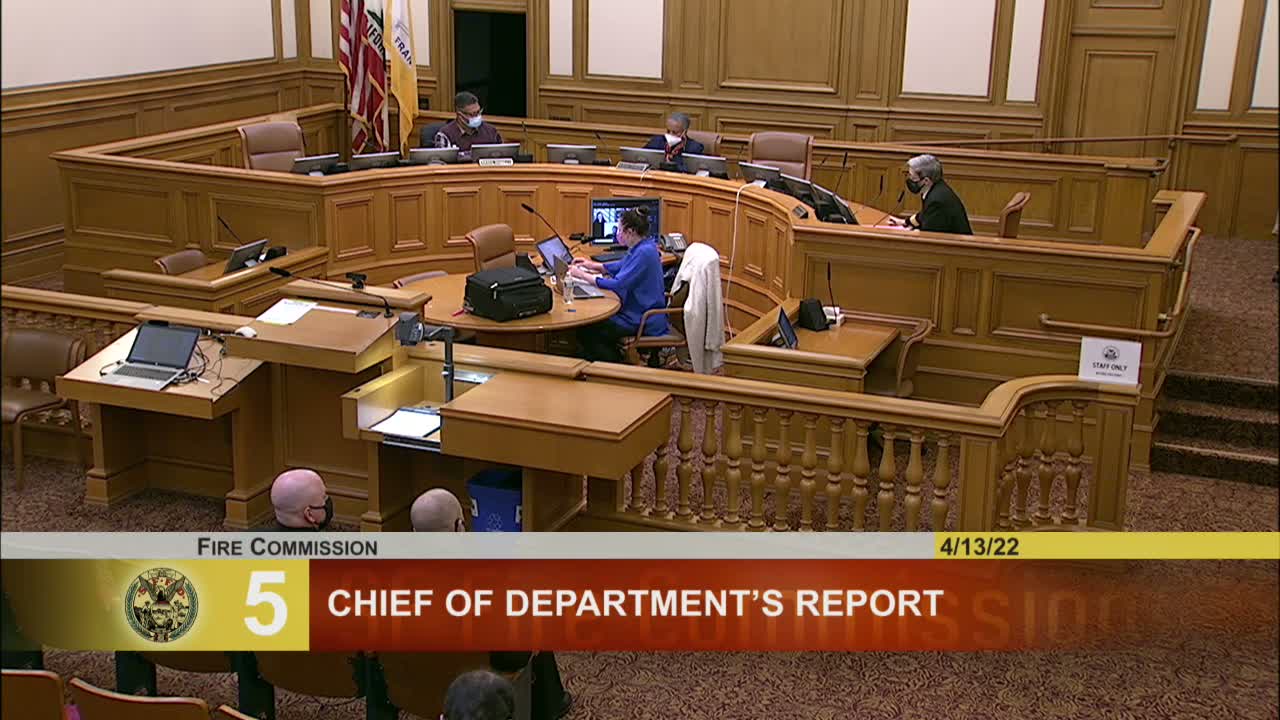
Janine Nicholson, chief of the San Francisco Fire Department, told the Fire Commission the department is managing COVID-related absences while advancing recruitment and outreach programs. "We have 2 members out with COVID, and 3 more that are in quarantine and 7 that have been out longer than 30 days," Nicholson said during her report, and she described recruit pipeline progress and paid internships drawn from a city EMT cohort.
Deputy Chief Robert Postel and Chief Simon Pang presented the operations report and focused on community paramedicine. Postel reported March activity and three major incidents, and Pang outlined plans to participate in the federal ET3 (Emergency Triage, Treat and Transport) Medicare model, which the department estimates could reimburse between $500 and $1,000 per patient encounter depending on service level. "ET3 is specifically made for community paramedic type programs where we can treat and refer or treat and release, versus a typical ambulance having to take someone to a hospital," Chief Pang said.
Commissioners discussed staffing for the expanded outreach teams. Chief Pang told the commission the department will operate 14 street teams in addition to EMS6 (four EMS6 units), amounting to roughly 18 field units and an estimated 54 FTEs devoted to community paramedicine by June.
The department also described a pilot to allow community paramedics to carry and administer buprenorphine for opioid dependence. Pang said the department has state approval for a pilot but must finalize operational details with state EMS agencies, pharmacy partners and poison control before crews can carry the medication. "We have been approved for a state pilot program for our community paramedic paramedics to administer buprenorphine ourselves," Pang said, noting the need for medical-control processes and additional training.
Postel highlighted performance metrics for street teams. The street wellness response team logged 353 encounters in March, with roughly 27% of encounters resulting in transport or connection to non-emergency care. The street overdose response team recorded 108 incidents, including 78 confirmed overdoses. Postel and Pang framed these results as a growing capacity to engage high-utilizer populations and connect people to primary care, shelter and treatment resources.
On training and facilities, Nicholson and Postel said the department is moving community paramedicine and some outreach teams into renovated space at old Station 49 (1450 Evans Street) and is pursuing a purchase agreement for a Carroll Avenue training site. Training updates also included academy graduations and a June 3 graduation target for the 129th recruit class.
Deputy Chief Robert Postel and Chief Simon Pang presented the operations report and focused on community paramedicine. Postel reported March activity and three major incidents, and Pang outlined plans to participate in the federal ET3 (Emergency Triage, Treat and Transport) Medicare model, which the department estimates could reimburse between $500 and $1,000 per patient encounter depending on service level. "ET3 is specifically made for community paramedic type programs where we can treat and refer or treat and release, versus a typical ambulance having to take someone to a hospital," Chief Pang said.
Commissioners discussed staffing for the expanded outreach teams. Chief Pang told the commission the department will operate 14 street teams in addition to EMS6 (four EMS6 units), amounting to roughly 18 field units and an estimated 54 FTEs devoted to community paramedicine by June.
The department also described a pilot to allow community paramedics to carry and administer buprenorphine for opioid dependence. Pang said the department has state approval for a pilot but must finalize operational details with state EMS agencies, pharmacy partners and poison control before crews can carry the medication. "We have been approved for a state pilot program for our community paramedic paramedics to administer buprenorphine ourselves," Pang said, noting the need for medical-control processes and additional training.
Postel highlighted performance metrics for street teams. The street wellness response team logged 353 encounters in March, with roughly 27% of encounters resulting in transport or connection to non-emergency care. The street overdose response team recorded 108 incidents, including 78 confirmed overdoses. Postel and Pang framed these results as a growing capacity to engage high-utilizer populations and connect people to primary care, shelter and treatment resources.
On training and facilities, Nicholson and Postel said the department is moving community paramedicine and some outreach teams into renovated space at old Station 49 (1450 Evans Street) and is pursuing a purchase agreement for a Carroll Avenue training site. Training updates also included academy graduations and a June 3 graduation target for the 129th recruit class.
Don't Miss a Word: See the Full Meeting!
Go beyond summaries. Unlock every video, transcript, and key insight with a Founder Membership.
✓
Get instant access to full meeting videos
✓
Search and clip any phrase from complete transcripts
✓
Receive AI-powered summaries & custom alerts
✓
Enjoy lifetime, unrestricted access to government data
30-day money-back guarantee
