Commissioners press fire department over slow-street barricades after challenging Noe Street third-alarm and engine collision
April 13, 2022 | San Francisco City, San Francisco County, California
This article was created by AI summarizing key points discussed. AI makes mistakes, so for full details and context, please refer to the video of the full meeting. Please report any errors so we can fix them. Report an error »
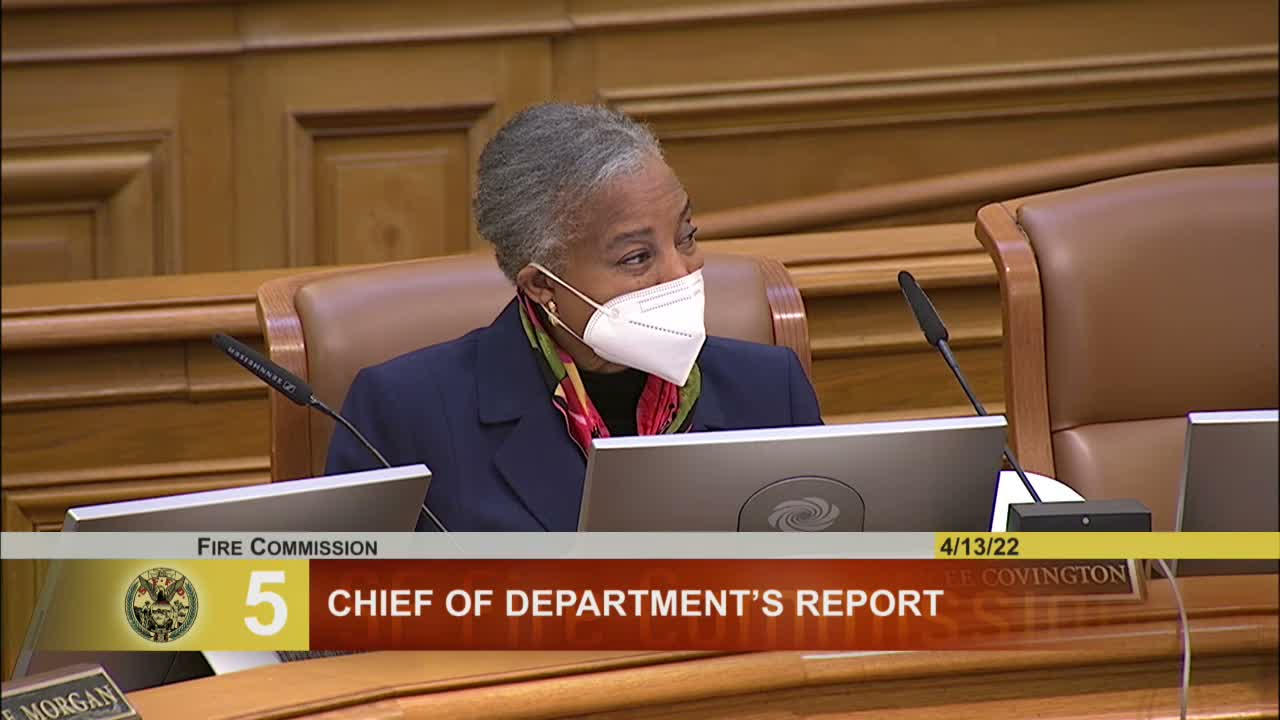
Commissioners used the operations briefing to press fire department leaders about access problems created by slow-street barricades and planters during the DuBose Triangle/Noe Street third-alarm fire. Deputy Chief Robert Postel described how hard barriers placed by neighbors "restricted our access into the fire block itself" and said companies in the field report barricades so the department can request MTA and DPW removal.
Assistant Chief Coughlin explained the removal process is bureaucratic and reactive: field companies report obstructions, the Bureau of Fire Prevention forwards requests to MTA, which in turn coordinates with the Department of Public Works for removal. "I don't think actually MTA actually has a team that goes out there. They are more responsive. So as chief Postel says, when the companies in the field notice something and they report it to us, and then we work with MTA to get that done," Coughlin said.
Assistant Chief Thompson, who served as incident commander at the Noe Street third-alarm, described operational constraints created by the barricades and building access at that incident: "It was a fire that took off very quickly... there were trees everywhere... the buildings were very tall," Thompson said, and added that he could not get an aerial truck onto Noe Street because of the barricades.
In a separate operational safety item, Chief Postel reported an intersection accident between Engine 38 and Engine 16 while both rigs were responding to a call at Laguna and Greenwich. Both engines sustained significant damage and are out of service pending repair; Postel said an investigation into speed and driver fault is ongoing and added that "there were no serious injuries to any of the members" though some were placed off duty for soreness and shock.
Commissioners requested follow-up reports. Division staff were asked to confirm whether barricades at the Noe Street location had been removed and the department said it would bring additional findings to a future meeting.
Assistant Chief Coughlin explained the removal process is bureaucratic and reactive: field companies report obstructions, the Bureau of Fire Prevention forwards requests to MTA, which in turn coordinates with the Department of Public Works for removal. "I don't think actually MTA actually has a team that goes out there. They are more responsive. So as chief Postel says, when the companies in the field notice something and they report it to us, and then we work with MTA to get that done," Coughlin said.
Assistant Chief Thompson, who served as incident commander at the Noe Street third-alarm, described operational constraints created by the barricades and building access at that incident: "It was a fire that took off very quickly... there were trees everywhere... the buildings were very tall," Thompson said, and added that he could not get an aerial truck onto Noe Street because of the barricades.
In a separate operational safety item, Chief Postel reported an intersection accident between Engine 38 and Engine 16 while both rigs were responding to a call at Laguna and Greenwich. Both engines sustained significant damage and are out of service pending repair; Postel said an investigation into speed and driver fault is ongoing and added that "there were no serious injuries to any of the members" though some were placed off duty for soreness and shock.
Commissioners requested follow-up reports. Division staff were asked to confirm whether barricades at the Noe Street location had been removed and the department said it would bring additional findings to a future meeting.
Don't Miss a Word: See the Full Meeting!
Go beyond summaries. Unlock every video, transcript, and key insight with a Founder Membership.
✓
Get instant access to full meeting videos
✓
Search and clip any phrase from complete transcripts
✓
Receive AI-powered summaries & custom alerts
✓
Enjoy lifetime, unrestricted access to government data
30-day money-back guarantee
