SF Fire Commission reviews June operations report, highlights two greater-alarm fires and rollout of community paramedicine teams
July 13, 2022 | San Francisco City, San Francisco County, California
This article was created by AI summarizing key points discussed. AI makes mistakes, so for full details and context, please refer to the video of the full meeting. Please report any errors so we can fix them. Report an error »
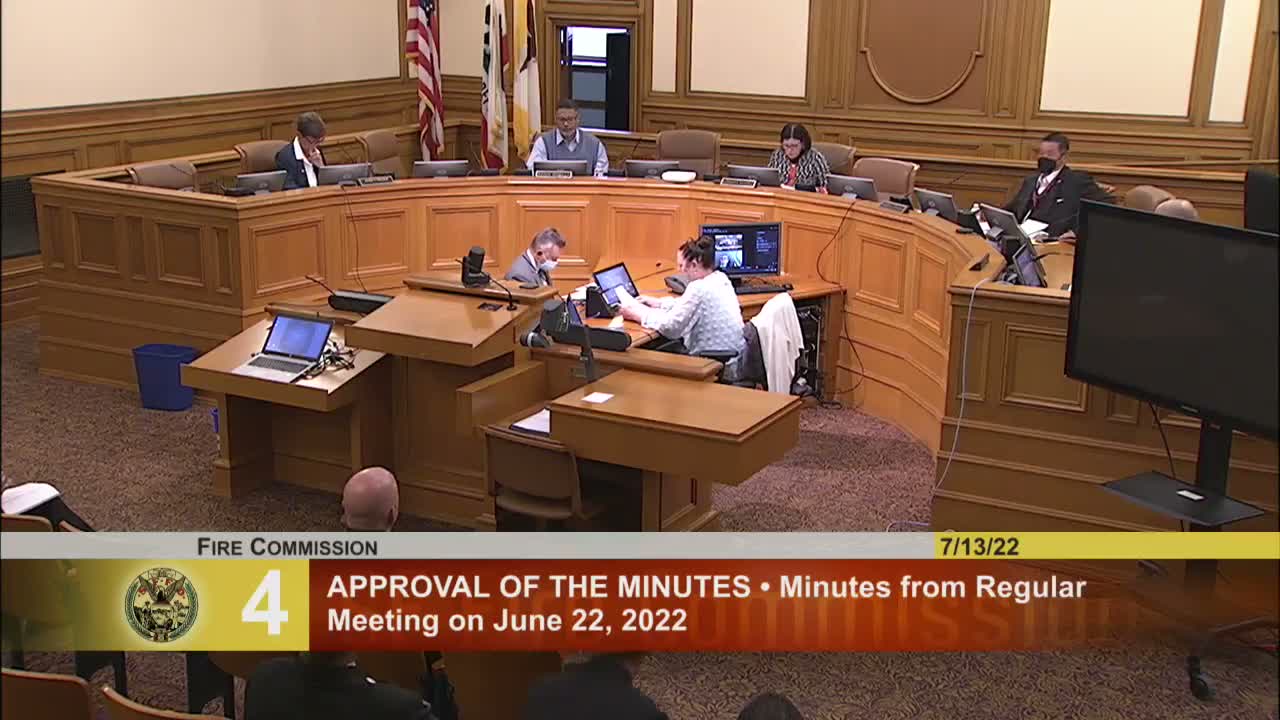
The San Francisco Fire Commission received a report July 13 from Chief of Department Janine Nicholson and Deputy Chief Robert Postel detailing department operations and emergency medical services activity for June. The briefing described two greater-alarm fires on June 1, COVID-related staffing impacts, recruit graduations, and the full implementation of community paramedicine teams.
Chief Nicholson told commissioners the department welcomed a new recruit academy and has been engaged with the Board of Supervisors on the department budget, which she said could not be acted on by the full board before July 15; she said she would provide details after the mayor signs the budget. Nicholson also reported about 30 members on quarantine and roughly six positive COVID cases among personnel.
Deputy Chief Postel reviewed operational statistics for the month: two greater-alarm fires, 21 working fires, 15 water rescues and four cliff rescues. He described a morning light-well fire at 74 Turk Street that was contained to the light well by tactics led by Assistant Chief Ken Yee and Battalion Chief Dean Crispin, and a second fire in a Chinatown restaurant flue on Washington Street that prompted an early second-alarm request to prevent escalation. Postel credited coordinated command decisions for limiting building damage and displacement.
The EMS portion of the report described staffing and program changes. Assistant Deputy Chief Sandy Tong and Section Chief April Sloan said the department recently graduated EMT and paramedic classes and that all funded community paramedicine programs were fully implemented as of June 27. The rollout includes 14 street teams: seven street crisis response teams (24-hour coverage with two overnight units), five street wellness response teams (one overnight), and two street overdose teams. Postel reported that EMS 6, which focuses on the system’s highest utilizers, recorded 353 patient encounters during June that contributed to a 44% reduction in 911 use among the top 20 users identified.
Program-level figures in the report included 844 street crisis team calls in June, 157 Street Overdose Response Team calls with 49 confirmed overdoses and 12 buprenorphine starts, and 235 street wellness encounters that resulted in 34 people moved into shelter and additional transports to clinics and treatment programs. Assistant Deputy Chief Ken Coughlin reported the Bureau of Fire Prevention completed 1,597 inspections in June; the bureau received 845 permit applications and approved 738 permits that month.
Commissioners asked follow-up questions about the cost of the expanded paramedicine programs (to be clarified in the budget process), ambulance staffing charts (levels 0–2), and the transition of a mayoral Tenderloin emergency initiative to city planning operations through year-end. The commission did not receive public comment on these items during the meeting.
The commission’s next procedural step on operational funding remains the full board of supervisors’ adoption and the mayor’s signature on the city budget.
Chief Nicholson told commissioners the department welcomed a new recruit academy and has been engaged with the Board of Supervisors on the department budget, which she said could not be acted on by the full board before July 15; she said she would provide details after the mayor signs the budget. Nicholson also reported about 30 members on quarantine and roughly six positive COVID cases among personnel.
Deputy Chief Postel reviewed operational statistics for the month: two greater-alarm fires, 21 working fires, 15 water rescues and four cliff rescues. He described a morning light-well fire at 74 Turk Street that was contained to the light well by tactics led by Assistant Chief Ken Yee and Battalion Chief Dean Crispin, and a second fire in a Chinatown restaurant flue on Washington Street that prompted an early second-alarm request to prevent escalation. Postel credited coordinated command decisions for limiting building damage and displacement.
The EMS portion of the report described staffing and program changes. Assistant Deputy Chief Sandy Tong and Section Chief April Sloan said the department recently graduated EMT and paramedic classes and that all funded community paramedicine programs were fully implemented as of June 27. The rollout includes 14 street teams: seven street crisis response teams (24-hour coverage with two overnight units), five street wellness response teams (one overnight), and two street overdose teams. Postel reported that EMS 6, which focuses on the system’s highest utilizers, recorded 353 patient encounters during June that contributed to a 44% reduction in 911 use among the top 20 users identified.
Program-level figures in the report included 844 street crisis team calls in June, 157 Street Overdose Response Team calls with 49 confirmed overdoses and 12 buprenorphine starts, and 235 street wellness encounters that resulted in 34 people moved into shelter and additional transports to clinics and treatment programs. Assistant Deputy Chief Ken Coughlin reported the Bureau of Fire Prevention completed 1,597 inspections in June; the bureau received 845 permit applications and approved 738 permits that month.
Commissioners asked follow-up questions about the cost of the expanded paramedicine programs (to be clarified in the budget process), ambulance staffing charts (levels 0–2), and the transition of a mayoral Tenderloin emergency initiative to city planning operations through year-end. The commission did not receive public comment on these items during the meeting.
The commission’s next procedural step on operational funding remains the full board of supervisors’ adoption and the mayor’s signature on the city budget.
View the Full Meeting & All Its Details
This article offers just a summary. Unlock complete video, transcripts, and insights as a Founder Member.
✓
Watch full, unedited meeting videos
✓
Search every word spoken in unlimited transcripts
✓
AI summaries & real-time alerts (all government levels)
✓
Permanent access to expanding government content
30-day money-back guarantee
