SFFD reports multiple greater‑alarm fires, rescues and plans study of streetscape impacts on response times
August 24, 2022 | San Francisco City, San Francisco County, California
This article was created by AI summarizing key points discussed. AI makes mistakes, so for full details and context, please refer to the video of the full meeting. Please report any errors so we can fix them. Report an error »
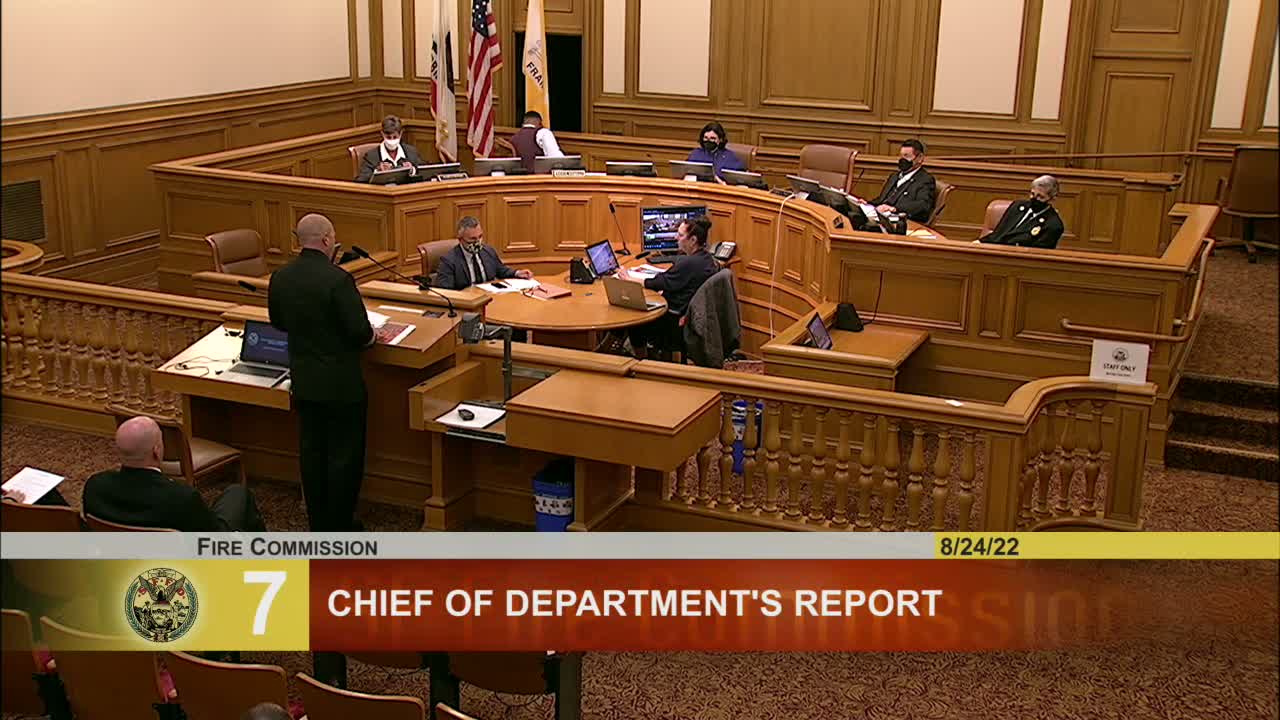
Deputy Chief Robert Postel told the Fire Commission on Aug. 4 that San Francisco Fire Department crews responded to multiple significant incidents in July, including a challenging third‑alarm fire on McAllister Street and several greater‑alarm events that required rapid interventions and rescues.
Describing the McAllister Street incident, Postel said crews encountered heavy smoke and structural complexities and had to breach an exterior wall to reach the seat of the fire. "They were able to bring us all in, cut through the exterior wall, and at least get some water in flowing on that fire," he said. Truck 5 crews rescued a woman from a neighboring roof and she was transported for smoke inhalation.
Postel also reviewed July's three greater alarms. At a Seacliff Avenue incident an officer conducting a search fell about 12 feet into an elevator shaft; a rapid intervention crew rescued and transported him for treatment and Postel said he is expected to make a full recovery. Postel said such events require simultaneous management of rescue and fire attack.
Another second‑alarm incident occurred at 1182 Fitzgerald and a separate boarded and vacant building at 16th Street produced an exposure concern; Postel said one exposure building turned out to be an illegal marijuana grow operation with extensive, dangerous electrical wiring. "In those grow houses, you have lots of electrical hazards and sometimes they're booby trapped," he said, noting the extra risk to firefighters.
Postel told commissioners the department responded to 13 working fires in July, 12 water rescues and three cliff rescues. He praised surf and cliff rescue teams and highlighted recent live‑burn training and ongoing recruit and bump‑up academies, including a hybrid level 3 EMT‑paramedic academy and the 130th recruit class slated to graduate on Sept. 30.
On response times, Postel said the department is working with the MTA to fund an independent study by the data firm Farron Pierce to analyze how streetscape changes have affected SFFD response times over the past four to five years. "The data shows our response signs have gone up steadily over the last 4 to 5 years and that coincides with the street...changes," he said. The study's first phase is complete and the second phase will compare corridors with and without changes.
Commissioners asked for clarification about building remediation and the role of the Department of Building Inspection; Postel and Chief Janine Nicholson said DBI can order demolition only when damage exceeds certain thresholds and that remediation is generally the owner's responsibility once FD relinquishes the scene.
The commission also discussed enforcement tools for illegal grow operations, including historical police and utility data tactics (PG&E usage records) used to identify illegal wiring.
Describing the McAllister Street incident, Postel said crews encountered heavy smoke and structural complexities and had to breach an exterior wall to reach the seat of the fire. "They were able to bring us all in, cut through the exterior wall, and at least get some water in flowing on that fire," he said. Truck 5 crews rescued a woman from a neighboring roof and she was transported for smoke inhalation.
Postel also reviewed July's three greater alarms. At a Seacliff Avenue incident an officer conducting a search fell about 12 feet into an elevator shaft; a rapid intervention crew rescued and transported him for treatment and Postel said he is expected to make a full recovery. Postel said such events require simultaneous management of rescue and fire attack.
Another second‑alarm incident occurred at 1182 Fitzgerald and a separate boarded and vacant building at 16th Street produced an exposure concern; Postel said one exposure building turned out to be an illegal marijuana grow operation with extensive, dangerous electrical wiring. "In those grow houses, you have lots of electrical hazards and sometimes they're booby trapped," he said, noting the extra risk to firefighters.
Postel told commissioners the department responded to 13 working fires in July, 12 water rescues and three cliff rescues. He praised surf and cliff rescue teams and highlighted recent live‑burn training and ongoing recruit and bump‑up academies, including a hybrid level 3 EMT‑paramedic academy and the 130th recruit class slated to graduate on Sept. 30.
On response times, Postel said the department is working with the MTA to fund an independent study by the data firm Farron Pierce to analyze how streetscape changes have affected SFFD response times over the past four to five years. "The data shows our response signs have gone up steadily over the last 4 to 5 years and that coincides with the street...changes," he said. The study's first phase is complete and the second phase will compare corridors with and without changes.
Commissioners asked for clarification about building remediation and the role of the Department of Building Inspection; Postel and Chief Janine Nicholson said DBI can order demolition only when damage exceeds certain thresholds and that remediation is generally the owner's responsibility once FD relinquishes the scene.
The commission also discussed enforcement tools for illegal grow operations, including historical police and utility data tactics (PG&E usage records) used to identify illegal wiring.
View the Full Meeting & All Its Details
This article offers just a summary. Unlock complete video, transcripts, and insights as a Founder Member.
✓
Watch full, unedited meeting videos
✓
Search every word spoken in unlimited transcripts
✓
AI summaries & real-time alerts (all government levels)
✓
Permanent access to expanding government content
30-day money-back guarantee
