Fire commission unanimously recommends sweeping 2022 fire-code amendments to Board of Supervisors
September 28, 2022 | San Francisco City, San Francisco County, California
This article was created by AI summarizing key points discussed. AI makes mistakes, so for full details and context, please refer to the video of the full meeting. Please report any errors so we can fix them. Report an error »
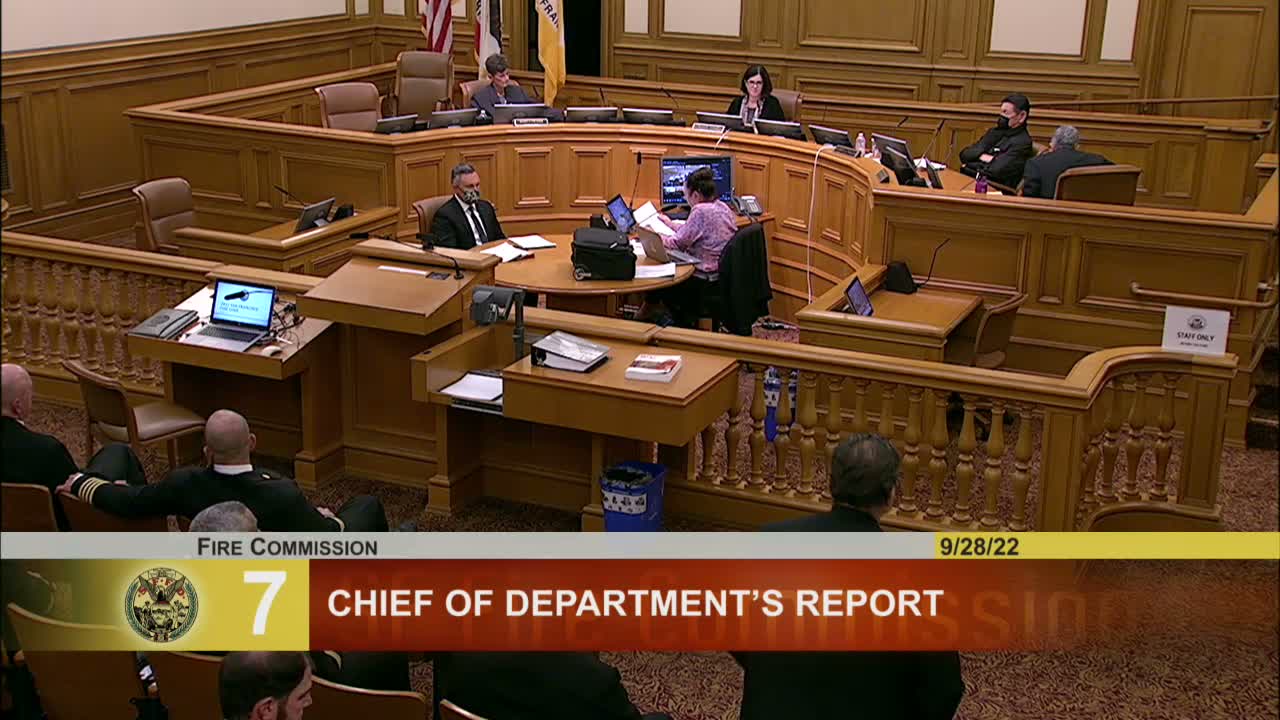
The San Francisco Fire Commission voted unanimously on Sept. 28 to recommend that the Board of Supervisors adopt a package of fire-code amendments that would replace the 2019 San Francisco Fire Code with provisions based on the 2022 California Fire Code and the 2021 International Fire Code, plus San Francisco-specific additions.
Fire Marshal Ken Coughlin told commissioners the package focuses on new operational permits and targeted safety updates. He said the department created three new permits — for mobile food vendor carts, mobile fueling operations and emergency responder radio-communications systems — so inspectors have a formal mechanism to verify safety measures. "We had to create some parameters of what are we looking for," he said, describing requirements such as onboard fire extinguishers, maximum permitted fuel containers and shutoff valves for vendor carts.
Coughlin outlined adjustments aimed at improving occupant egress and first-responder access. For buildings with roof access doors or hatches, the code would require mechanisms that allow doors to be unlocked from the interior during an alarm or power outage, or include a remote-unlock function and a palm-button exit that triggers an alarm. The proposal also requires testing and certification of emergency radio repeater systems on a scheduled basis, with UL-recognition for qualified service providers to ensure reliable maintenance.
A substantial local addition would phase sprinkler retrofits for taller residential buildings. Coughlin said buildings taller than roughly 120 feet (about 10 stories) would be required to install sprinklers, while a staggered compliance schedule would give roughly 120–135 buildings time to plan, secure water-supply upgrades and complete work. He explained the ordinance sets a phased approach — the first three years for plans and contractor agreements, additional years for water hookups and unit-by-unit installation — because retrofits often require complicated coordination with water utilities, contractors and tenants.
Commissioners pressed Coughlin on the length of the retrofit timeline and on how the code will address outdoor shared-space structures in front of restaurants. Coughlin said the department has been coordinating with the Department of Public Works and the municipal transit agency on shared-space guidelines and has interim enforcement tools for structures that impede access.
After the discussion, a motion to adopt the proposed ordinance package as the commission's recommendation to the Board of Supervisors was moved, seconded and approved unanimously. "The motion is unanimous," the secretary announced.
Next steps: the commission will forward the ordinance package, legislative digest and required findings to the Board of Supervisors for consideration, and the department will publish administrative bulletins to clarify implementation details after public posting and the required comment period.
Details from the record: the package includes adoption of the 2022 California Fire Code and selective adoption of the 2021 International Fire Code with San Francisco amendments, new permit requirements for mobile vendors and mobile fueling, radio system certification timelines, phased sprinkler retrofit requirements for a subset of taller residential buildings, and strengthened temporary-construction safety measures.
Fire Marshal Ken Coughlin told commissioners the package focuses on new operational permits and targeted safety updates. He said the department created three new permits — for mobile food vendor carts, mobile fueling operations and emergency responder radio-communications systems — so inspectors have a formal mechanism to verify safety measures. "We had to create some parameters of what are we looking for," he said, describing requirements such as onboard fire extinguishers, maximum permitted fuel containers and shutoff valves for vendor carts.
Coughlin outlined adjustments aimed at improving occupant egress and first-responder access. For buildings with roof access doors or hatches, the code would require mechanisms that allow doors to be unlocked from the interior during an alarm or power outage, or include a remote-unlock function and a palm-button exit that triggers an alarm. The proposal also requires testing and certification of emergency radio repeater systems on a scheduled basis, with UL-recognition for qualified service providers to ensure reliable maintenance.
A substantial local addition would phase sprinkler retrofits for taller residential buildings. Coughlin said buildings taller than roughly 120 feet (about 10 stories) would be required to install sprinklers, while a staggered compliance schedule would give roughly 120–135 buildings time to plan, secure water-supply upgrades and complete work. He explained the ordinance sets a phased approach — the first three years for plans and contractor agreements, additional years for water hookups and unit-by-unit installation — because retrofits often require complicated coordination with water utilities, contractors and tenants.
Commissioners pressed Coughlin on the length of the retrofit timeline and on how the code will address outdoor shared-space structures in front of restaurants. Coughlin said the department has been coordinating with the Department of Public Works and the municipal transit agency on shared-space guidelines and has interim enforcement tools for structures that impede access.
After the discussion, a motion to adopt the proposed ordinance package as the commission's recommendation to the Board of Supervisors was moved, seconded and approved unanimously. "The motion is unanimous," the secretary announced.
Next steps: the commission will forward the ordinance package, legislative digest and required findings to the Board of Supervisors for consideration, and the department will publish administrative bulletins to clarify implementation details after public posting and the required comment period.
Details from the record: the package includes adoption of the 2022 California Fire Code and selective adoption of the 2021 International Fire Code with San Francisco amendments, new permit requirements for mobile vendors and mobile fueling, radio system certification timelines, phased sprinkler retrofit requirements for a subset of taller residential buildings, and strengthened temporary-construction safety measures.
View the Full Meeting & All Its Details
This article offers just a summary. Unlock complete video, transcripts, and insights as a Founder Member.
✓
Watch full, unedited meeting videos
✓
Search every word spoken in unlimited transcripts
✓
AI summaries & real-time alerts (all government levels)
✓
Permanent access to expanding government content
30-day money-back guarantee
