San Francisco Fire Department tells commission storms doubled workloads; city seeks budget reductions
January 11, 2023 | San Francisco City, San Francisco County, California
This article was created by AI summarizing key points discussed. AI makes mistakes, so for full details and context, please refer to the video of the full meeting. Please report any errors so we can fix them. Report an error »
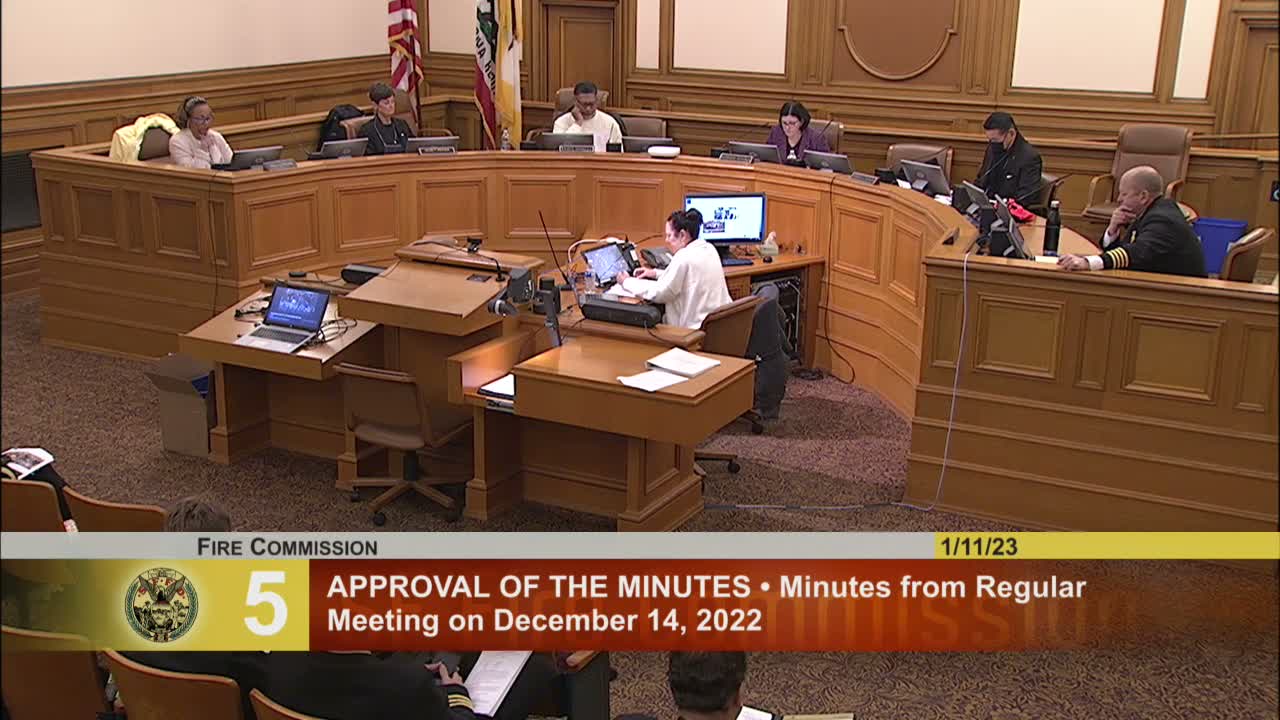
San Francisco — Fire Department leaders told the Fire Commission on Jan. 11 that a series of heavy storms late in December and on New Year’s Eve created an unprecedented surge in calls and stretched department resources, and they warned that mandatory mayoral budget reductions will make it harder to sustain frontline staffing.
Chief Janine Nicholson opened the meeting’s departmental report by praising firefighters and command staff for handling widespread flooding, downed trees and downed wires during recent storms, saying “our folks have just stood up and gotten the job done.” Deputy Chief of Operations Bob Postel quantified the pressure: on the worst night the department handled approximately 800 calls, more than double a normal day’s volume.
Why it matters: The department’s surge response involved scaling back some automatic responses to single-engine assignments for alarm calls, pre-positioning state mutual-aid strike teams, and triaging 911 demand to focus on life-safety incidents. Postel said that creative on-scene work—such as using eight-inch hard suction hose to divert stormwater and sending trucks to obtain sandbags from the Department of Public Works—helped prevent greater property damage and addressed immediate needs when other agencies were thinly staffed.
What officials said: Postel described several major incidents during November and December, including greater-alarm structure fires and second-alarm events at commercial and residential targets. He also said the department has observed a roughly 20% increase in response times in some areas since streetscape changes began and announced a corridor-level study with the Municipal Transportation Agency and consultant Farr & Piers to analyze how specific street redesigns affect response routes.
Budget pressure: Later in the meeting Mark Corso, deputy director for finance and planning, told commissioners that the mayor’s office is instructing departments to reduce adjusted general fund support by 5% in fiscal year 2023–24 (about $6.9 million for the Fire Department) and 8% in the following year (about $11 million). Corso noted that SFFD is largely a personnel-driven organization and has limited non-staffing flexibility.
What’s next: Commissioners requested more data on system impacts and corridor-level response-time comparisons; Postel said the next phase of the MTA study will examine matched corridors (streets with and without recent changes) to draw firmer conclusions. Corso said detailed budget spreadsheets and sources-and-uses data will be provided ahead of the commission’s next budget discussion.
The commission took no final budget vote on Jan. 11; the mayor’s office schedule calls for departmental submittals in February and a mayoral budget by June 1.
Chief Janine Nicholson opened the meeting’s departmental report by praising firefighters and command staff for handling widespread flooding, downed trees and downed wires during recent storms, saying “our folks have just stood up and gotten the job done.” Deputy Chief of Operations Bob Postel quantified the pressure: on the worst night the department handled approximately 800 calls, more than double a normal day’s volume.
Why it matters: The department’s surge response involved scaling back some automatic responses to single-engine assignments for alarm calls, pre-positioning state mutual-aid strike teams, and triaging 911 demand to focus on life-safety incidents. Postel said that creative on-scene work—such as using eight-inch hard suction hose to divert stormwater and sending trucks to obtain sandbags from the Department of Public Works—helped prevent greater property damage and addressed immediate needs when other agencies were thinly staffed.
What officials said: Postel described several major incidents during November and December, including greater-alarm structure fires and second-alarm events at commercial and residential targets. He also said the department has observed a roughly 20% increase in response times in some areas since streetscape changes began and announced a corridor-level study with the Municipal Transportation Agency and consultant Farr & Piers to analyze how specific street redesigns affect response routes.
Budget pressure: Later in the meeting Mark Corso, deputy director for finance and planning, told commissioners that the mayor’s office is instructing departments to reduce adjusted general fund support by 5% in fiscal year 2023–24 (about $6.9 million for the Fire Department) and 8% in the following year (about $11 million). Corso noted that SFFD is largely a personnel-driven organization and has limited non-staffing flexibility.
What’s next: Commissioners requested more data on system impacts and corridor-level response-time comparisons; Postel said the next phase of the MTA study will examine matched corridors (streets with and without recent changes) to draw firmer conclusions. Corso said detailed budget spreadsheets and sources-and-uses data will be provided ahead of the commission’s next budget discussion.
The commission took no final budget vote on Jan. 11; the mayor’s office schedule calls for departmental submittals in February and a mayoral budget by June 1.
Don't Miss a Word: See the Full Meeting!
Go beyond summaries. Unlock every video, transcript, and key insight with a Founder Membership.
✓
Get instant access to full meeting videos
✓
Search and clip any phrase from complete transcripts
✓
Receive AI-powered summaries & custom alerts
✓
Enjoy lifetime, unrestricted access to government data
30-day money-back guarantee
