New CD4 chief and EMS updates: ambulances, academies and operational gains for community paramedicine
September 28, 2022 | San Francisco City, San Francisco County, California
This article was created by AI summarizing key points discussed. AI makes mistakes, so for full details and context, please refer to the video of the full meeting. Please report any errors so we can fix them. Report an error »
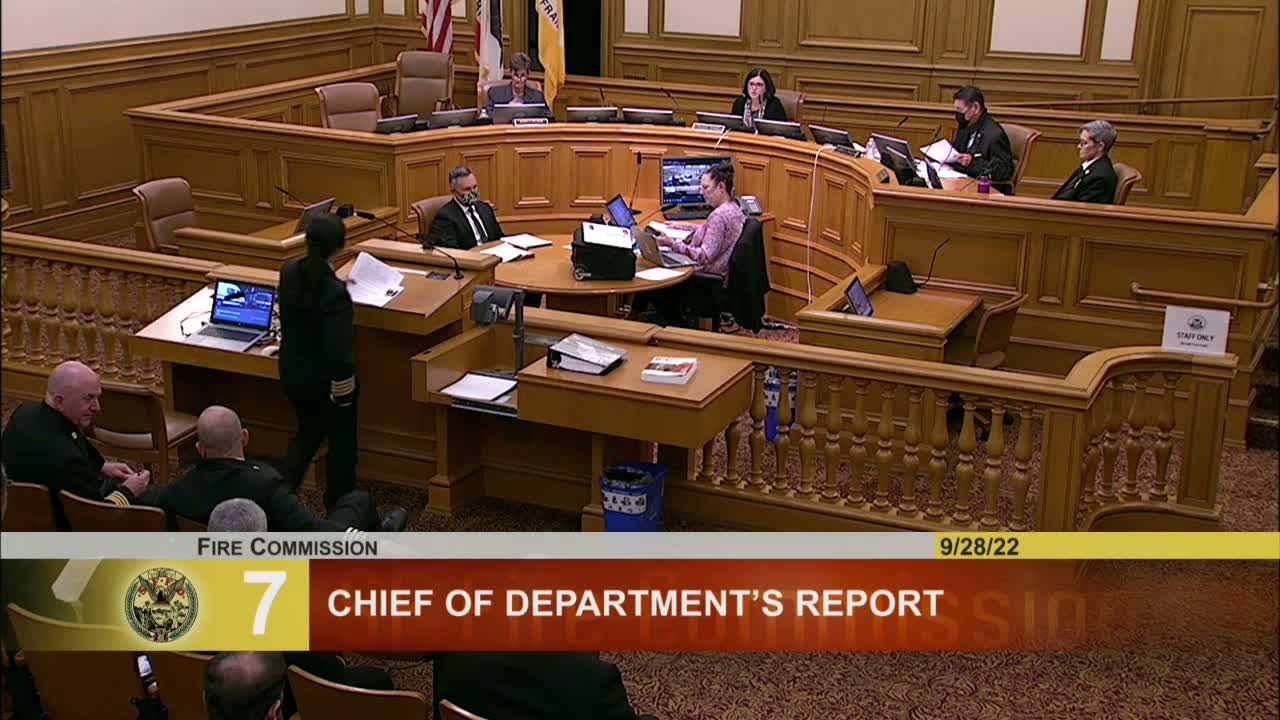
Deputy Chief Sandra Tong, in her first presentation as the department's CD4, outlined recent EMS and community paramedicine developments, including personnel changes, new ambulances, training progress and operational metrics.
Tong noted that the department expects roughly 25 graduates from the current hybrid paramedic/EMT academy and that 14 EMTs were recently elevated to paramedic status. She highlighted three newly delivered type-1 ambulances — the first of 14 — and said the vehicles are intended to improve durability and crew comfort while the department refines specifications through an RFP for future ambulances.
On system performance, Tong said EMS call volume rose 3.2% from July to August, averaging about 340 calls per day. She reported an increase in the department's ambulance "market share" to roughly 85% after hiring about 60 full-time equivalents; a year earlier the market share was roughly 73%.
Tong gave operational details on community paramedicine. She said the program began placing 51.50 holds this August after a Board of Supervisors resolution enabled the practice and that dispatch changes to assign emergency medical dispatch (EMD) calls to street overdose and wellness teams reduced the department's "unable to locate" rate from 36% to 15%. "The street teams also engaged over 1,100 individuals," she added, noting about 29% of encounters resulted in transport to appropriate care.
Commissioners asked about chaplaincy committee membership, funding for duffel bags for turnout gear (1,700 bags to be funded through a coalition of the cancer foundation, credit union and the fire union), and ambulance maneuverability on crowded city streets. Tong said the procurement team specified ambulances comparable in width to existing units and designed to remain maneuverable while improving longevity.
Other items in the monthly reports included temporary COVID-19 impacts (Chief Nicholson earlier reported "8 members on quarantine and 2 members positive"), interagency training (a full-scale airport drill with multiple jurisdictions), and ongoing efforts to expand behavioral health and wellness services for members.
Tong concluded by asking commissioners what additional data they would like included in future reports so the division's metrics and program maps can be more useful for oversight.
Tong noted that the department expects roughly 25 graduates from the current hybrid paramedic/EMT academy and that 14 EMTs were recently elevated to paramedic status. She highlighted three newly delivered type-1 ambulances — the first of 14 — and said the vehicles are intended to improve durability and crew comfort while the department refines specifications through an RFP for future ambulances.
On system performance, Tong said EMS call volume rose 3.2% from July to August, averaging about 340 calls per day. She reported an increase in the department's ambulance "market share" to roughly 85% after hiring about 60 full-time equivalents; a year earlier the market share was roughly 73%.
Tong gave operational details on community paramedicine. She said the program began placing 51.50 holds this August after a Board of Supervisors resolution enabled the practice and that dispatch changes to assign emergency medical dispatch (EMD) calls to street overdose and wellness teams reduced the department's "unable to locate" rate from 36% to 15%. "The street teams also engaged over 1,100 individuals," she added, noting about 29% of encounters resulted in transport to appropriate care.
Commissioners asked about chaplaincy committee membership, funding for duffel bags for turnout gear (1,700 bags to be funded through a coalition of the cancer foundation, credit union and the fire union), and ambulance maneuverability on crowded city streets. Tong said the procurement team specified ambulances comparable in width to existing units and designed to remain maneuverable while improving longevity.
Other items in the monthly reports included temporary COVID-19 impacts (Chief Nicholson earlier reported "8 members on quarantine and 2 members positive"), interagency training (a full-scale airport drill with multiple jurisdictions), and ongoing efforts to expand behavioral health and wellness services for members.
Tong concluded by asking commissioners what additional data they would like included in future reports so the division's metrics and program maps can be more useful for oversight.
Don't Miss a Word: See the Full Meeting!
Go beyond summaries. Unlock every video, transcript, and key insight with a Founder Membership.
✓
Get instant access to full meeting videos
✓
Search and clip any phrase from complete transcripts
✓
Receive AI-powered summaries & custom alerts
✓
Enjoy lifetime, unrestricted access to government data
30-day money-back guarantee
