Fire department combines street crisis and wellness teams, seeks 14 EMTs to replace clinicians on rigs
March 08, 2023 | San Francisco City, San Francisco County, California
This article was created by AI summarizing key points discussed. AI makes mistakes, so for full details and context, please refer to the video of the full meeting. Please report any errors so we can fix them. Report an error »
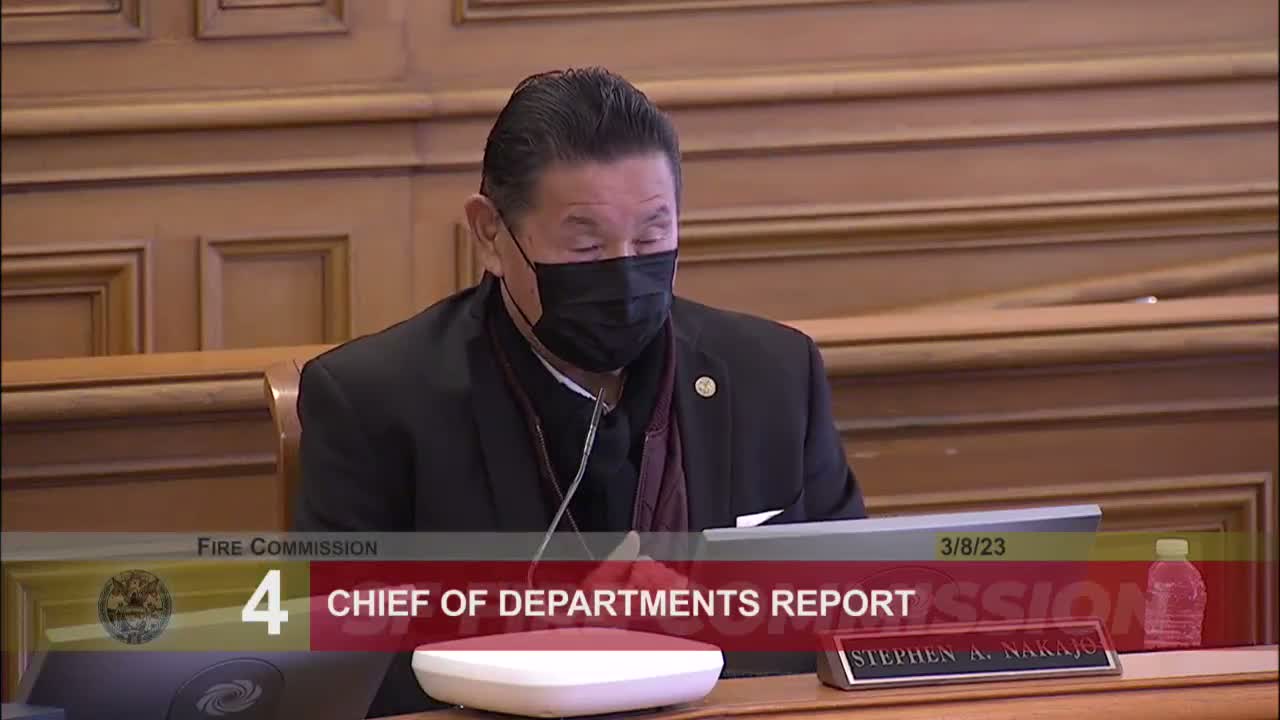
The San Francisco Fire Department on March 8 told the Fire Commission it is reorganizing its field crisis response to improve efficiency and follow-up care.
Assistant Deputy Chief Simon Pang said the department has merged the Street Crisis Response Team and the Street Wellness Team into a single Street Crisis Response Team that will staff each vehicle with a community paramedic, an EMT and a peer-support specialist. "We're really doing an expansion of the city's response for people in need on the street," Pang said, adding that the change is meant to reduce siloing of resources and improve response times.
Pang said the move shifts 14 behavioral health clinicians off frontline vans and onto follow-up teams that provide persistent outreach. "The behavioral health clinicians that were on our rapid response vans will be added to the follow-up side," he said. To replace those clinicians on the rigs, the department is requesting funding for 14 additional EMT positions in this fiscal-year budget.
The department presented early performance data he said were promising: "All of our key performance indicators are either equivalent or better in the last four days than they were in February," Pang said, while cautioning the sample was small. Commissioners pressed for details about the follow-up pipeline and service capacity, noting limited shelter beds and scarcity of acute psychiatric placements.
Commissioner Marcy Fraser and others asked how the city will keep people connected after an initial contact. Pang acknowledged the limits: shelter placements can range from zero to eight per day and acute treatment beds are scarce, and he described persistent, daily follow-up as a remedy when people choose to remain in the community.
Deputy Chief Sandra Tong and other department staff described plans for coordination: behavioral health clinicians will join the Department of Public Health’s Office of Care Coordination for follow-up, and community paramedic captains will take on some on-scene 5150 hold authority after training. "We assessed the data and reconfigured to improve safety and efficiency," Tong said.
What happens next: the department will seek budget approval for the 14 EMT positions and continue to monitor response and follow-up metrics as the new SCRT model is implemented.
Assistant Deputy Chief Simon Pang said the department has merged the Street Crisis Response Team and the Street Wellness Team into a single Street Crisis Response Team that will staff each vehicle with a community paramedic, an EMT and a peer-support specialist. "We're really doing an expansion of the city's response for people in need on the street," Pang said, adding that the change is meant to reduce siloing of resources and improve response times.
Pang said the move shifts 14 behavioral health clinicians off frontline vans and onto follow-up teams that provide persistent outreach. "The behavioral health clinicians that were on our rapid response vans will be added to the follow-up side," he said. To replace those clinicians on the rigs, the department is requesting funding for 14 additional EMT positions in this fiscal-year budget.
The department presented early performance data he said were promising: "All of our key performance indicators are either equivalent or better in the last four days than they were in February," Pang said, while cautioning the sample was small. Commissioners pressed for details about the follow-up pipeline and service capacity, noting limited shelter beds and scarcity of acute psychiatric placements.
Commissioner Marcy Fraser and others asked how the city will keep people connected after an initial contact. Pang acknowledged the limits: shelter placements can range from zero to eight per day and acute treatment beds are scarce, and he described persistent, daily follow-up as a remedy when people choose to remain in the community.
Deputy Chief Sandra Tong and other department staff described plans for coordination: behavioral health clinicians will join the Department of Public Health’s Office of Care Coordination for follow-up, and community paramedic captains will take on some on-scene 5150 hold authority after training. "We assessed the data and reconfigured to improve safety and efficiency," Tong said.
What happens next: the department will seek budget approval for the 14 EMT positions and continue to monitor response and follow-up metrics as the new SCRT model is implemented.
View the Full Meeting & All Its Details
This article offers just a summary. Unlock complete video, transcripts, and insights as a Founder Member.
✓
Watch full, unedited meeting videos
✓
Search every word spoken in unlimited transcripts
✓
AI summaries & real-time alerts (all government levels)
✓
Permanent access to expanding government content
30-day money-back guarantee
