Fire Department data team pitches community paramedicine expansion after year of analysis
February 08, 2023 | San Francisco City, San Francisco County, California
This article was created by AI summarizing key points discussed. AI makes mistakes, so for full details and context, please refer to the video of the full meeting. Please report any errors so we can fix them. Report an error »
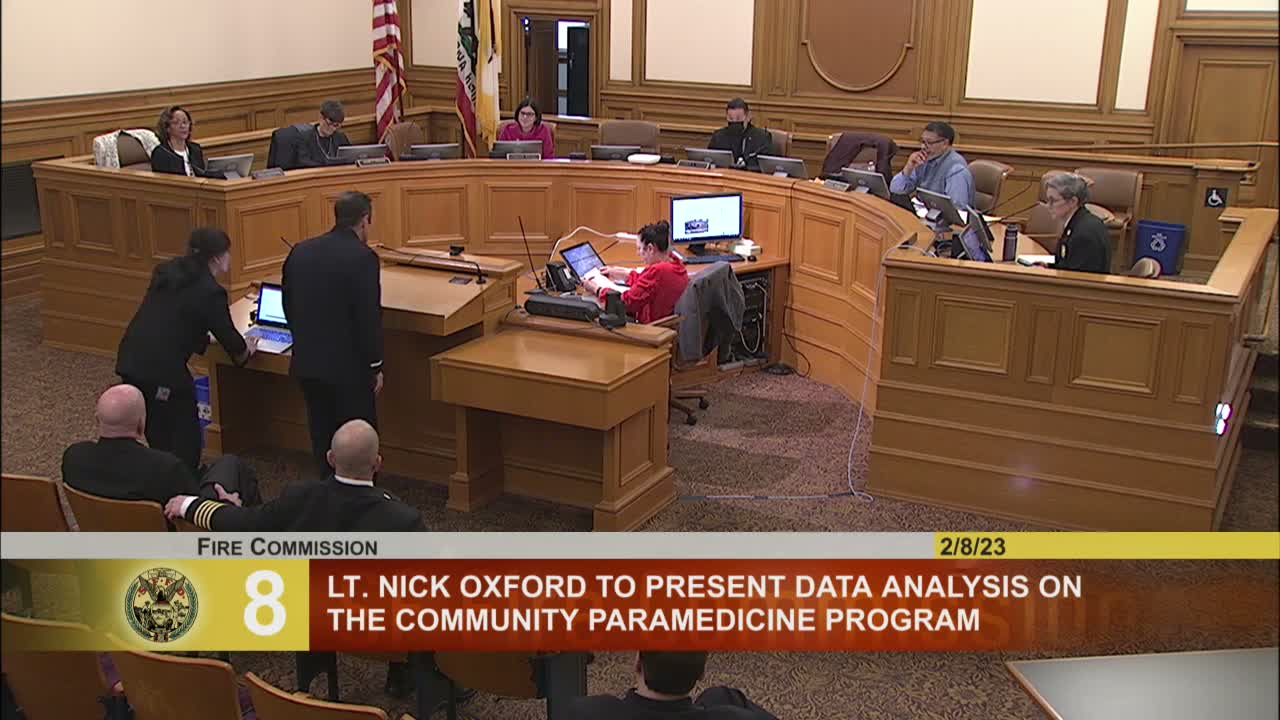
Lieutenant Nick Oxford, returning to field duty after a year in community paramedicine, told the Fire Commission that data work has identified patterns that could reduce emergency transports and better match responses to needs.
Oxford said the department's EMS calls increased substantially over two decades and that some high-resource call types — including unresponsive-person calls, overdoses and mental-health crises — absorb disproportionate resources. "Call volume is rising ... if 9-1-1 is the ultimate downstream safety net, there are supposed to be any number of safety nets before 9-1-1," Oxford said, arguing the data can be used to guide policy and resource allocation.
Chief Sandra Tong reported EMS 2022 totals of 122,879 ambulance dispatches (a 9% increase from 2021) and said the department is piloting a BLS ambulance project and reconfiguring street crisis and wellness teams into 12 street-crisis-response teams with an anticipated March implementation. Tong highlighted training efforts — 500 members trained in BLS/CPR in the last month — and said increased Narcan administration corresponded with fewer opioid-related deaths in the latest medical-examiner data.
Oxford detailed partnerships with UC Berkeley, San Jose State and data-science SF to deepen program evaluation and said the department plans to deploy dashboards in the Fire Portal so field staff and leadership can monitor performance metrics. Commissioners praised the data-driven approach and asked that the department maintain continuity of analysis after Oxford transitions; department leaders said they are advertising for a civilian policy and data analyst to sustain the work.
Oxford said the department's EMS calls increased substantially over two decades and that some high-resource call types — including unresponsive-person calls, overdoses and mental-health crises — absorb disproportionate resources. "Call volume is rising ... if 9-1-1 is the ultimate downstream safety net, there are supposed to be any number of safety nets before 9-1-1," Oxford said, arguing the data can be used to guide policy and resource allocation.
Chief Sandra Tong reported EMS 2022 totals of 122,879 ambulance dispatches (a 9% increase from 2021) and said the department is piloting a BLS ambulance project and reconfiguring street crisis and wellness teams into 12 street-crisis-response teams with an anticipated March implementation. Tong highlighted training efforts — 500 members trained in BLS/CPR in the last month — and said increased Narcan administration corresponded with fewer opioid-related deaths in the latest medical-examiner data.
Oxford detailed partnerships with UC Berkeley, San Jose State and data-science SF to deepen program evaluation and said the department plans to deploy dashboards in the Fire Portal so field staff and leadership can monitor performance metrics. Commissioners praised the data-driven approach and asked that the department maintain continuity of analysis after Oxford transitions; department leaders said they are advertising for a civilian policy and data analyst to sustain the work.
Don't Miss a Word: See the Full Meeting!
Go beyond summaries. Unlock every video, transcript, and key insight with a Founder Membership.
✓
Get instant access to full meeting videos
✓
Search and clip any phrase from complete transcripts
✓
Receive AI-powered summaries & custom alerts
✓
Enjoy lifetime, unrestricted access to government data
30-day money-back guarantee
