EMS report: offload delays and outreach programs highlighted; department awarded civic-bridge to study EMS 6
January 10, 2024 | San Francisco City, San Francisco County, California
This article was created by AI summarizing key points discussed. AI makes mistakes, so for full details and context, please refer to the video of the full meeting. Please report any errors so we can fix them. Report an error »
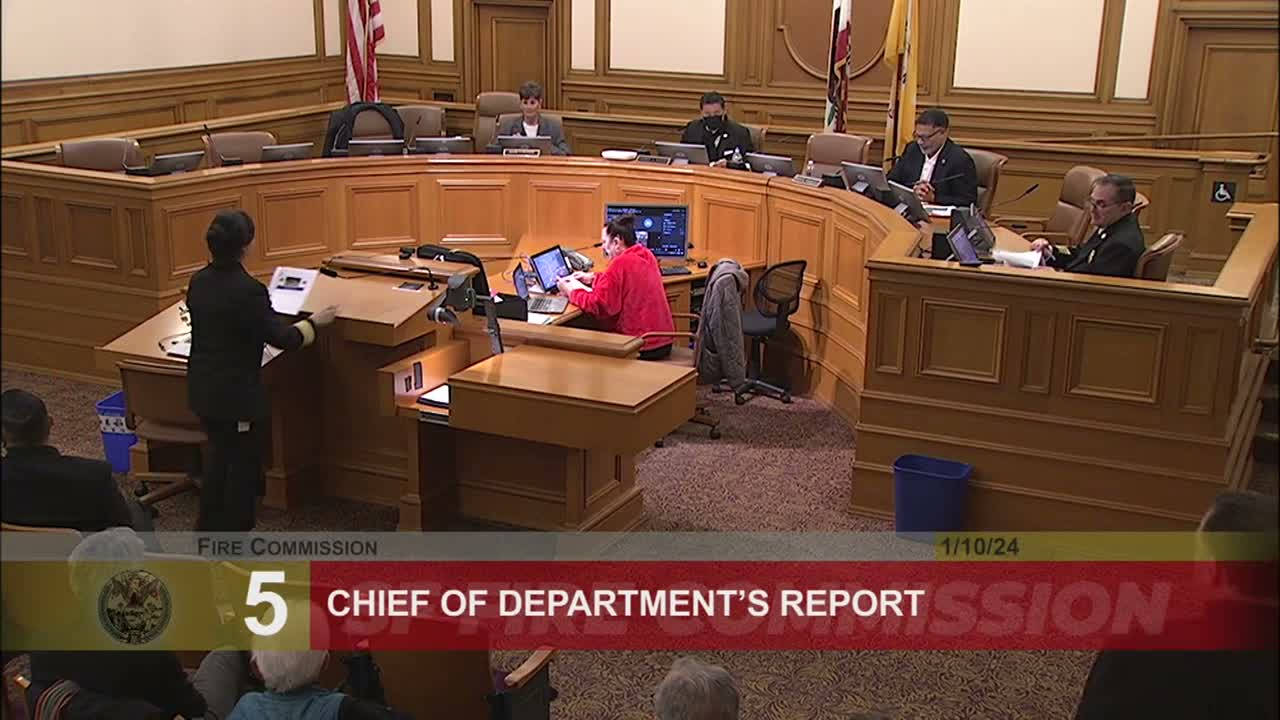
Deputy Chief Sandra Tong presented the EMS and Community Paramedicine report for December at the Jan. 10 meeting, reviewing call volume, task times, and program initiatives.
"We averaged about 366 calls with 77% of the market share," Tong said, summarizing call-volume metrics. She told commissioners that APOD (arrival‑to‑patient‑offload) times were "significantly extended" in late December, though the department saw improvement into January.
Tong highlighted program work including training for rescue captains and multi‑casualty incident scenarios, and she described outreach and treatment activity from community paramedicine: "In this month, we had 10 of those [Suboxone] starts." She also said the department was preparing to implement elements of SB 43, which expands the definition of "gravely disabled" to include people disabled by substance use disorder, and asked the commission to help identify candidates who might qualify under the law for additional outreach and services.
Tong reported the department was awarded a civic-bridge grant to work with a private partner to study EMS 6 metrics and identify performance improvements over a 16‑week program. Commissioners asked about comparative metrics with other cities and expressed interest in more benchmarking data; Tong agreed to provide additional comparator information where available.
The commission and department discussed that a high share of EMS 6 calls involve people experiencing homelessness, and members asked the department to continue analyzing how those calls affect response strategy and resource needs.
"We averaged about 366 calls with 77% of the market share," Tong said, summarizing call-volume metrics. She told commissioners that APOD (arrival‑to‑patient‑offload) times were "significantly extended" in late December, though the department saw improvement into January.
Tong highlighted program work including training for rescue captains and multi‑casualty incident scenarios, and she described outreach and treatment activity from community paramedicine: "In this month, we had 10 of those [Suboxone] starts." She also said the department was preparing to implement elements of SB 43, which expands the definition of "gravely disabled" to include people disabled by substance use disorder, and asked the commission to help identify candidates who might qualify under the law for additional outreach and services.
Tong reported the department was awarded a civic-bridge grant to work with a private partner to study EMS 6 metrics and identify performance improvements over a 16‑week program. Commissioners asked about comparative metrics with other cities and expressed interest in more benchmarking data; Tong agreed to provide additional comparator information where available.
The commission and department discussed that a high share of EMS 6 calls involve people experiencing homelessness, and members asked the department to continue analyzing how those calls affect response strategy and resource needs.
View the Full Meeting & All Its Details
This article offers just a summary. Unlock complete video, transcripts, and insights as a Founder Member.
✓
Watch full, unedited meeting videos
✓
Search every word spoken in unlimited transcripts
✓
AI summaries & real-time alerts (all government levels)
✓
Permanent access to expanding government content
30-day money-back guarantee
