San Francisco Fire Department highlights new hose tenders, storm surge response and public‑education push on lithium‑ion batteries
March 13, 2024 | San Francisco City, San Francisco County, California
This article was created by AI summarizing key points discussed. AI makes mistakes, so for full details and context, please refer to the video of the full meeting. Please report any errors so we can fix them. Report an error »
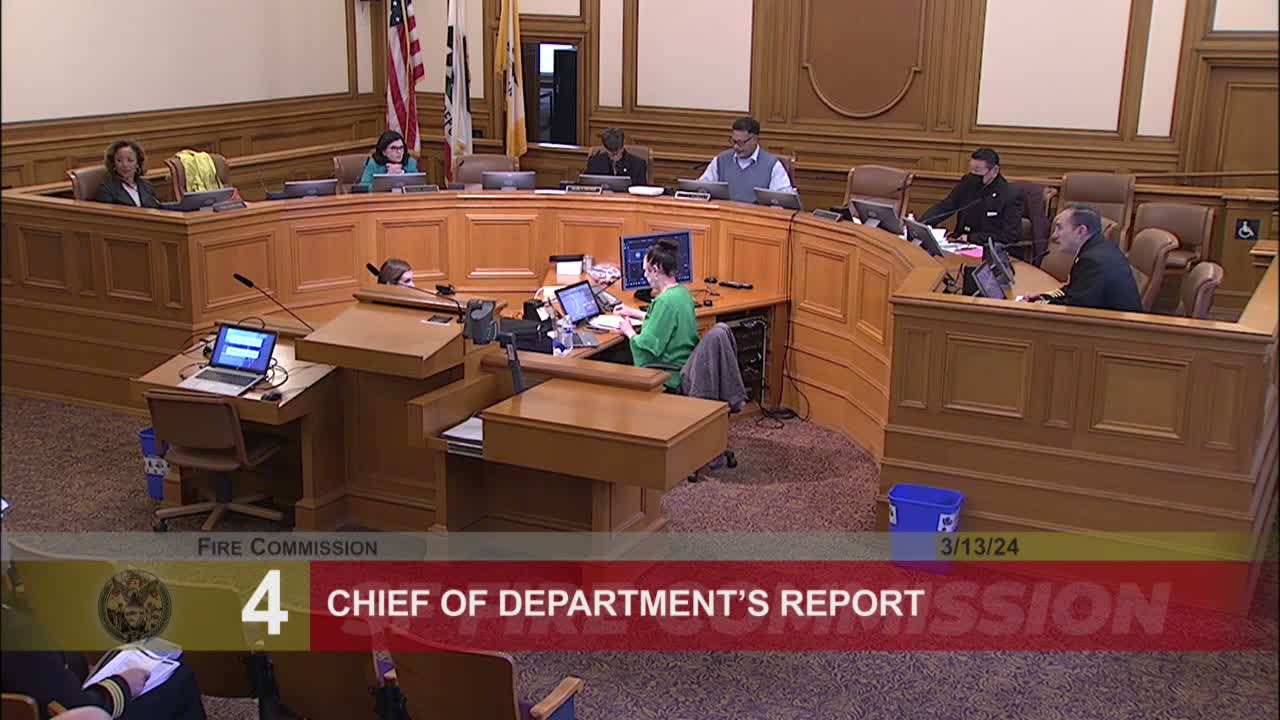
San Francisco — At its March meeting the San Francisco Fire Commission heard detailed operational reports from department leadership about equipment demonstrations, a recent storm surge of emergency calls and new public‑education efforts tied to a proposed fire‑marshal ordinance.
Deputy Chief Darius Letthrop described a hose‑tender demonstration at Twin Peaks Reservoir on Feb. 29, calling the apparatus “a quite substantial pumper and the ability to move water.” He gave capacity figures: “It has the ability to draw in the range of 8,000 gallons a minute” and “It can push about 5,000 gallons a minute,” and noted a portable submersible pump that “will pump 3,000 gallons all by itself.” Letthrop said the department plans to quarter the first three units at Station 18 (Sunset), Station 22 (border of Sunset/Richmond) and Station 17 (Bayview‑Hunters Point) to expand coverage where the high‑pressure hydro system is not available.
Why it matters: the hose tender provides a mobile water‑supply option that can augment or substitute for fixed pipe infrastructure — significant amid rising estimates for pipe replacement and earthquake‑safety projects, which Letthrop described as a major budgetary pressure.
Operational tempo and mutual aid: Letthrop highlighted a demonstrative storm day on Feb. 4 when the department ran a very large volume of calls. He said the department “ran 733 calls for service” on that day above baseline activity and “we doubled our volume in a day,” emphasizing limits on calling in off‑duty staff during concentrated surges and the role of prepositioned mutual‑aid resources on weather‑threat days.
Fire prevention and battery safety: The commission was briefed on fire‑marshal work, including a public‑education campaign tied to proposed storage and charging rules for lithium‑ion batteries. Chief Coughlin said the campaign has a two‑minute PSA, outreach materials and a webpage on sffd.org; the department worked with the Department of the Environment for disposal guidance. The outreach is aligned with ordinance work the marshal prepared and the department’s community‑education program.
Other operational items: Letthrop also discussed ongoing adjustments to the National Fire Incident Reporting System and the fire‑marshal’s dot map tracking “outside fires,” noting an apparent increase in small outside‑fire calls that the department is attempting to disaggregate for supervisors and planning. Commissioners pressed for clarity on definitions and neighborhood mapping.
Safety concerns and interagency issues: Letthrop flagged temporary collapsible bollards on Cap Street as a safety and maintenance problem, saying they are sometimes left collapsed, obstructed by ad‑hoc planters or parked cars and are not maintained by suppression companies. He said MTA and Public Works handle maintenance and that the department is seeking alternatives and continued coordination.
What commissioners asked: Commissioners asked about staffing and academy recruitment (the chief said staff are vetting roughly 130 candidates for an upcoming academy), the department’s approach when encountering downed power lines (coordinate and stand by for PG&E), and how the department documents storm damage and public‑records workload from sunshine requests.
Next steps: Commissioners requested ongoing updates on the hose‑tender deployment, enforcement of sleeping‑area alarm upgrades and the lithium‑ion battery public‑education rollout.
Deputy Chief Darius Letthrop described a hose‑tender demonstration at Twin Peaks Reservoir on Feb. 29, calling the apparatus “a quite substantial pumper and the ability to move water.” He gave capacity figures: “It has the ability to draw in the range of 8,000 gallons a minute” and “It can push about 5,000 gallons a minute,” and noted a portable submersible pump that “will pump 3,000 gallons all by itself.” Letthrop said the department plans to quarter the first three units at Station 18 (Sunset), Station 22 (border of Sunset/Richmond) and Station 17 (Bayview‑Hunters Point) to expand coverage where the high‑pressure hydro system is not available.
Why it matters: the hose tender provides a mobile water‑supply option that can augment or substitute for fixed pipe infrastructure — significant amid rising estimates for pipe replacement and earthquake‑safety projects, which Letthrop described as a major budgetary pressure.
Operational tempo and mutual aid: Letthrop highlighted a demonstrative storm day on Feb. 4 when the department ran a very large volume of calls. He said the department “ran 733 calls for service” on that day above baseline activity and “we doubled our volume in a day,” emphasizing limits on calling in off‑duty staff during concentrated surges and the role of prepositioned mutual‑aid resources on weather‑threat days.
Fire prevention and battery safety: The commission was briefed on fire‑marshal work, including a public‑education campaign tied to proposed storage and charging rules for lithium‑ion batteries. Chief Coughlin said the campaign has a two‑minute PSA, outreach materials and a webpage on sffd.org; the department worked with the Department of the Environment for disposal guidance. The outreach is aligned with ordinance work the marshal prepared and the department’s community‑education program.
Other operational items: Letthrop also discussed ongoing adjustments to the National Fire Incident Reporting System and the fire‑marshal’s dot map tracking “outside fires,” noting an apparent increase in small outside‑fire calls that the department is attempting to disaggregate for supervisors and planning. Commissioners pressed for clarity on definitions and neighborhood mapping.
Safety concerns and interagency issues: Letthrop flagged temporary collapsible bollards on Cap Street as a safety and maintenance problem, saying they are sometimes left collapsed, obstructed by ad‑hoc planters or parked cars and are not maintained by suppression companies. He said MTA and Public Works handle maintenance and that the department is seeking alternatives and continued coordination.
What commissioners asked: Commissioners asked about staffing and academy recruitment (the chief said staff are vetting roughly 130 candidates for an upcoming academy), the department’s approach when encountering downed power lines (coordinate and stand by for PG&E), and how the department documents storm damage and public‑records workload from sunshine requests.
Next steps: Commissioners requested ongoing updates on the hose‑tender deployment, enforcement of sleeping‑area alarm upgrades and the lithium‑ion battery public‑education rollout.
View the Full Meeting & All Its Details
This article offers just a summary. Unlock complete video, transcripts, and insights as a Founder Member.
✓
Watch full, unedited meeting videos
✓
Search every word spoken in unlimited transcripts
✓
AI summaries & real-time alerts (all government levels)
✓
Permanent access to expanding government content
30-day money-back guarantee
