Ethics staff outline proposed gift‑law ballot measure and regulations; unions and nonprofits seek more talks
February 11, 2022 | San Francisco City, San Francisco County, California
This article was created by AI summarizing key points discussed. AI makes mistakes, so for full details and context, please refer to the video of the full meeting. Please report any errors so we can fix them. Report an error »
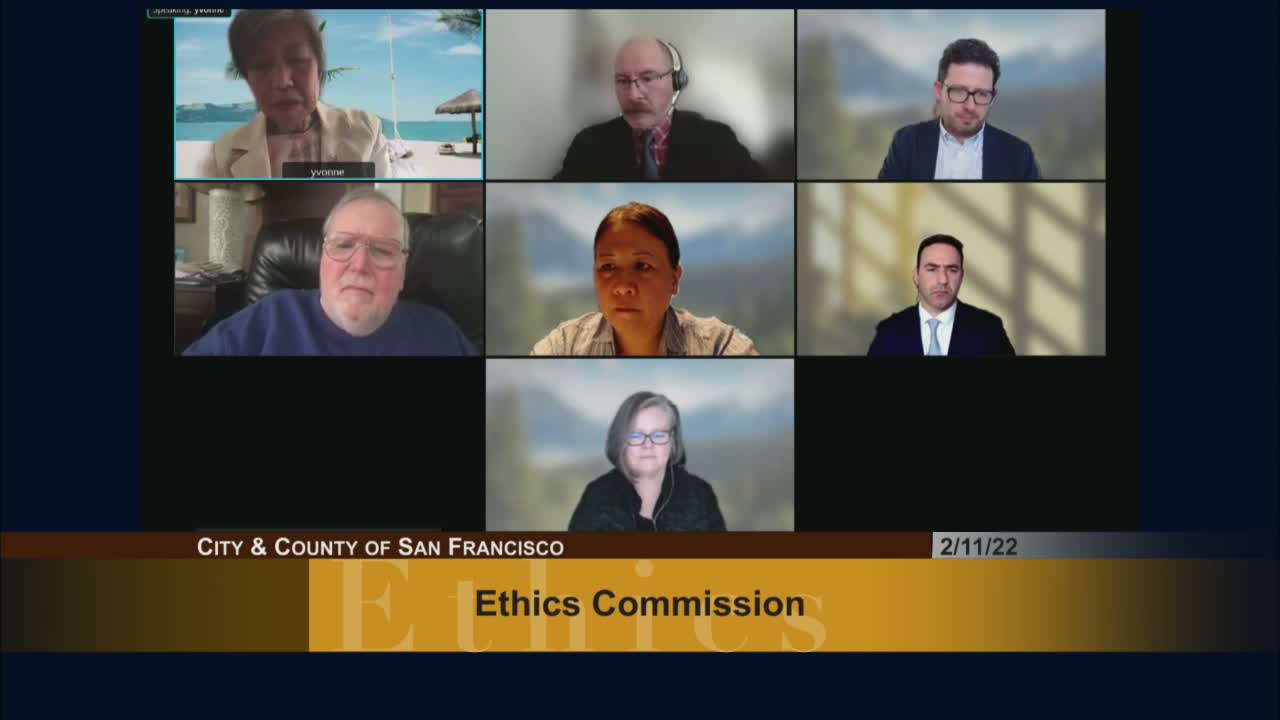
San Francisco Ethics Commission staff on Feb. 11 presented a two‑part package — a proposed ballot ordinance and companion regulation amendments — that would rewrite local rules on gifts, restricted sources and related disclosures. The staff presentation described multiple changes aimed at preventing conflicts of interest revealed by recent corruption cases.
Key proposals include adopting a local definition of "gift," expanding the restricted‑source rule to prohibit giving as well as accepting prohibited gifts (and to cover affiliates and permit applicants), standardizing disclosures for payments to departments, aligning local bribery rules with federal standards (banning "anything of value" in bribery), expanding annual ethics training to all Form 700 filers, and giving the Commission authority to require electronic filing of disclosures. Staff also proposed exceptions for widely available promotional items, certain nonprofit fundraisers and limited nonprofit ticketing for necessary job duties.
Staff described an extensive meet‑and‑confer history with unions and said four outstanding issues had been raised by the Municipal Executives Association (MEA). Deputy City Attorney Shen advised the Commission that the meet‑and‑confer process remains open and that, legally, the Commission cannot approve a ballot measure while those proceedings are active. The next scheduled meet‑and‑confer session is Feb. 16.
Members of the nonprofit and arts communities urged caution. Ralph Remington, director of cultural affairs for the San Francisco Arts Commission, told commissioners that city staff routinely attend and assess arts events for grantmaking and that a modest "ticket plus one" industry practice supports informed funding decisions. Debbie Lerman of the San Francisco Human Services Network urged clearer definitions to avoid sweeping volunteer board members or grassroots petitioners into restricted‑source liability.
Commissioners discussed three staff options on whether to extend enforcement liability to gift givers: keep giver liability as drafted, remove giver liability while retaining prohibitions for lobbyists and permit consultants, or adopt a narrowed hybrid that prohibits entity giving but not individual affiliates. Many commissioners asked staff to pursue additional outreach to nonprofit partners and to consider refining the regulatory ticket exceptions rather than locking them into the ballot language.
The Commission approved a separate motion directing staff to issue a public update about the process and to schedule interested‑persons meetings; it also set a Feb. 25 special session to hear stakeholders in public and to collect written summaries for Commissioners before any final action. Staff emphasized that regulatory refinements can be pursued separately from a ballot ordinance if the Commission decides to do so.
What happens next: staff will continue meet‑and‑confer with unions (next session Feb. 16), schedule interested‑persons hearings with nonprofit and community partners, issue a public update on progress, and return to the Commission with a summary of input and proposed refinements ahead of any March 4 ballot‑submission decision.
Key proposals include adopting a local definition of "gift," expanding the restricted‑source rule to prohibit giving as well as accepting prohibited gifts (and to cover affiliates and permit applicants), standardizing disclosures for payments to departments, aligning local bribery rules with federal standards (banning "anything of value" in bribery), expanding annual ethics training to all Form 700 filers, and giving the Commission authority to require electronic filing of disclosures. Staff also proposed exceptions for widely available promotional items, certain nonprofit fundraisers and limited nonprofit ticketing for necessary job duties.
Staff described an extensive meet‑and‑confer history with unions and said four outstanding issues had been raised by the Municipal Executives Association (MEA). Deputy City Attorney Shen advised the Commission that the meet‑and‑confer process remains open and that, legally, the Commission cannot approve a ballot measure while those proceedings are active. The next scheduled meet‑and‑confer session is Feb. 16.
Members of the nonprofit and arts communities urged caution. Ralph Remington, director of cultural affairs for the San Francisco Arts Commission, told commissioners that city staff routinely attend and assess arts events for grantmaking and that a modest "ticket plus one" industry practice supports informed funding decisions. Debbie Lerman of the San Francisco Human Services Network urged clearer definitions to avoid sweeping volunteer board members or grassroots petitioners into restricted‑source liability.
Commissioners discussed three staff options on whether to extend enforcement liability to gift givers: keep giver liability as drafted, remove giver liability while retaining prohibitions for lobbyists and permit consultants, or adopt a narrowed hybrid that prohibits entity giving but not individual affiliates. Many commissioners asked staff to pursue additional outreach to nonprofit partners and to consider refining the regulatory ticket exceptions rather than locking them into the ballot language.
The Commission approved a separate motion directing staff to issue a public update about the process and to schedule interested‑persons meetings; it also set a Feb. 25 special session to hear stakeholders in public and to collect written summaries for Commissioners before any final action. Staff emphasized that regulatory refinements can be pursued separately from a ballot ordinance if the Commission decides to do so.
What happens next: staff will continue meet‑and‑confer with unions (next session Feb. 16), schedule interested‑persons hearings with nonprofit and community partners, issue a public update on progress, and return to the Commission with a summary of input and proposed refinements ahead of any March 4 ballot‑submission decision.
Don't Miss a Word: See the Full Meeting!
Go beyond summaries. Unlock every video, transcript, and key insight with a Founder Membership.
✓
Get instant access to full meeting videos
✓
Search and clip any phrase from complete transcripts
✓
Receive AI-powered summaries & custom alerts
✓
Enjoy lifetime, unrestricted access to government data
30-day money-back guarantee
