Controller's Office finds ethics lapses in Department of the Environment's dealings with Recology, recommends clearer roles and disclosures
May 13, 2022 | San Francisco City, San Francisco County, California
This article was created by AI summarizing key points discussed. AI makes mistakes, so for full details and context, please refer to the video of the full meeting. Please report any errors so we can fix them. Report an error »
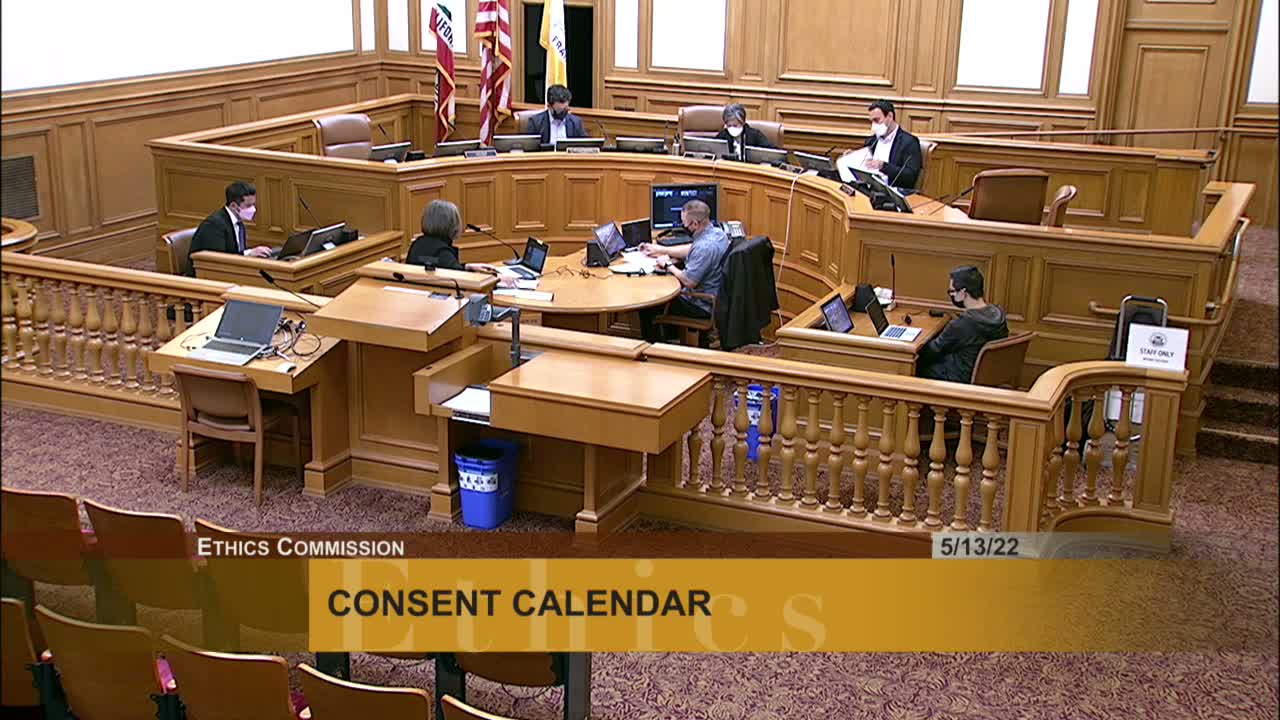
The San Francisco Controller's Office told the Ethics Commission on May 13 that its preliminary assessment of the Department of the Environment's relationship with Recology found repeated problems with gift acceptance, solicitation and disclosure and recommended policy fixes to strengthen internal controls.
Mark Della Rosa, director of audits at the Controller's Office, summarized the April report and told commissioners the audit found that SF Environment employees, including a former director, regularly accepted gifts from Recology, a contractor and therefore a restricted source for the department. The report said the department also solicited donations from Recology before signing contracts in 2015 and 2019 and that staff sometimes withheld requested documents about donations. The Controller's presentation noted a 2015 Recology donation of $25,000 for Earth Day events that was not proactively disclosed to oversight offices.
The report highlighted three broad areas of concern: unclear departmental roles in refuse rate setting, a lax tone at the top concerning ethics expectations, and insufficient formal agreements and disclosure practices with noncity "friends" organizations. To address those gaps, Della Rosa said the Controller's Office recommended that policymakers define the Department of the Environment's role in rate setting, require an MOU between the department and Friends of SF Environment, ensure mandatory training for contracting staff, and direct the department to consult the City Attorney and the Ethics Commission when questions arise.
Commissioners pressed the Controller's team on what was and was not illegal at the times the conduct occurred. Tiffany Wong and other audit managers told the Commission that some earlier solicitations fell into a gray area under the rules then in effect, but that more recent changes'including a behested-payment rule that went into effect in January'would cover solicitations of parties doing business with a filer. Pat Ford, the Commission's director of enforcement, confirmed that the behested-payment law adopted last year and operative in January is intended to address solicitations by officers who file Form 700.
Public callers at the meeting offered mixed reactions: some defended the former department director's integrity and urged clearer executive directives and consistent enforcement across agencies; others said the Controller's Office report was only the tip of deeper, enterprise-level problems and called for broader reforms. The Controller's Office said it is tracking roughly 58 recommendations from a suite of public-integrity deliverables and will issue a 24-month implementation status update.
The Ethics Commission did not take regulatory action at the meeting but discussed coordination with other agencies and the Commission's capacity to help implement training and disclosure recommendations. The Controller's Office said follow-ups on refuse rate-related work and other assessments are forthcoming.
Mark Della Rosa, director of audits at the Controller's Office, summarized the April report and told commissioners the audit found that SF Environment employees, including a former director, regularly accepted gifts from Recology, a contractor and therefore a restricted source for the department. The report said the department also solicited donations from Recology before signing contracts in 2015 and 2019 and that staff sometimes withheld requested documents about donations. The Controller's presentation noted a 2015 Recology donation of $25,000 for Earth Day events that was not proactively disclosed to oversight offices.
The report highlighted three broad areas of concern: unclear departmental roles in refuse rate setting, a lax tone at the top concerning ethics expectations, and insufficient formal agreements and disclosure practices with noncity "friends" organizations. To address those gaps, Della Rosa said the Controller's Office recommended that policymakers define the Department of the Environment's role in rate setting, require an MOU between the department and Friends of SF Environment, ensure mandatory training for contracting staff, and direct the department to consult the City Attorney and the Ethics Commission when questions arise.
Commissioners pressed the Controller's team on what was and was not illegal at the times the conduct occurred. Tiffany Wong and other audit managers told the Commission that some earlier solicitations fell into a gray area under the rules then in effect, but that more recent changes'including a behested-payment rule that went into effect in January'would cover solicitations of parties doing business with a filer. Pat Ford, the Commission's director of enforcement, confirmed that the behested-payment law adopted last year and operative in January is intended to address solicitations by officers who file Form 700.
Public callers at the meeting offered mixed reactions: some defended the former department director's integrity and urged clearer executive directives and consistent enforcement across agencies; others said the Controller's Office report was only the tip of deeper, enterprise-level problems and called for broader reforms. The Controller's Office said it is tracking roughly 58 recommendations from a suite of public-integrity deliverables and will issue a 24-month implementation status update.
The Ethics Commission did not take regulatory action at the meeting but discussed coordination with other agencies and the Commission's capacity to help implement training and disclosure recommendations. The Controller's Office said follow-ups on refuse rate-related work and other assessments are forthcoming.
View the Full Meeting & All Its Details
This article offers just a summary. Unlock complete video, transcripts, and insights as a Founder Member.
✓
Watch full, unedited meeting videos
✓
Search every word spoken in unlimited transcripts
✓
AI summaries & real-time alerts (all government levels)
✓
Permanent access to expanding government content
30-day money-back guarantee
