Commission schedules late-July special meeting to weigh mayoral and board proposals on behested payments after departments report program disruptions
July 08, 2022 | San Francisco City, San Francisco County, California
This article was created by AI summarizing key points discussed. AI makes mistakes, so for full details and context, please refer to the video of the full meeting. Please report any errors so we can fix them. Report an error »
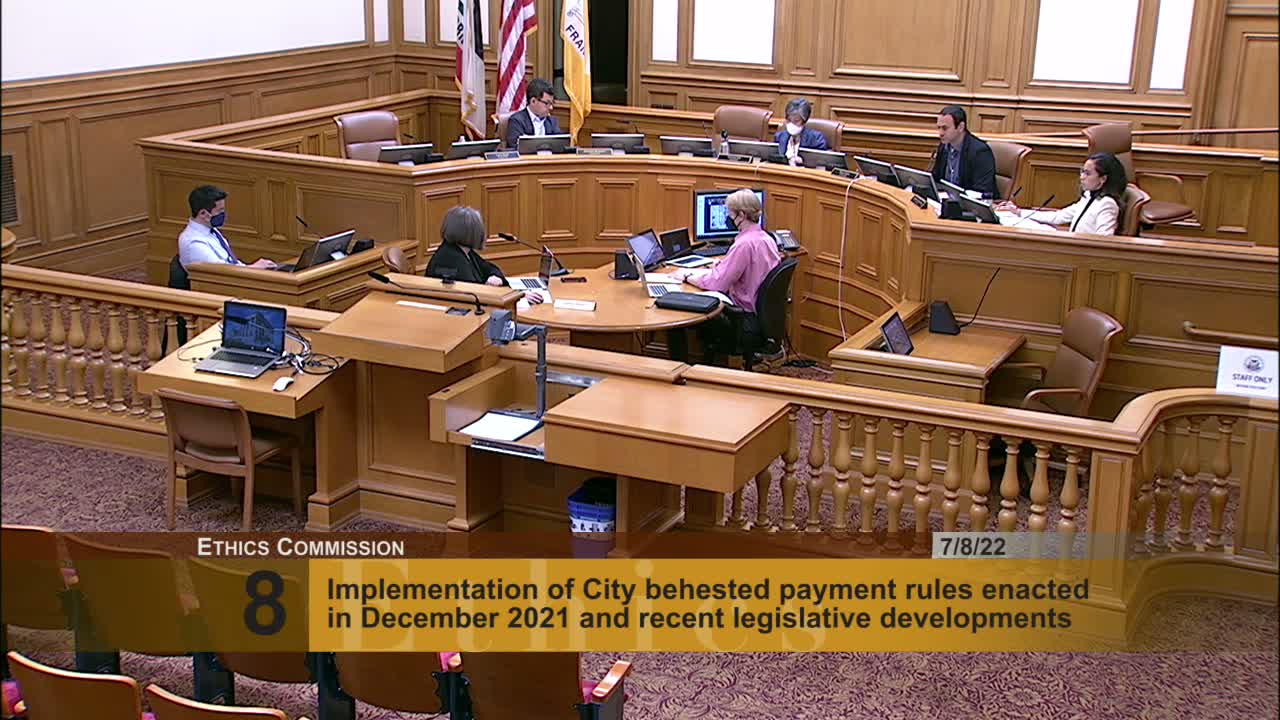
The San Francisco Ethics Commission agreed to hold a special meeting in late July to continue deliberations on proposed changes to the city'9s behested-payments and related ethics rules after staff and department witnesses described operational disruptions.
Acting senior policy analyst Michael Canning summarized the implementation experience since rules enacted in January: the law expanded the definition of "interested party," eliminated prior reporting (because soliciting certain payments is now prohibited), and prompted guidance requests from multiple departments. "Since being enacted, staff have received requests for informal advice and engaged with departments," Canning said, citing mayoral letters and a set of 48 questions posed to the Commission and city attorney.
Mayor'9s office compliance officer Hank Heckel described practical impacts on city programs and asked the Commission to consider mayoral amendments that narrow the "attempt to influence" prong and add ministerial-permit carve-outs and community-benefit exceptions for development agreements and contract-based community benefits. "There are a number of substantive problematic consequences to the legislation and we've proposed a number of amendments to deal with those," Heckel said. He said the mayor could withdraw a ballot measure before August 5 if satisfactory legislative changes are adopted.
Department and stakeholder commenters backing clarification included staff from the Department of Children, Youth and Families, Recreation and Parks, the Department of Homelessness and Supportive Housing, philanthropy representatives (Tipping Point Community, Coalition for San Francisco Neighborhoods), and nonprofit networks. They described paused projects, uncertainty about who qualifies as an interested party, and the risk of scuttling partnerships that deliver services.
Commissioners discussed timing, the interplay with Proposition E (passed with about 69% of the vote), and the short window for legislative action before August 5. Staff reported room availability and the Commission settled on Wednesday, July 27 for a special meeting to review proposed amendments, hear department testimony (including SFPUC social-impact program reforms), and consider potential Commission recommendations to the Board of Supervisors.
Acting senior policy analyst Michael Canning summarized the implementation experience since rules enacted in January: the law expanded the definition of "interested party," eliminated prior reporting (because soliciting certain payments is now prohibited), and prompted guidance requests from multiple departments. "Since being enacted, staff have received requests for informal advice and engaged with departments," Canning said, citing mayoral letters and a set of 48 questions posed to the Commission and city attorney.
Mayor'9s office compliance officer Hank Heckel described practical impacts on city programs and asked the Commission to consider mayoral amendments that narrow the "attempt to influence" prong and add ministerial-permit carve-outs and community-benefit exceptions for development agreements and contract-based community benefits. "There are a number of substantive problematic consequences to the legislation and we've proposed a number of amendments to deal with those," Heckel said. He said the mayor could withdraw a ballot measure before August 5 if satisfactory legislative changes are adopted.
Department and stakeholder commenters backing clarification included staff from the Department of Children, Youth and Families, Recreation and Parks, the Department of Homelessness and Supportive Housing, philanthropy representatives (Tipping Point Community, Coalition for San Francisco Neighborhoods), and nonprofit networks. They described paused projects, uncertainty about who qualifies as an interested party, and the risk of scuttling partnerships that deliver services.
Commissioners discussed timing, the interplay with Proposition E (passed with about 69% of the vote), and the short window for legislative action before August 5. Staff reported room availability and the Commission settled on Wednesday, July 27 for a special meeting to review proposed amendments, hear department testimony (including SFPUC social-impact program reforms), and consider potential Commission recommendations to the Board of Supervisors.
Don't Miss a Word: See the Full Meeting!
Go beyond summaries. Unlock every video, transcript, and key insight with a Founder Membership.
✓
Get instant access to full meeting videos
✓
Search and clip any phrase from complete transcripts
✓
Receive AI-powered summaries & custom alerts
✓
Enjoy lifetime, unrestricted access to government data
30-day money-back guarantee
