San Francisco Ethics Commission delays action on behested-payments changes after hours of testimony and debate
July 27, 2022 | San Francisco City, San Francisco County, California
This article was created by AI summarizing key points discussed. AI makes mistakes, so for full details and context, please refer to the video of the full meeting. Please report any errors so we can fix them. Report an error »
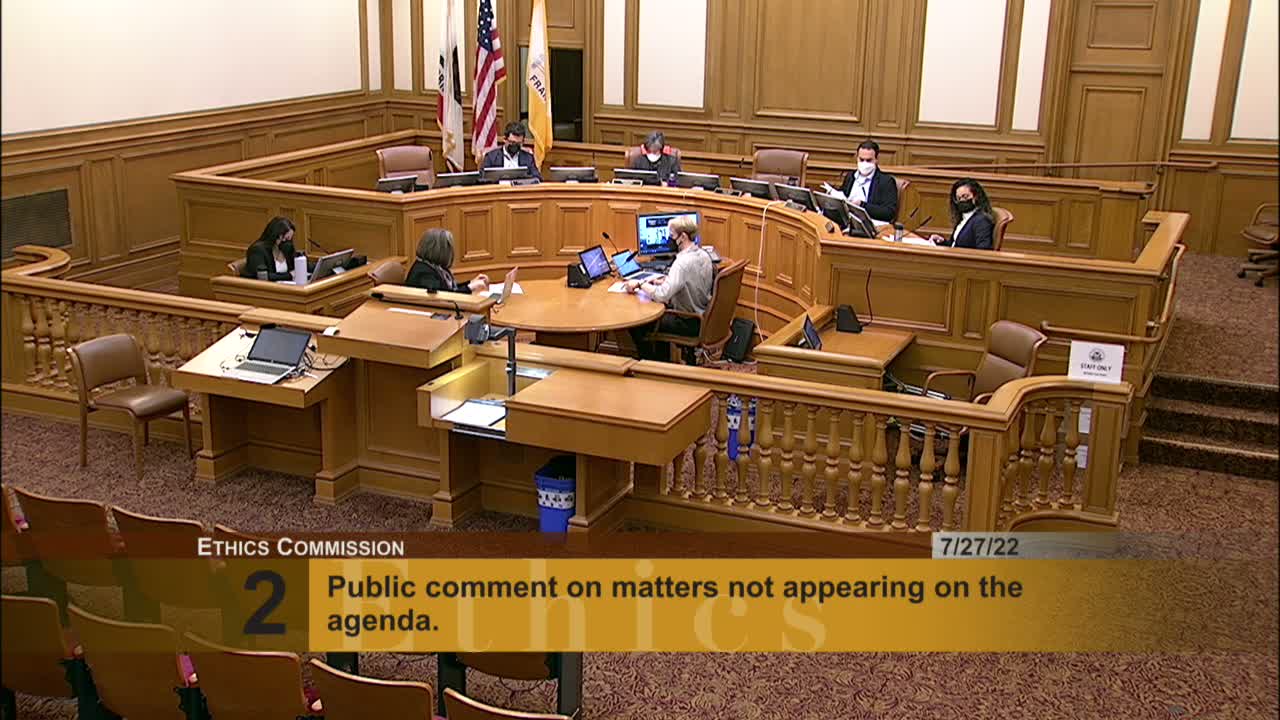
The San Francisco Ethics Commission on July 27 heard hours of presentations and public testimony about competing amendments to the city's behested-payments law and voted to continue deliberations rather than approve changes that would immediately create exceptions for philanthropic and community-benefit contributions.
The panel's special meeting brought staff recommendations, a compromise package from Supervisor Aaron Peskin and Mayor London Breed's office, and presentations from the Public Utilities Commission and multiple nonprofit and city department leaders who said the law's implementation has stalled critical programs. After debate, the Commission voted to take no action at the meeting and to resume consideration at its Aug. 12 regular meeting.
Peskin, the primary author of the ballot measure known as Proposition E, told commissioners he submitted a compromise version with the mayor's office to narrow implementation questions and urged the Ethics Commission to act as a "thought partner" as regulations are drafted. "Ultimately, it is my hope that a piece of consensus legislation with your imprimatur can come forward," Peskin said.
Hank Heckel, legal compliance officer in the mayor's office, described a consensus amendment package that removes what he characterized as an unworkable "attempt to influence" prong from the ordinance, adds a de minimis exemption for small donations (proposed at $1,000), limits the contractor prohibition to the procurement window (beginning at bid and ending 12 months after award), and creates a regulatory grace period allowing Ethics to adopt rules before full enforcement. "We believe it's unnecessary and problematic" to keep the attempt-to-influence element, Heckel said, citing examples where routine policy discussions could be swept into the restriction.
Representing the San Francisco Public Utilities Commission, Deputy General Manager Ron Flynn outlined the PUC's decade-old Social Impact Partnership program, which lets proposers offer volunteer or donation commitments as part of contract evaluations and that has been the subject of a controller's audit. Flynn said the PUC has accepted the audit's seven recommendations and implemented a public dashboard to track firms' SIP commitments and compliance. He asked the Commission to preserve an exception so competitively procured community-benefit packages can continue. "Every single contract that has a SIP commitment is now publicly available on a dashboard," Flynn said.
Commissioners pressed the mayor's office and Supervisor Peskin on drafting details and timing. Several commissioners expressed concern about a proposed safe-harbor provision that would bar penalties while the Ethics Commission promulgates regulations, saying the panel's enforcement authority is a voter-mandated tool to address corruption. "On principle, I do have a lot of problems with this being a challenge to this Commission's mandated function given by the people of the city," Chair Gary Lee said.
Nonprofit leaders and city department officials gave multiple examples of programs and grant matches that they said have been halted or compromised by uncertainty over the ordinance. Sam Cobbs, CEO of Tipping Point Community, said legal reviews of the law can render philanthropy an "interested party" even when the foundation is advising on or funding neighborhood-focused programs; he described prior philanthropic support for shelter and vaccine work that would be difficult under the current reading of the rules. Susie Smith, deputy director at the San Francisco Human Services Agency, said her department has worked with foundations to secure roughly $25 million in grants in recent years and warned that a short window for a newly released state grant would be missed without clarity.
Speakers representing Rec and Park partnerships, homeless services coalitions and cultural organizations cited stalled projects ranging from ballfield rehabilitation to a potential $2 million philanthropic match for a state grant application. "This ordinance has had a chilling effect on philanthropy," Cathy Lowery of the Rising Up Initiative said.
After public comment and additional discussion, Commissioner Finleff moved — with a second from Commissioner Romano — to take no action at the special meeting and continue the matter to the Commission's next regular meeting on Aug. 12. The motion passed, with the record showing three votes in favor and one opposed.
The Commission also convened a closed session on labor negotiations related to a proposed November ballot measure and voted not to disclose closed-session deliberations on reconvening.
The Ethics Commission will resume public deliberations on the behested-payments amendments at its Aug. 12 meeting and staff committed to continue working with the mayor's office, the Board of Supervisors and city departments to resolve technical and implementation questions.
The panel's special meeting brought staff recommendations, a compromise package from Supervisor Aaron Peskin and Mayor London Breed's office, and presentations from the Public Utilities Commission and multiple nonprofit and city department leaders who said the law's implementation has stalled critical programs. After debate, the Commission voted to take no action at the meeting and to resume consideration at its Aug. 12 regular meeting.
Peskin, the primary author of the ballot measure known as Proposition E, told commissioners he submitted a compromise version with the mayor's office to narrow implementation questions and urged the Ethics Commission to act as a "thought partner" as regulations are drafted. "Ultimately, it is my hope that a piece of consensus legislation with your imprimatur can come forward," Peskin said.
Hank Heckel, legal compliance officer in the mayor's office, described a consensus amendment package that removes what he characterized as an unworkable "attempt to influence" prong from the ordinance, adds a de minimis exemption for small donations (proposed at $1,000), limits the contractor prohibition to the procurement window (beginning at bid and ending 12 months after award), and creates a regulatory grace period allowing Ethics to adopt rules before full enforcement. "We believe it's unnecessary and problematic" to keep the attempt-to-influence element, Heckel said, citing examples where routine policy discussions could be swept into the restriction.
Representing the San Francisco Public Utilities Commission, Deputy General Manager Ron Flynn outlined the PUC's decade-old Social Impact Partnership program, which lets proposers offer volunteer or donation commitments as part of contract evaluations and that has been the subject of a controller's audit. Flynn said the PUC has accepted the audit's seven recommendations and implemented a public dashboard to track firms' SIP commitments and compliance. He asked the Commission to preserve an exception so competitively procured community-benefit packages can continue. "Every single contract that has a SIP commitment is now publicly available on a dashboard," Flynn said.
Commissioners pressed the mayor's office and Supervisor Peskin on drafting details and timing. Several commissioners expressed concern about a proposed safe-harbor provision that would bar penalties while the Ethics Commission promulgates regulations, saying the panel's enforcement authority is a voter-mandated tool to address corruption. "On principle, I do have a lot of problems with this being a challenge to this Commission's mandated function given by the people of the city," Chair Gary Lee said.
Nonprofit leaders and city department officials gave multiple examples of programs and grant matches that they said have been halted or compromised by uncertainty over the ordinance. Sam Cobbs, CEO of Tipping Point Community, said legal reviews of the law can render philanthropy an "interested party" even when the foundation is advising on or funding neighborhood-focused programs; he described prior philanthropic support for shelter and vaccine work that would be difficult under the current reading of the rules. Susie Smith, deputy director at the San Francisco Human Services Agency, said her department has worked with foundations to secure roughly $25 million in grants in recent years and warned that a short window for a newly released state grant would be missed without clarity.
Speakers representing Rec and Park partnerships, homeless services coalitions and cultural organizations cited stalled projects ranging from ballfield rehabilitation to a potential $2 million philanthropic match for a state grant application. "This ordinance has had a chilling effect on philanthropy," Cathy Lowery of the Rising Up Initiative said.
After public comment and additional discussion, Commissioner Finleff moved — with a second from Commissioner Romano — to take no action at the special meeting and continue the matter to the Commission's next regular meeting on Aug. 12. The motion passed, with the record showing three votes in favor and one opposed.
The Commission also convened a closed session on labor negotiations related to a proposed November ballot measure and voted not to disclose closed-session deliberations on reconvening.
The Ethics Commission will resume public deliberations on the behested-payments amendments at its Aug. 12 meeting and staff committed to continue working with the mayor's office, the Board of Supervisors and city departments to resolve technical and implementation questions.
Don't Miss a Word: See the Full Meeting!
Go beyond summaries. Unlock every video, transcript, and key insight with a Founder Membership.
✓
Get instant access to full meeting videos
✓
Search and clip any phrase from complete transcripts
✓
Receive AI-powered summaries & custom alerts
✓
Enjoy lifetime, unrestricted access to government data
30-day money-back guarantee
