Ethics commission approves narrowed behested‑payment amendments, adds $1,000 de‑minimis exception and short PUC grace period
August 12, 2022 | San Francisco City, San Francisco County, California
This article was created by AI summarizing key points discussed. AI makes mistakes, so for full details and context, please refer to the video of the full meeting. Please report any errors so we can fix them. Report an error »
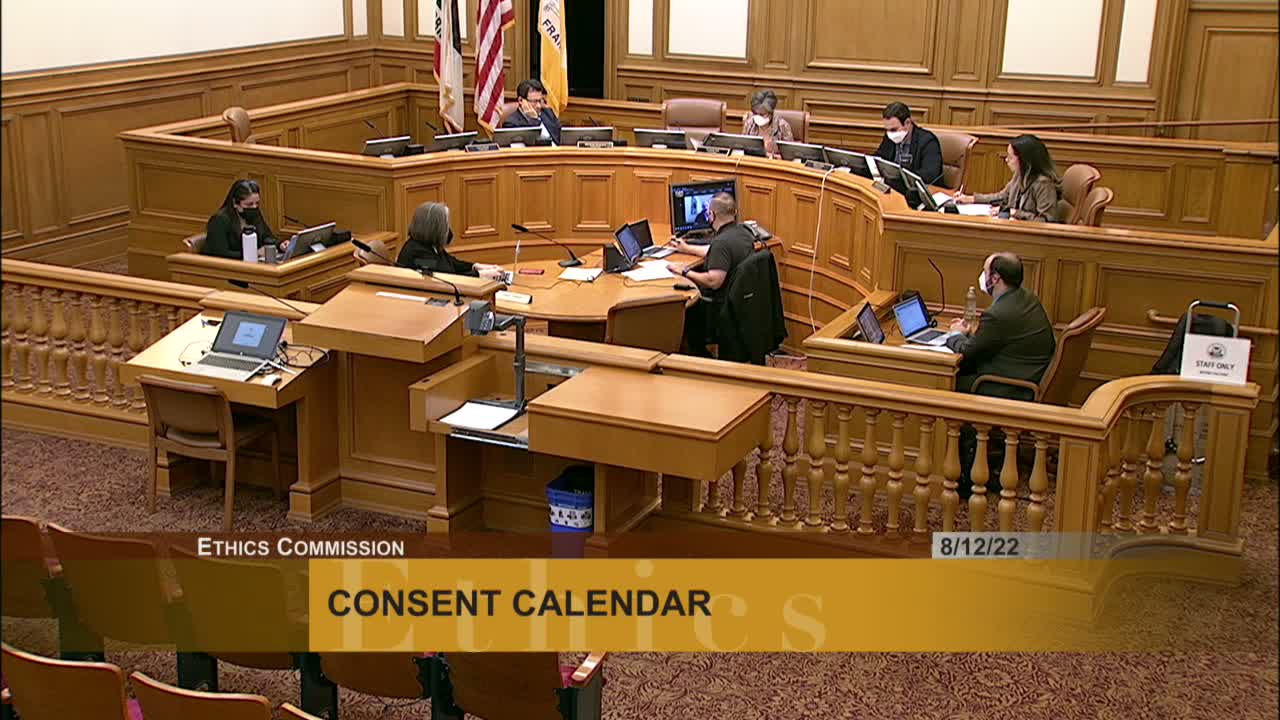
SAN FRANCISCO — The San Francisco Ethics Commission voted 3–2 on Aug. 12 to adopt amendments to the city’s behested‑payment rules and transmit them to the Board of Supervisors, concluding a months‑long negotiation among the mayor’s office, the Board and commission staff.
The adopted changes narrow the ordinance’s “attempt to influence” prong so it applies primarily in the context of city contracts and certain permits, add a de‑minimis exception of $1,000 per year for small payments, and include a limited grace period for preexisting programs such as the San Francisco Public Utilities Commission’s Social Impact Partnership (SIP) program. The commission’s vote followed extended debate about whether the narrower approach would leave gaps in coverage for legislative and budgetary advocacy.
“We went from two competing versions to the combined version,” Supervisor Aaron Peskin, author of the draft ordinance, told the commission, saying the new text reflects tripartite collaboration among his office, the mayor’s office and Ethics staff. “I commend to you the legislation as now amended per your staff’s recommendation and happy to discuss the two outstanding issues,” Peskin said during the meeting.
PUC officials urged the commission to restore a short grace period so the utility could continue to include community benefits in solicitations that were already in the procurement pipeline. “What we are proposing is that we do have a grace period…to allow our program to continue until 01/31/2023,” Ron Flynn, deputy general manager at the San Francisco Public Utilities Commission, said, adding that several large infrastructure bids are planned that require community‑benefit language in requests for proposals.
Representatives of the mayor’s office and the city attorney’s office defended the $1,000 safe harbor as an administrable compromise. “A thousand dollar safe harbor is an appropriate amount that strikes the right balance,” Hank Heckle, representing the mayor’s office, said, arguing the threshold would reduce unnecessary vetting for small charitable contributions and in‑kind donations.
Several commissioners pushed back. Commissioner Romano said limiting the “attempt to influence” prong to contracts and permits could exclude efforts to influence legislative or budgetary decisions and leave major activity unregulated. “I will not be voting for this today unless the ‘attempt to influence’ definition is tightened,” Romano said during the discussion.
Deputy City Attorney Flores read proposed non‑substantive drafting clarifications into the record, including adding administrative enforcement explicitly to the definition of “proceeding,” changing a connective word from “and” to “or” in the interested‑party definition, removing a reference to communications “via email,” and adding conforming language for contract‑related sections. Staff also proposed a carve‑out authorizing departments that ran preexisting programs on or before Jan. 23, 2022, to include those programs in competitively secured solicitations only until Jan. 31, 2023, unless extended by the Board of Supervisors.
The commission took public comment before voting. Debbie Lerman of the San Francisco Human Services Network urged approval of the amendments, saying they would mitigate harms to the city’s fundraising and program delivery that officials had described since the behested‑payment rules changed. By contrast, public commenter Charles Marsteller criticized the process for rapidly altering voter‑approved language, calling the amendment approach “a bastardization of that mechanism.”
On roll call the motion carried 3–2. Commissioners Finliff, Lee and Bush voted yes; Commissioners Flores Feng and Romano voted no. The commission’s action sends the amended ordinance to the Board of Supervisors, which — under Proposition E — must consider the commission’s transmittal and then adopt the changes by a two‑thirds supermajority vote. Staff noted that a 30‑day public‑review period is required before the Board can act, putting an initial Board committee review into October on the calendar in normal course of business.
The commission also agreed to pursue further regulatory clarifications and to continue dialogue with the supervisor’s and mayor’s offices on how the rules should treat grants, coordination with third parties and other narrow exceptions that commissioners said merit more work.
The Ethics Commission’s next meeting is scheduled for Sept. 9.
The adopted changes narrow the ordinance’s “attempt to influence” prong so it applies primarily in the context of city contracts and certain permits, add a de‑minimis exception of $1,000 per year for small payments, and include a limited grace period for preexisting programs such as the San Francisco Public Utilities Commission’s Social Impact Partnership (SIP) program. The commission’s vote followed extended debate about whether the narrower approach would leave gaps in coverage for legislative and budgetary advocacy.
“We went from two competing versions to the combined version,” Supervisor Aaron Peskin, author of the draft ordinance, told the commission, saying the new text reflects tripartite collaboration among his office, the mayor’s office and Ethics staff. “I commend to you the legislation as now amended per your staff’s recommendation and happy to discuss the two outstanding issues,” Peskin said during the meeting.
PUC officials urged the commission to restore a short grace period so the utility could continue to include community benefits in solicitations that were already in the procurement pipeline. “What we are proposing is that we do have a grace period…to allow our program to continue until 01/31/2023,” Ron Flynn, deputy general manager at the San Francisco Public Utilities Commission, said, adding that several large infrastructure bids are planned that require community‑benefit language in requests for proposals.
Representatives of the mayor’s office and the city attorney’s office defended the $1,000 safe harbor as an administrable compromise. “A thousand dollar safe harbor is an appropriate amount that strikes the right balance,” Hank Heckle, representing the mayor’s office, said, arguing the threshold would reduce unnecessary vetting for small charitable contributions and in‑kind donations.
Several commissioners pushed back. Commissioner Romano said limiting the “attempt to influence” prong to contracts and permits could exclude efforts to influence legislative or budgetary decisions and leave major activity unregulated. “I will not be voting for this today unless the ‘attempt to influence’ definition is tightened,” Romano said during the discussion.
Deputy City Attorney Flores read proposed non‑substantive drafting clarifications into the record, including adding administrative enforcement explicitly to the definition of “proceeding,” changing a connective word from “and” to “or” in the interested‑party definition, removing a reference to communications “via email,” and adding conforming language for contract‑related sections. Staff also proposed a carve‑out authorizing departments that ran preexisting programs on or before Jan. 23, 2022, to include those programs in competitively secured solicitations only until Jan. 31, 2023, unless extended by the Board of Supervisors.
The commission took public comment before voting. Debbie Lerman of the San Francisco Human Services Network urged approval of the amendments, saying they would mitigate harms to the city’s fundraising and program delivery that officials had described since the behested‑payment rules changed. By contrast, public commenter Charles Marsteller criticized the process for rapidly altering voter‑approved language, calling the amendment approach “a bastardization of that mechanism.”
On roll call the motion carried 3–2. Commissioners Finliff, Lee and Bush voted yes; Commissioners Flores Feng and Romano voted no. The commission’s action sends the amended ordinance to the Board of Supervisors, which — under Proposition E — must consider the commission’s transmittal and then adopt the changes by a two‑thirds supermajority vote. Staff noted that a 30‑day public‑review period is required before the Board can act, putting an initial Board committee review into October on the calendar in normal course of business.
The commission also agreed to pursue further regulatory clarifications and to continue dialogue with the supervisor’s and mayor’s offices on how the rules should treat grants, coordination with third parties and other narrow exceptions that commissioners said merit more work.
The Ethics Commission’s next meeting is scheduled for Sept. 9.
Don't Miss a Word: See the Full Meeting!
Go beyond summaries. Unlock every video, transcript, and key insight with a Founder Membership.
✓
Get instant access to full meeting videos
✓
Search and clip any phrase from complete transcripts
✓
Receive AI-powered summaries & custom alerts
✓
Enjoy lifetime, unrestricted access to government data
30-day money-back guarantee
