Ethics Commission moves confidential probable‑cause review to closed session amid broad public support for former environment director
January 13, 2023 | San Francisco City, San Francisco County, California
This article was created by AI summarizing key points discussed. AI makes mistakes, so for full details and context, please refer to the video of the full meeting. Please report any errors so we can fix them. Report an error »
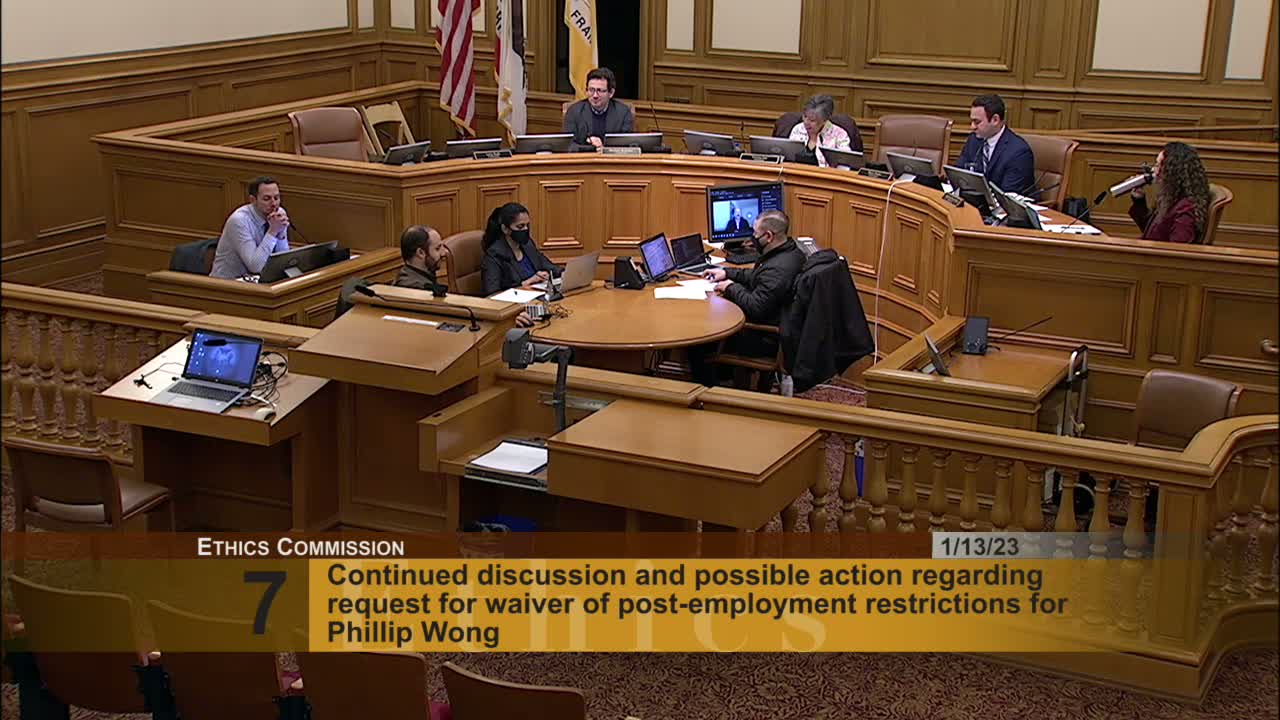
The San Francisco Ethics Commission held a public session to explain a confidential probable‑cause review under Article 3, Chapter 2 of the San Francisco Campaign and Governmental Conduct Code and then moved the matter into closed session after extensive public comment.
Chair Shirley Lee explained that the item before the commission was a request for review of an Executive Director probable‑cause determination. She described the probable‑cause process and the commission’s obligation to keep investigations confidential prior to ratification of probable cause. Chair Lee said the name(s) of any respondent(s) cannot be publicly disclosed before that determination, but that a respondent and counsel may attend and speak during the public portion as they chose.
Deputy City Attorney Bridal Russi told commissioners that the code and regulations do not supply a precise legal definition of "undue influence" for these proceedings; she said a court would likely look to the plain meaning of relevant provisions and that the commission must make a context‑specific judgment using the regulatory factors available.
After a period of legal and procedural discussion about whether members of the public could comment on a confidential matter, the commission allowed public comment. More than a dozen speakers — current and former city staff, nonprofit leaders, former state officials and other subject‑matter experts — spoke in person and by phone. Many described the respondent as a career public servant with high ethical standards, cited technical achievements and said they had seen no personal enrichment that would suggest corruption. Speakers included longtime colleagues and locally and nationally prominent environmental officials who urged the commission to weigh context, intent and the absence of financial benefit when considering potential enforcement actions.
Representative comments included:
- Ken Rich, former director of development at OEWD, who said he found the respondent "upstanding and thorough" and urged commissioners to trust her to "stay within the lines."
- Jen Jackson, a former senior manager in the Department of the Environment, who said she "watched closely" the respondent "model the art of servant leadership."
- Jared Blumenfeld, a former San Francisco environment director, who said "due process failed Debbie" and that the city should remedy the reputational harm already suffered.
Respondent counsel Gary Winnick introduced the respondent (identified in the room as Debbie Raphael in multiple public comments) and said he and co‑counsel were present and prepared to answer questions in closed session. Several speakers said the investigation had already caused reputational and professional harm and warned of a broader chilling effect on the city’s ability to recruit top environmental talent.
After hearing public comment, the commission voted to meet in closed session to review the probable‑cause matter and later announced that the item would be continued to the February meeting for further action. Back in open session the commission voted not to disclose the substance of the closed‑session deliberations, aside from any formal disclosure required about whether probable cause was ratified for each count.
What happened next: The commission recorded a vote to go into closed session and then returned to open session to continue the matter to February. In a subsequent roll call the commission approved a motion "not to disclose" closed‑session deliberations, with recorded affirmative votes and the clerk’s notation that the motion passed.
Why it matters: The case raises questions about how the Ethics Commission applies standards such as "undue influence" in post‑employment and conduct reviews, and the extensive public comment — from both local advocates and state officials — spotlighted reputational stakes for senior public servants and the potential consequences for recruitment of technical leaders.
Next steps: The Enforcement Division will carry the matter forward in closed session; the commission scheduled continuation of agenda item 8 for its February meeting and directed staff to prepare any required limited disclosures about whether probable cause was ratified.
Chair Shirley Lee explained that the item before the commission was a request for review of an Executive Director probable‑cause determination. She described the probable‑cause process and the commission’s obligation to keep investigations confidential prior to ratification of probable cause. Chair Lee said the name(s) of any respondent(s) cannot be publicly disclosed before that determination, but that a respondent and counsel may attend and speak during the public portion as they chose.
Deputy City Attorney Bridal Russi told commissioners that the code and regulations do not supply a precise legal definition of "undue influence" for these proceedings; she said a court would likely look to the plain meaning of relevant provisions and that the commission must make a context‑specific judgment using the regulatory factors available.
After a period of legal and procedural discussion about whether members of the public could comment on a confidential matter, the commission allowed public comment. More than a dozen speakers — current and former city staff, nonprofit leaders, former state officials and other subject‑matter experts — spoke in person and by phone. Many described the respondent as a career public servant with high ethical standards, cited technical achievements and said they had seen no personal enrichment that would suggest corruption. Speakers included longtime colleagues and locally and nationally prominent environmental officials who urged the commission to weigh context, intent and the absence of financial benefit when considering potential enforcement actions.
Representative comments included:
- Ken Rich, former director of development at OEWD, who said he found the respondent "upstanding and thorough" and urged commissioners to trust her to "stay within the lines."
- Jen Jackson, a former senior manager in the Department of the Environment, who said she "watched closely" the respondent "model the art of servant leadership."
- Jared Blumenfeld, a former San Francisco environment director, who said "due process failed Debbie" and that the city should remedy the reputational harm already suffered.
Respondent counsel Gary Winnick introduced the respondent (identified in the room as Debbie Raphael in multiple public comments) and said he and co‑counsel were present and prepared to answer questions in closed session. Several speakers said the investigation had already caused reputational and professional harm and warned of a broader chilling effect on the city’s ability to recruit top environmental talent.
After hearing public comment, the commission voted to meet in closed session to review the probable‑cause matter and later announced that the item would be continued to the February meeting for further action. Back in open session the commission voted not to disclose the substance of the closed‑session deliberations, aside from any formal disclosure required about whether probable cause was ratified for each count.
What happened next: The commission recorded a vote to go into closed session and then returned to open session to continue the matter to February. In a subsequent roll call the commission approved a motion "not to disclose" closed‑session deliberations, with recorded affirmative votes and the clerk’s notation that the motion passed.
Why it matters: The case raises questions about how the Ethics Commission applies standards such as "undue influence" in post‑employment and conduct reviews, and the extensive public comment — from both local advocates and state officials — spotlighted reputational stakes for senior public servants and the potential consequences for recruitment of technical leaders.
Next steps: The Enforcement Division will carry the matter forward in closed session; the commission scheduled continuation of agenda item 8 for its February meeting and directed staff to prepare any required limited disclosures about whether probable cause was ratified.
View the Full Meeting & All Its Details
This article offers just a summary. Unlock complete video, transcripts, and insights as a Founder Member.
✓
Watch full, unedited meeting videos
✓
Search every word spoken in unlimited transcripts
✓
AI summaries & real-time alerts (all government levels)
✓
Permanent access to expanding government content
30-day money-back guarantee
