San Francisco Ethics Commission warns mayoral cuts could curtail enforcement and data services
January 20, 2023 | San Francisco City, San Francisco County, California
This article was created by AI summarizing key points discussed. AI makes mistakes, so for full details and context, please refer to the video of the full meeting. Please report any errors so we can fix them. Report an error »
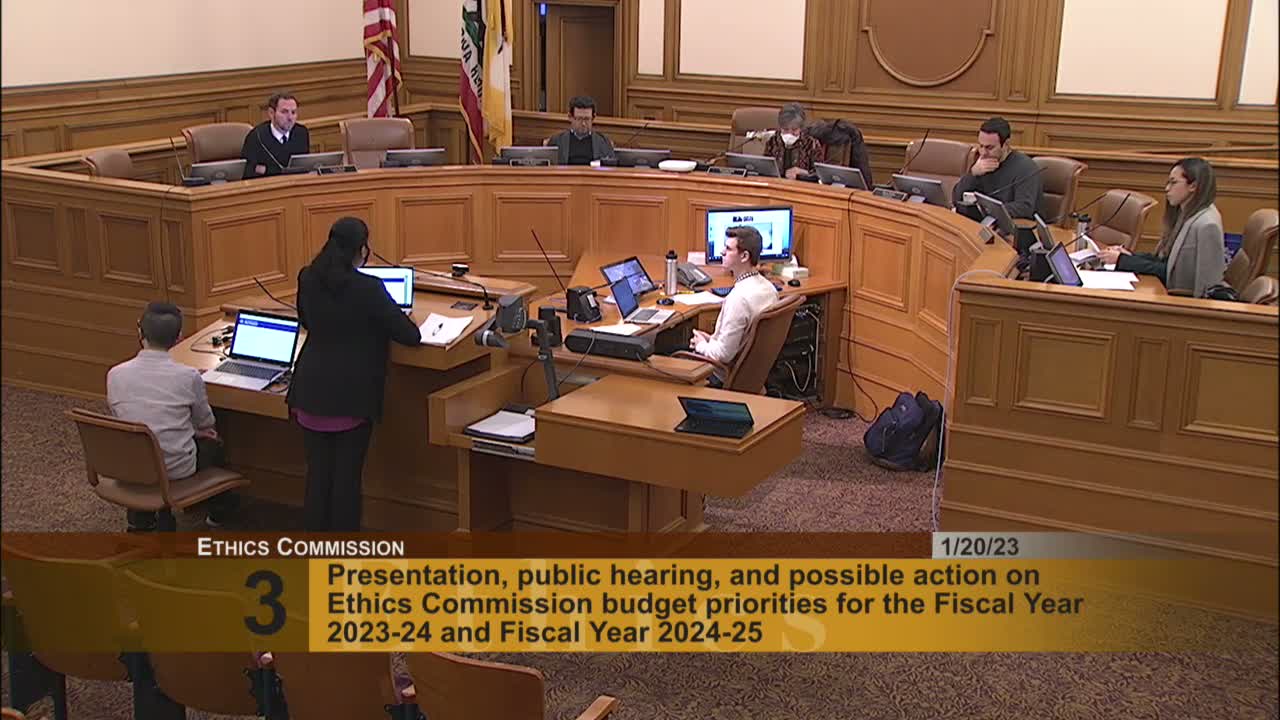
SAN FRANCISCO — The San Francisco Ethics Commission said at its Jan. 28 special meeting that mayoral-directed cuts and expiring limited‑term funding threaten core enforcement, public‑facing data tools and filer support, and asked the mayor’s office to preserve several positions and ongoing funding.
The commission’s director told commissioners the city expects roughly a $722 million deficit across the two fiscal years and that the mayor’s office has asked departments to plan for about a 5% reduction in the first year and an additional 3% in the second (8% cumulative). "The city is expecting a deficit of about $722,000,000," the director said, and staff presented a baseline operating budget for the Commission of about $7.1 million for FY23, $6.9 million for FY24 and $5.4 million for FY25.
Why it matters: Commission staff said the combination of automatic cuts and expiring funding for limited‑term positions would remove institutional capacity the department now uses to maintain campaign‑finance dashboards, an online complaint form, the city’s contract‑disclosure systems and the Commission’s new Ethics at Work training program. The director said retaining a small number of technical, enforcement and filer‑support positions is essential to preserve the Commission’s ability to provide public disclosure and timely investigations.
What staff asked for: The director outlined specific personnel requests and one‑time/ongoing technology funding. Staff asked to convert a senior IS engineer position (responsible for campaign finance dashboards and open‑data integrations) to permanent funding, to make client‑support specialist roles ongoing to support more than 5,000 filers, to reclassify one compliance officer to reflect more complex duties, and to continue funding for three senior investigator positions. Staff presented a funding request of about $474,000 for FY24 (roughly a 6.8% increase over the baseline) and roughly $2.2 million for FY25 (about a 37% increase), and estimated mayoral target cuts would require reductions of about $339,000 in the first year and $543,000 in the second year if achieved strictly by dollar amount.
Commissioner questions and staff response: Commissioners pressed staff on whether the Commission could meet the targets by relying only on expiring positions and attrition. The director said the city’s guidance emphasizes using vacancies and attrition where possible and that staff will prepare justification materials to argue that certain roles are essential to the Commission’s core functions. The director also outlined the calendar: staff will bring a proposed budget for discussion on Feb. 10, submit the formal request to the Mayor’s office by Feb. 21, and then participate in the Mayor’s compilation and the Board of Supervisors’ budget committee review in June.
Debate over revenue options and legal limits: Some commissioners proposed exploring revenue options such as raising late‑filing fines or surcharges for lobbyists and contracting for auditing work. One commissioner urged the Commission to examine whether fine schedules (for example, the late filing penalty for Form 700) were set at an adequately deterrent level. Deputy City Attorney Bridal Rusty responded that the penalty amount for late filings is set by state law (Government Code) and noted that revenue from fines and fees historically has not been directed to the Commission’s operating budget. Several commissioners said fines should be a deterrent, not a budget fix.
Public comment: David Pilfel, a caller, urged flexible staffing approaches — such as moving classifications between enforcement and audit functions or using contract resources — and recommended prioritizing website usability, PDF availability for documents, and translating key user‑facing materials. He said hybrid meetings improve participation.
Next steps: The Commission will finalize a proposed budget for its Feb. 10 meeting and submit its request into the Mayor’s budget system by Feb. 21. Commissioners asked staff to prepare a budget statement that would accompany the submission to emphasize the Commission’s limited ability to absorb automatic cuts without reducing personnel.
No formal votes or motions were taken at the special meeting; the Commission closed public comment, scheduled further discussion for Feb. 10 and adjourned.
The commission’s director told commissioners the city expects roughly a $722 million deficit across the two fiscal years and that the mayor’s office has asked departments to plan for about a 5% reduction in the first year and an additional 3% in the second (8% cumulative). "The city is expecting a deficit of about $722,000,000," the director said, and staff presented a baseline operating budget for the Commission of about $7.1 million for FY23, $6.9 million for FY24 and $5.4 million for FY25.
Why it matters: Commission staff said the combination of automatic cuts and expiring funding for limited‑term positions would remove institutional capacity the department now uses to maintain campaign‑finance dashboards, an online complaint form, the city’s contract‑disclosure systems and the Commission’s new Ethics at Work training program. The director said retaining a small number of technical, enforcement and filer‑support positions is essential to preserve the Commission’s ability to provide public disclosure and timely investigations.
What staff asked for: The director outlined specific personnel requests and one‑time/ongoing technology funding. Staff asked to convert a senior IS engineer position (responsible for campaign finance dashboards and open‑data integrations) to permanent funding, to make client‑support specialist roles ongoing to support more than 5,000 filers, to reclassify one compliance officer to reflect more complex duties, and to continue funding for three senior investigator positions. Staff presented a funding request of about $474,000 for FY24 (roughly a 6.8% increase over the baseline) and roughly $2.2 million for FY25 (about a 37% increase), and estimated mayoral target cuts would require reductions of about $339,000 in the first year and $543,000 in the second year if achieved strictly by dollar amount.
Commissioner questions and staff response: Commissioners pressed staff on whether the Commission could meet the targets by relying only on expiring positions and attrition. The director said the city’s guidance emphasizes using vacancies and attrition where possible and that staff will prepare justification materials to argue that certain roles are essential to the Commission’s core functions. The director also outlined the calendar: staff will bring a proposed budget for discussion on Feb. 10, submit the formal request to the Mayor’s office by Feb. 21, and then participate in the Mayor’s compilation and the Board of Supervisors’ budget committee review in June.
Debate over revenue options and legal limits: Some commissioners proposed exploring revenue options such as raising late‑filing fines or surcharges for lobbyists and contracting for auditing work. One commissioner urged the Commission to examine whether fine schedules (for example, the late filing penalty for Form 700) were set at an adequately deterrent level. Deputy City Attorney Bridal Rusty responded that the penalty amount for late filings is set by state law (Government Code) and noted that revenue from fines and fees historically has not been directed to the Commission’s operating budget. Several commissioners said fines should be a deterrent, not a budget fix.
Public comment: David Pilfel, a caller, urged flexible staffing approaches — such as moving classifications between enforcement and audit functions or using contract resources — and recommended prioritizing website usability, PDF availability for documents, and translating key user‑facing materials. He said hybrid meetings improve participation.
Next steps: The Commission will finalize a proposed budget for its Feb. 10 meeting and submit its request into the Mayor’s budget system by Feb. 21. Commissioners asked staff to prepare a budget statement that would accompany the submission to emphasize the Commission’s limited ability to absorb automatic cuts without reducing personnel.
No formal votes or motions were taken at the special meeting; the Commission closed public comment, scheduled further discussion for Feb. 10 and adjourned.
Don't Miss a Word: See the Full Meeting!
Go beyond summaries. Unlock every video, transcript, and key insight with a Founder Membership.
✓
Get instant access to full meeting videos
✓
Search and clip any phrase from complete transcripts
✓
Receive AI-powered summaries & custom alerts
✓
Enjoy lifetime, unrestricted access to government data
30-day money-back guarantee
