Ethics commission approves ballot measure to tighten gifts, training and conflicts rules for March 2024 ballot
August 18, 2023 | San Francisco City, San Francisco County, California
This article was created by AI summarizing key points discussed. AI makes mistakes, so for full details and context, please refer to the video of the full meeting. Please report any errors so we can fix them. Report an error »
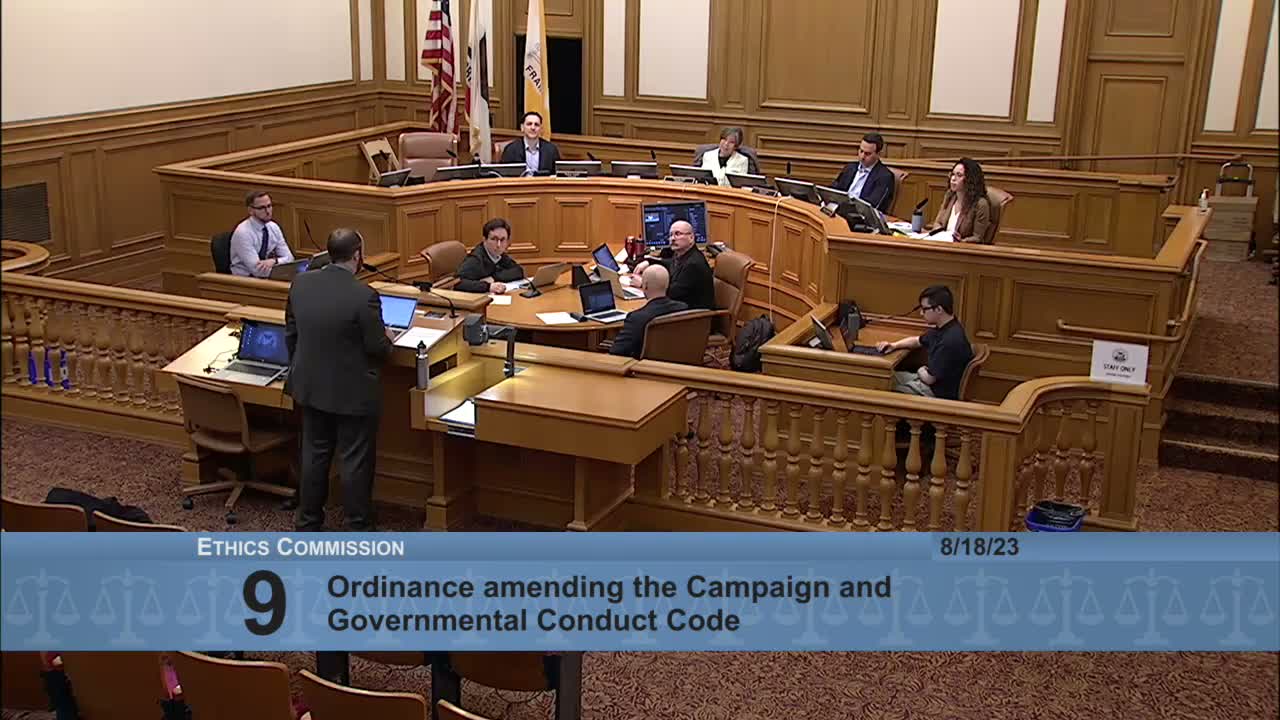
The San Francisco Ethics Commission on Aug. 18 voted unanimously to place a proposed ordinance and regulation package on the March 5, 2024 ballot that would tighten city ethics rules on gifts, require broader ethics training and change how some ethics-code amendments are approved.
The measure — the culmination of a multiyear project staff described as the commission’s top policy priority — would strengthen the city’s restricted‑source rule for gifts, expand annual ethics training requirements to Form 700 filers, codify department-level incompatibility rules into a uniform standard and require supermajority approval by both the Board of Supervisors and the Ethics Commission for some future ethics‑code changes. Acting policy and legislative affairs manager Michael Kenny told commissioners the proposals grew from a three‑phase review started after local corruption allegations surfaced in 2020 and that staff had repeatedly revised the draft based on stakeholder feedback and meet‑and‑confer bargaining over the past year.
The discussion turned on one provision—section 3.218—which the Department of Public Health (DPH) and nonprofit providers said could be read to prohibit many forms of dual employment or board service by city employees who also work for organizations that contract with their department. DPH officials warned that, as drafted, the rule could capture nurses and other frontline staff who hold part‑time jobs or volunteer roles. Several nonprofit speakers, including Debbie Lerman of the San Francisco Human Services Network, said the language risked harming lower‑paid workers and nonprofit program capacity.
To respond, staff recommended two narrow changes: limit the rule so it applies only to individuals who are required to file a Form 700 (the city’s economic‑interest disclosure), and clarify that employment with another government entity (federal, state or local) is not a ‘‘financial interest’’ for purposes of the provision. Commissioners ultimately adopted a further amendment at the meeting that removed the phrase "having a financial interest in" from the section in two places — a targeted edit staff and the city attorney’s office said could be done immediately and would reduce the provision’s scope. Chair Lee moved to place the amended measure on the ballot and also to adopt the proposed regulation changes; the motion passed on a 4–0 roll‑call vote.
Kenny told commissioners that even if voters approve the measure next year, implementation would not be immediate: the commission would have more than a year to write additional regulations and work with departments and bargaining units to resolve technical issues before the ordinance would become operative.
What happens next: the commission will transmit the ballot measure to the Department of Elections by the December 1 drop‑dead deadline for the March ballot. Staff also said the commission can pursue targeted regulatory clarifications or separate legislation to address any remaining concerns before the rules take effect.
Authorities cited in the meeting included the San Francisco Campaign and Governmental Conduct Code (sections referenced in the staff memo) and Charter Section 15.102, which the commission cited for its regulatory authority. The commission recorded no opposition votes on the motion to place the measure on the ballot.
The commission’s action leaves open further rule‑making and policy work: staff and commissioners repeatedly said they expect to continue stakeholder engagement, produce clarifying regulations and, if needed, work with the Board of Supervisors on legislative fixes prior to the measure becoming operative.
The measure — the culmination of a multiyear project staff described as the commission’s top policy priority — would strengthen the city’s restricted‑source rule for gifts, expand annual ethics training requirements to Form 700 filers, codify department-level incompatibility rules into a uniform standard and require supermajority approval by both the Board of Supervisors and the Ethics Commission for some future ethics‑code changes. Acting policy and legislative affairs manager Michael Kenny told commissioners the proposals grew from a three‑phase review started after local corruption allegations surfaced in 2020 and that staff had repeatedly revised the draft based on stakeholder feedback and meet‑and‑confer bargaining over the past year.
The discussion turned on one provision—section 3.218—which the Department of Public Health (DPH) and nonprofit providers said could be read to prohibit many forms of dual employment or board service by city employees who also work for organizations that contract with their department. DPH officials warned that, as drafted, the rule could capture nurses and other frontline staff who hold part‑time jobs or volunteer roles. Several nonprofit speakers, including Debbie Lerman of the San Francisco Human Services Network, said the language risked harming lower‑paid workers and nonprofit program capacity.
To respond, staff recommended two narrow changes: limit the rule so it applies only to individuals who are required to file a Form 700 (the city’s economic‑interest disclosure), and clarify that employment with another government entity (federal, state or local) is not a ‘‘financial interest’’ for purposes of the provision. Commissioners ultimately adopted a further amendment at the meeting that removed the phrase "having a financial interest in" from the section in two places — a targeted edit staff and the city attorney’s office said could be done immediately and would reduce the provision’s scope. Chair Lee moved to place the amended measure on the ballot and also to adopt the proposed regulation changes; the motion passed on a 4–0 roll‑call vote.
Kenny told commissioners that even if voters approve the measure next year, implementation would not be immediate: the commission would have more than a year to write additional regulations and work with departments and bargaining units to resolve technical issues before the ordinance would become operative.
What happens next: the commission will transmit the ballot measure to the Department of Elections by the December 1 drop‑dead deadline for the March ballot. Staff also said the commission can pursue targeted regulatory clarifications or separate legislation to address any remaining concerns before the rules take effect.
Authorities cited in the meeting included the San Francisco Campaign and Governmental Conduct Code (sections referenced in the staff memo) and Charter Section 15.102, which the commission cited for its regulatory authority. The commission recorded no opposition votes on the motion to place the measure on the ballot.
The commission’s action leaves open further rule‑making and policy work: staff and commissioners repeatedly said they expect to continue stakeholder engagement, produce clarifying regulations and, if needed, work with the Board of Supervisors on legislative fixes prior to the measure becoming operative.
Don't Miss a Word: See the Full Meeting!
Go beyond summaries. Unlock every video, transcript, and key insight with a Founder Membership.
✓
Get instant access to full meeting videos
✓
Search and clip any phrase from complete transcripts
✓
Receive AI-powered summaries & custom alerts
✓
Enjoy lifetime, unrestricted access to government data
30-day money-back guarantee
