Enforcement division outlines campaign-finance priorities and enforcement tools ahead of 2024 elections
September 08, 2023 | San Francisco City, San Francisco County, California
This article was created by AI summarizing key points discussed. AI makes mistakes, so for full details and context, please refer to the video of the full meeting. Please report any errors so we can fix them. Report an error »
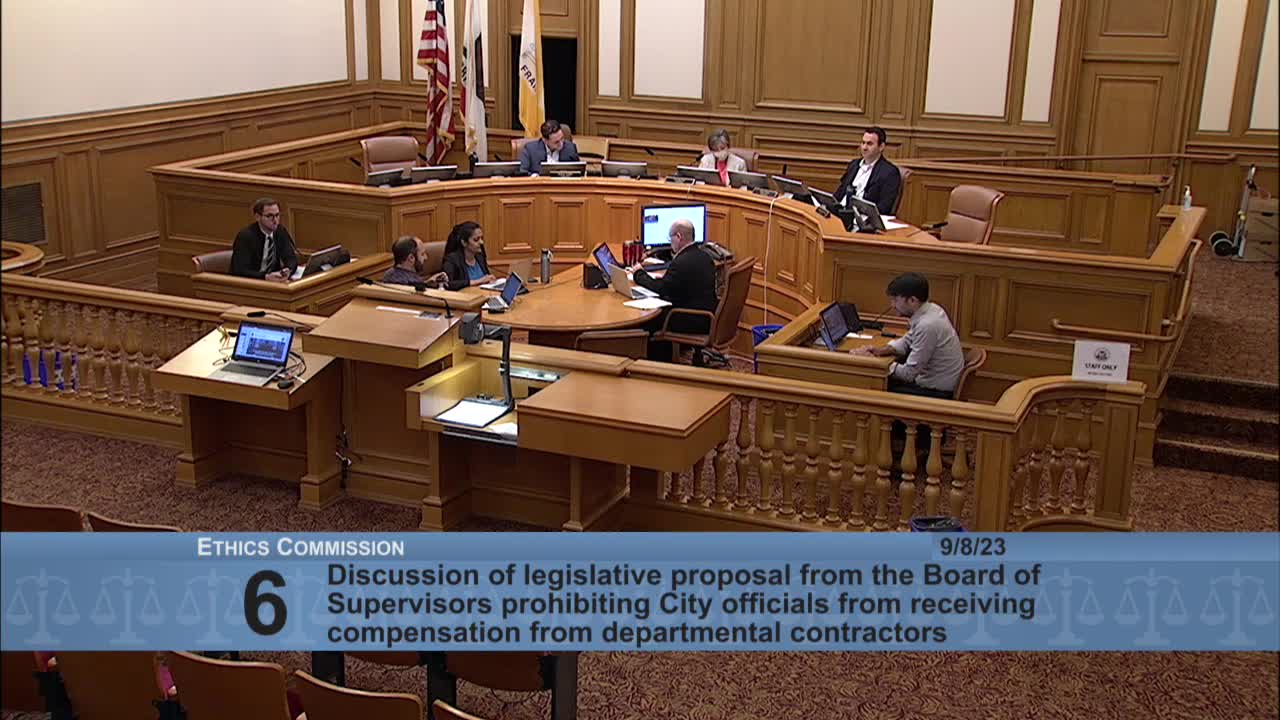
San Francisco’s Ethics Commission received a 15-minute overview from the enforcement division on Sept. 8 about campaign finance rules and enforcement priorities ahead of a busy 2024 election year.
"Over the last several years, the division has taken on, we think, more wide ranging campaign finance cases to better achieve some of the policy goals underlying those laws, including public access to information and avoidance of undue influence," Senior Investigator Zach Damico said. He outlined key formation thresholds: a recipient committee is formed when it receives $2,000 in a year, an independent-expenditure committee forms at $1,000, and a major donor committee at $10,000.
Damico reviewed reporting obligations (semiannual and pre-election statements, late reports within 24 hours for large near-election contributions), jurisdiction rules (a general-purpose committee falls under the city’s jurisdiction if more than 70% of activity targets San Francisco, using either a 24-month test or a current-period test), and the five-factor coordination tests that can convert an independent expenditure into a contribution. He illustrated enforcement using local and out-of-area examples, including a recent stipulation involving Progress San Francisco and a San Francisco Bicycle Coalition case that required committee reporting.
He also described how investigators identify assumed-name contributions—where a donor’s contribution is paid or reimbursed by another person or entity—which the city treats as a prohibited practice and enforces as a knowing attempt to subvert contribution limits.
Commissioners asked about lobbying vs. political activity distinctions, possible data tools to detect contractor-linked contribution laundering, and whether staff could present on lobbying and social-media slate-mail tactics in future meetings. Damico said staff currently relies on manual review and red-flag indicators but is open to automated triggers and said staff will post the slide deck to the commission website.
"Over the last several years, the division has taken on, we think, more wide ranging campaign finance cases to better achieve some of the policy goals underlying those laws, including public access to information and avoidance of undue influence," Senior Investigator Zach Damico said. He outlined key formation thresholds: a recipient committee is formed when it receives $2,000 in a year, an independent-expenditure committee forms at $1,000, and a major donor committee at $10,000.
Damico reviewed reporting obligations (semiannual and pre-election statements, late reports within 24 hours for large near-election contributions), jurisdiction rules (a general-purpose committee falls under the city’s jurisdiction if more than 70% of activity targets San Francisco, using either a 24-month test or a current-period test), and the five-factor coordination tests that can convert an independent expenditure into a contribution. He illustrated enforcement using local and out-of-area examples, including a recent stipulation involving Progress San Francisco and a San Francisco Bicycle Coalition case that required committee reporting.
He also described how investigators identify assumed-name contributions—where a donor’s contribution is paid or reimbursed by another person or entity—which the city treats as a prohibited practice and enforces as a knowing attempt to subvert contribution limits.
Commissioners asked about lobbying vs. political activity distinctions, possible data tools to detect contractor-linked contribution laundering, and whether staff could present on lobbying and social-media slate-mail tactics in future meetings. Damico said staff currently relies on manual review and red-flag indicators but is open to automated triggers and said staff will post the slide deck to the commission website.
View the Full Meeting & All Its Details
This article offers just a summary. Unlock complete video, transcripts, and insights as a Founder Member.
✓
Watch full, unedited meeting videos
✓
Search every word spoken in unlimited transcripts
✓
AI summaries & real-time alerts (all government levels)
✓
Permanent access to expanding government content
30-day money-back guarantee
