Ethics staff outlines San Francisco's lobbyist registration and reporting rules; explains thresholds and filing cadence
March 22, 2024 | San Francisco City, San Francisco County, California
This article was created by AI summarizing key points discussed. AI makes mistakes, so for full details and context, please refer to the video of the full meeting. Please report any errors so we can fix them. Report an error »
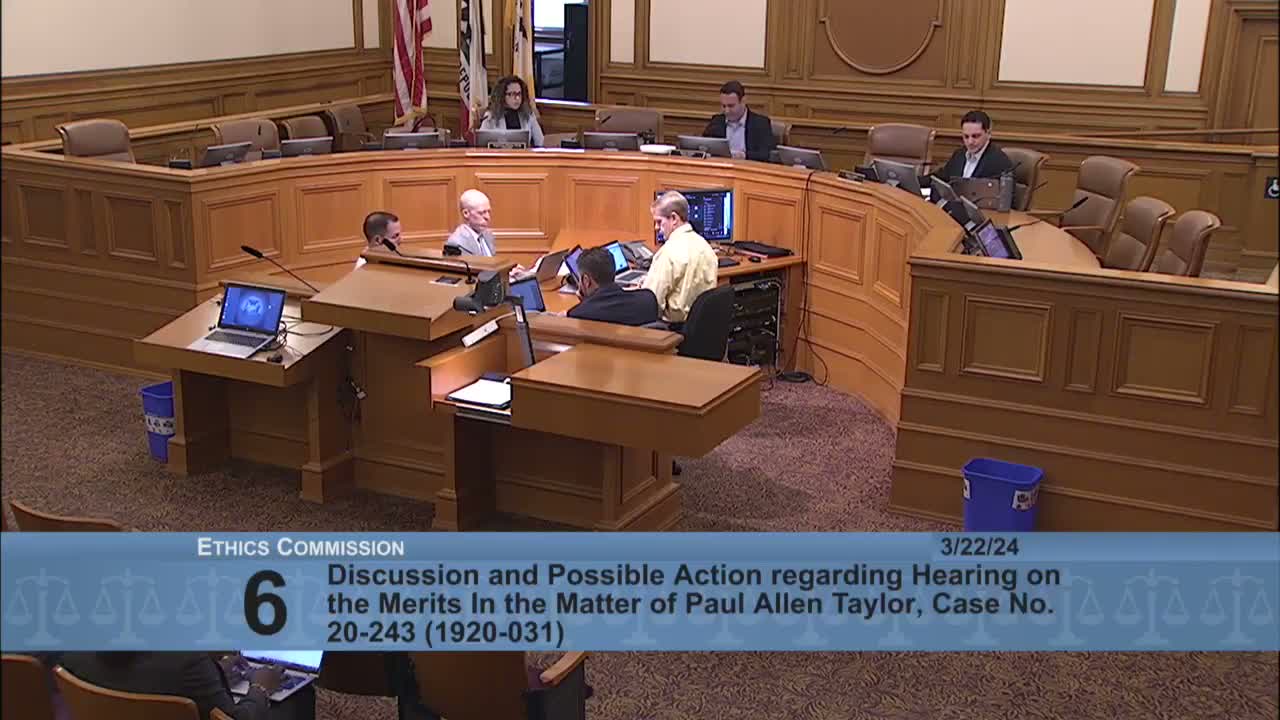
John Kim, Senior Program Administrator in the Engagement & Compliance Division, presented an informational overview March 22 of San Francisco's lobbyist ordinance and the division's filing and disclosure practices.
Kim summarized who qualifies as a contact lobbyist (in-house: five contacts on behalf of an employer in a calendar month; client-based: one contact; and expenditure lobbyists where spending $2,500 to solicit others to communicate with city officers triggers reporting). He explained the ordinance's broad definitions of "contact" and "economic consideration," and noted certain exemptions (owners with 20%+ ownership, some nonprofit representatives and public officials acting within salaried duties).
Kim described filing obligations: a registration statement due within five days of qualification and monthly statements due on the 15th. Monthly statements must disclose who was contacted, which officials were targeted, dates, and any economic consideration; expenditure lobbyists must itemize payments of $1,000 or more.
Program statistics Kim provided showed roughly 220–250 registered lobbyists annually, 180–210 active lobbyists per month, about 50 new lobbyists per year, 2,300 monthly reports annually with 98% filed on time, and an average annual disclosed economic consideration around $12,000,000. He also described updated guidance materials, fact sheets and trainings staff provide to support compliance.
In Q&A, commissioners asked where advocacy by public officials ends and lobbying begins. Kim explained the distinction hinges on economic consideration and noted that Proposition D added further restrictions on public officials lobbying; if payment or other economic consideration is involved, the communication may qualify as lobbying even when the speaker is a government employee.
The commission took no action on the presentation; staff said they will provide guidance and training materials and can return with additional data if requested.
Kim summarized who qualifies as a contact lobbyist (in-house: five contacts on behalf of an employer in a calendar month; client-based: one contact; and expenditure lobbyists where spending $2,500 to solicit others to communicate with city officers triggers reporting). He explained the ordinance's broad definitions of "contact" and "economic consideration," and noted certain exemptions (owners with 20%+ ownership, some nonprofit representatives and public officials acting within salaried duties).
Kim described filing obligations: a registration statement due within five days of qualification and monthly statements due on the 15th. Monthly statements must disclose who was contacted, which officials were targeted, dates, and any economic consideration; expenditure lobbyists must itemize payments of $1,000 or more.
Program statistics Kim provided showed roughly 220–250 registered lobbyists annually, 180–210 active lobbyists per month, about 50 new lobbyists per year, 2,300 monthly reports annually with 98% filed on time, and an average annual disclosed economic consideration around $12,000,000. He also described updated guidance materials, fact sheets and trainings staff provide to support compliance.
In Q&A, commissioners asked where advocacy by public officials ends and lobbying begins. Kim explained the distinction hinges on economic consideration and noted that Proposition D added further restrictions on public officials lobbying; if payment or other economic consideration is involved, the communication may qualify as lobbying even when the speaker is a government employee.
The commission took no action on the presentation; staff said they will provide guidance and training materials and can return with additional data if requested.
Don't Miss a Word: See the Full Meeting!
Go beyond summaries. Unlock every video, transcript, and key insight with a Founder Membership.
✓
Get instant access to full meeting videos
✓
Search and clip any phrase from complete transcripts
✓
Receive AI-powered summaries & custom alerts
✓
Enjoy lifetime, unrestricted access to government data
30-day money-back guarantee
