Commission advances Mayor's EV charging ordinance to ease permitting for public chargers
March 22, 2022 | San Francisco City, San Francisco County, California
This article was created by AI summarizing key points discussed. AI makes mistakes, so for full details and context, please refer to the video of the full meeting. Please report any errors so we can fix them. Report an error »
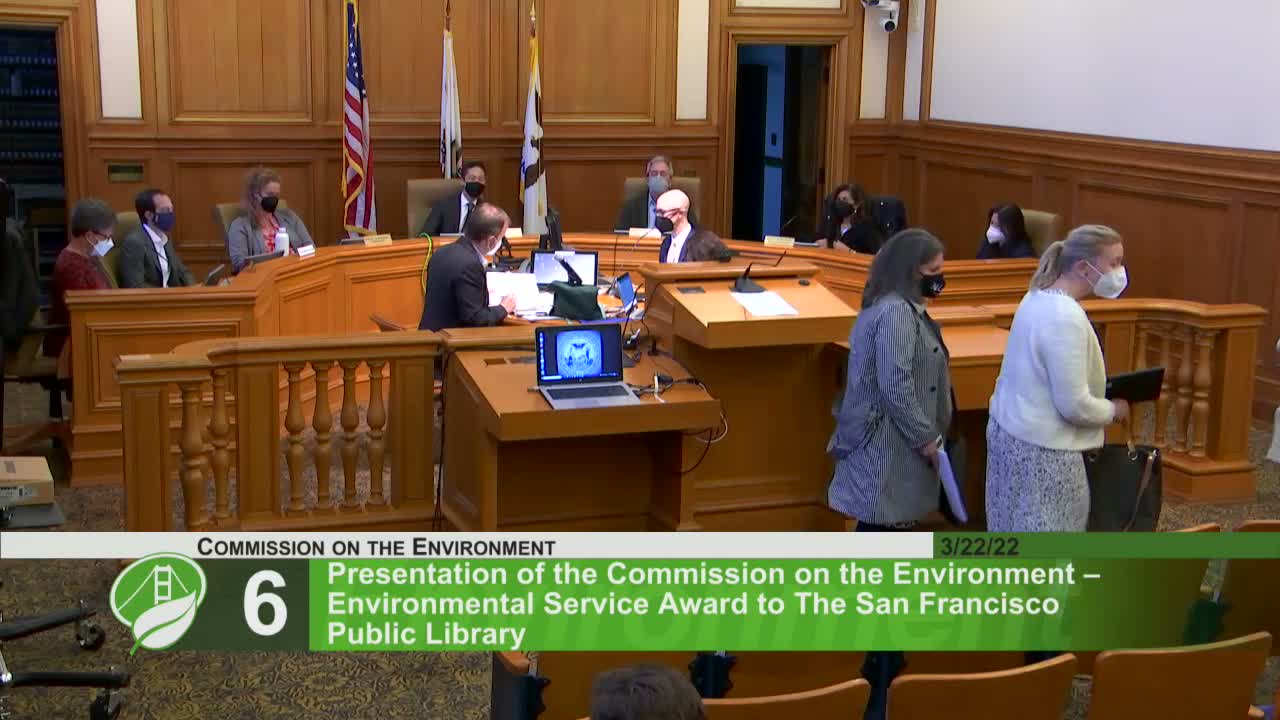
The San Francisco Commission on the Environment voted March 22 to advance mayoral legislation designed to make it easier to build public electric vehicle charging stations across the city.
Sarah Owens, Mayor Breed's environmental policy adviser, told commissioners the ordinance updates the planning code to create explicit, modern land-use pathways for stand-alone EV charging locations and to allow certain existing auto-oriented uses to convert to charging sites by right. Owens said San Francisco needs "1,400 public level 2 and 350 DC fast chargers by 2030" and that the proposal would reduce permitting delays that currently force developers to use planning rules written for gas stations.
The measure would: create zoning categories for stand-alone EV charging locations, allow conversions of existing parking lots, garages and gas stations in certain districts without discretionary review, and define fleet charging (up to one-third of a public charging location) while limiting principal-use fleet facilities citywide. Owens said the ordinance is expected to go to the Planning Commission on March 24 before land-use committee hearings and full Board of Supervisors consideration; it would take effect 30 days after the mayor signs it.
Commissioners pressed staff on how much of the city is zoned for PDR (production, distribution, repair) uses and whether that alone would be sufficient to host chargers. Aaron Starr, speaking for planning, said PDR covers about 5% of the city but noted many auto-oriented uses (garages, lots, service stations) are distributed citywide and could convert under the new code. Lowell Chu of the Department of the Environment added that individual EV plugs can also be installed as accessory uses to other primary uses and that the ordinance is meant to clarify "gas-station-like" EV locations rather than block smaller deployments.
Several commissioners expressed support for the measure as an important step toward the city's climate goals and equitable access to charging. Commissioner Wald moved to advance the resolution recommending the ordinance and Vice President Stevenson seconded. The commission took a roll-call vote and the motion passed unanimously.
Next steps: the ordinance will be reviewed by the Planning Commission and then by the Board of Supervisors; if approved and signed, it would take effect 30 days after signature.
Sarah Owens, Mayor Breed's environmental policy adviser, told commissioners the ordinance updates the planning code to create explicit, modern land-use pathways for stand-alone EV charging locations and to allow certain existing auto-oriented uses to convert to charging sites by right. Owens said San Francisco needs "1,400 public level 2 and 350 DC fast chargers by 2030" and that the proposal would reduce permitting delays that currently force developers to use planning rules written for gas stations.
The measure would: create zoning categories for stand-alone EV charging locations, allow conversions of existing parking lots, garages and gas stations in certain districts without discretionary review, and define fleet charging (up to one-third of a public charging location) while limiting principal-use fleet facilities citywide. Owens said the ordinance is expected to go to the Planning Commission on March 24 before land-use committee hearings and full Board of Supervisors consideration; it would take effect 30 days after the mayor signs it.
Commissioners pressed staff on how much of the city is zoned for PDR (production, distribution, repair) uses and whether that alone would be sufficient to host chargers. Aaron Starr, speaking for planning, said PDR covers about 5% of the city but noted many auto-oriented uses (garages, lots, service stations) are distributed citywide and could convert under the new code. Lowell Chu of the Department of the Environment added that individual EV plugs can also be installed as accessory uses to other primary uses and that the ordinance is meant to clarify "gas-station-like" EV locations rather than block smaller deployments.
Several commissioners expressed support for the measure as an important step toward the city's climate goals and equitable access to charging. Commissioner Wald moved to advance the resolution recommending the ordinance and Vice President Stevenson seconded. The commission took a roll-call vote and the motion passed unanimously.
Next steps: the ordinance will be reviewed by the Planning Commission and then by the Board of Supervisors; if approved and signed, it would take effect 30 days after signature.
View the Full Meeting & All Its Details
This article offers just a summary. Unlock complete video, transcripts, and insights as a Founder Member.
✓
Watch full, unedited meeting videos
✓
Search every word spoken in unlimited transcripts
✓
AI summaries & real-time alerts (all government levels)
✓
Permanent access to expanding government content
30-day money-back guarantee
