San Francisco environment staff outline progress, gaps in implementing 2021 Climate Action Plan
July 26, 2022 | San Francisco City, San Francisco County, California
This article was created by AI summarizing key points discussed. AI makes mistakes, so for full details and context, please refer to the video of the full meeting. Please report any errors so we can fix them. Report an error »
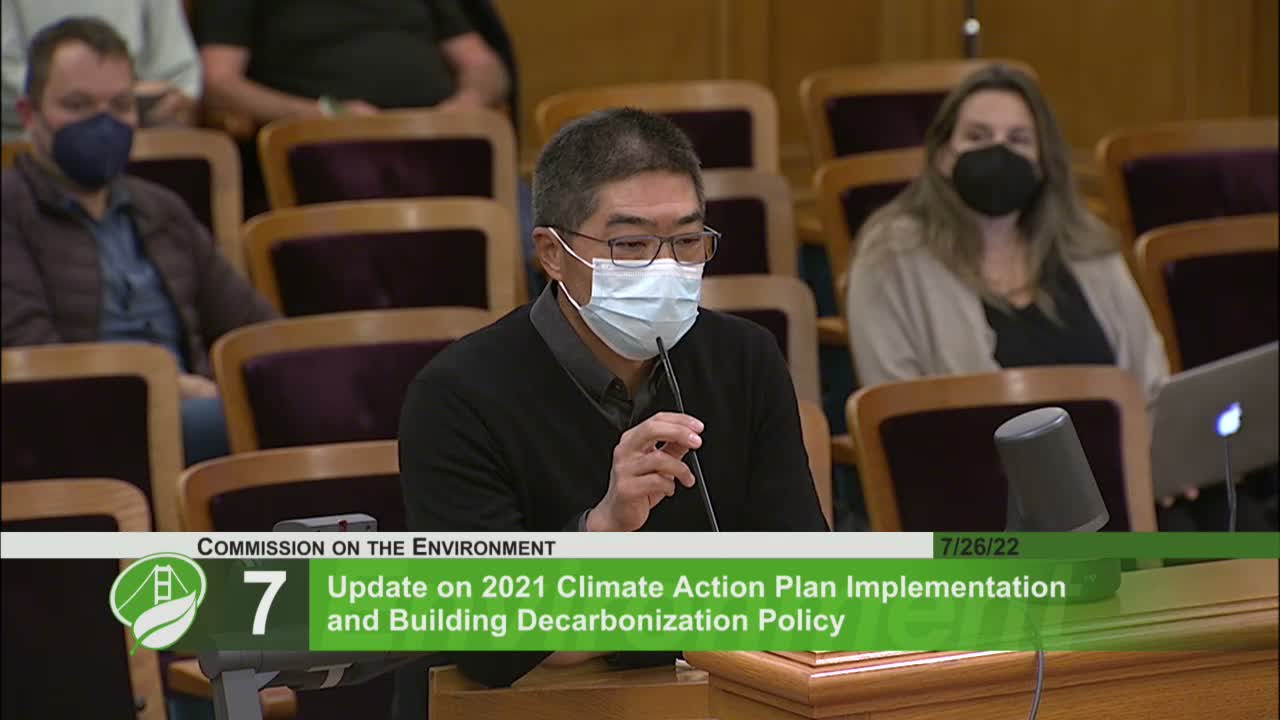
Department of the Environment staff presented an update on implementation of the 2021 Climate Action Plan and a detailed briefing on building‑decarbonization policies at the July 26 commission meeting.
Rich Chen, senior environmental specialist, said departments have provided implementation updates and the City will launch a public-facing dashboard and a year-long outreach campaign. "About 40% of the total actions are on track," he said, while noting many actions are long term and ownership across departments still needs to be clarified.
Climate program manager Cindy Comerford gave a focused presentation on building policies. She said San Francisco has already adopted a net‑zero requirement for new construction and that the department is now considering how to cover major renovations. For existing residential buildings, Comerford described two approaches under active consideration: a time‑of‑replacement pathway (replace gas appliances with electric when they reach end of life) and updates to the residential energy conservation ordinance to require electrification‑oriented measures at point‑of‑sale. For larger commercial properties she said a building performance standard—setting a target date for eliminating natural gas use and interim greenhouse‑gas performance thresholds—may be appropriate.
Comerford also described the proposed Climate Equity Hub, a one‑stop council to support residential electrification and direct subsidies and technical assistance to vulnerable communities. She said the department is completing technical and economic studies to inform policy design and emphasized workforce development and tenant protections as cross‑cutting needs.
Commissioners pressed staff on implementation details. Commissioner Sullivan asked about heat pumps; Comerford replied that heat pumps for space conditioning and water heating are a key strategy and identified rebates available through regional programs and planned fact sheets and permitting streamlining. Vice President Stevenson raised electrical‑capacity constraints and asked whether "district‑scale electrification" could reduce PG&E upgrade costs; Comerford said the department is exploring neighborhood‑scale approaches and conversations with PG&E and public‑works staff are underway to expedite permitting.
Multiple public commenters described home installations, noise concerns from heat‑pump outdoor equipment, and the potential role of district thermal systems and smart panels. Staff said a long‑term funding study—commissioned last year—will report in September and will inform funding strategies (including state, regional and potential local measures) for implementing the plan.
The department said it expects to launch its outreach website (sfclimateaction.org) and related materials by around September and will roll the outreach campaign beginning with building‑operations topics. The presentation emphasized that the add‑back funding recently approved by the Board of Supervisors will accelerate outreach and staffing but is not a long‑term funding solution.
Next steps: staff will continue technical analysis, convene sector technical working groups, and return to the Commission with further policy details and reporting tools.
Rich Chen, senior environmental specialist, said departments have provided implementation updates and the City will launch a public-facing dashboard and a year-long outreach campaign. "About 40% of the total actions are on track," he said, while noting many actions are long term and ownership across departments still needs to be clarified.
Climate program manager Cindy Comerford gave a focused presentation on building policies. She said San Francisco has already adopted a net‑zero requirement for new construction and that the department is now considering how to cover major renovations. For existing residential buildings, Comerford described two approaches under active consideration: a time‑of‑replacement pathway (replace gas appliances with electric when they reach end of life) and updates to the residential energy conservation ordinance to require electrification‑oriented measures at point‑of‑sale. For larger commercial properties she said a building performance standard—setting a target date for eliminating natural gas use and interim greenhouse‑gas performance thresholds—may be appropriate.
Comerford also described the proposed Climate Equity Hub, a one‑stop council to support residential electrification and direct subsidies and technical assistance to vulnerable communities. She said the department is completing technical and economic studies to inform policy design and emphasized workforce development and tenant protections as cross‑cutting needs.
Commissioners pressed staff on implementation details. Commissioner Sullivan asked about heat pumps; Comerford replied that heat pumps for space conditioning and water heating are a key strategy and identified rebates available through regional programs and planned fact sheets and permitting streamlining. Vice President Stevenson raised electrical‑capacity constraints and asked whether "district‑scale electrification" could reduce PG&E upgrade costs; Comerford said the department is exploring neighborhood‑scale approaches and conversations with PG&E and public‑works staff are underway to expedite permitting.
Multiple public commenters described home installations, noise concerns from heat‑pump outdoor equipment, and the potential role of district thermal systems and smart panels. Staff said a long‑term funding study—commissioned last year—will report in September and will inform funding strategies (including state, regional and potential local measures) for implementing the plan.
The department said it expects to launch its outreach website (sfclimateaction.org) and related materials by around September and will roll the outreach campaign beginning with building‑operations topics. The presentation emphasized that the add‑back funding recently approved by the Board of Supervisors will accelerate outreach and staffing but is not a long‑term funding solution.
Next steps: staff will continue technical analysis, convene sector technical working groups, and return to the Commission with further policy details and reporting tools.
View the Full Meeting & All Its Details
This article offers just a summary. Unlock complete video, transcripts, and insights as a Founder Member.
✓
Watch full, unedited meeting videos
✓
Search every word spoken in unlimited transcripts
✓
AI summaries & real-time alerts (all government levels)
✓
Permanent access to expanding government content
30-day money-back guarantee
