Planning Department presents Environmental Justice Framework and local EJ communities map
February 07, 2023 | San Francisco City, San Francisco County, California
This article was created by AI summarizing key points discussed. AI makes mistakes, so for full details and context, please refer to the video of the full meeting. Please report any errors so we can fix them. Report an error »
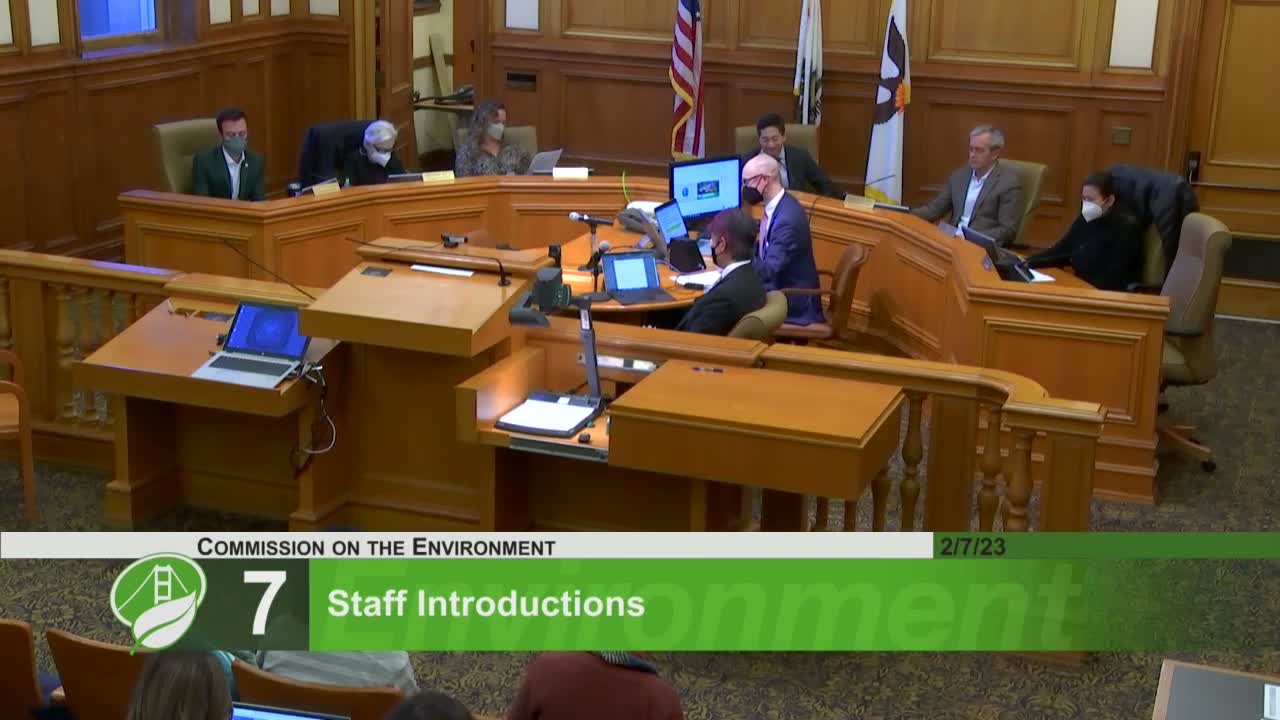
Lisa Chen and Danielle Goh of the Planning Department presented the proposed Environmental Justice (EJ) Framework to the San Francisco Commission on the Environment on Feb. 7, describing it as the city's first citywide policy to guide environmental justice work across agencies.
The presentation said the framework is structured to meet SB 1000, a 2016 state law that requires municipalities to analyze and plan for disadvantaged communities. The department used CalEnviroScreen as a starting point and added local layers—household income, DPH air-pollution data and DPH vulnerability indicators—to create a higher-resolution EJ communities map that staff said captures the city's top 30% of urgent areas. The map, the presenters said, identifies neighborhoods such as Bayview Hunters Point, Chinatown, the Tenderloin, SoMa, the Mission, Treasure Island and the Western Addition as priority areas.
Danielle Goh described an extensive two‑year community engagement process that included youth engagement, an eight-month EJ working group and more than 50 workshops; staff said the working group reached unanimous consensus on a 28‑page set of draft recommendations now posted online as supplemental materials. Lisa Chen said the framework will be incorporated by reference into the General Plan introduction and layered through future element updates, including the transportation element scheduled for 2025.
Commissioners asked for clarification about the General Plan's role and update cadence; staff said the housing element is updated on an eight‑year cycle while other elements are updated as needed and that this would be the first time an EJ component is formally incorporated into the plan. Vice President Stevenson and others recommended coordinating with state agencies to share the locally refined map and data—staff said they plan to engage with CalEPA/OEHHA on future CalEnviroScreen updates once the map is finalized.
Staff said the EJ Framework and map are scheduled for adoption hearings at the Planning Commission on March 2, with Board of Supervisors hearings to follow in April and May. Staff invited commissioners to submit feedback and to reach out directly for follow-up questions.
The Commission did not take formal action on the framework during this meeting; the presentation concluded and the item moved to public comment (none), then onto subsequent agenda items.
The presentation said the framework is structured to meet SB 1000, a 2016 state law that requires municipalities to analyze and plan for disadvantaged communities. The department used CalEnviroScreen as a starting point and added local layers—household income, DPH air-pollution data and DPH vulnerability indicators—to create a higher-resolution EJ communities map that staff said captures the city's top 30% of urgent areas. The map, the presenters said, identifies neighborhoods such as Bayview Hunters Point, Chinatown, the Tenderloin, SoMa, the Mission, Treasure Island and the Western Addition as priority areas.
Danielle Goh described an extensive two‑year community engagement process that included youth engagement, an eight-month EJ working group and more than 50 workshops; staff said the working group reached unanimous consensus on a 28‑page set of draft recommendations now posted online as supplemental materials. Lisa Chen said the framework will be incorporated by reference into the General Plan introduction and layered through future element updates, including the transportation element scheduled for 2025.
Commissioners asked for clarification about the General Plan's role and update cadence; staff said the housing element is updated on an eight‑year cycle while other elements are updated as needed and that this would be the first time an EJ component is formally incorporated into the plan. Vice President Stevenson and others recommended coordinating with state agencies to share the locally refined map and data—staff said they plan to engage with CalEPA/OEHHA on future CalEnviroScreen updates once the map is finalized.
Staff said the EJ Framework and map are scheduled for adoption hearings at the Planning Commission on March 2, with Board of Supervisors hearings to follow in April and May. Staff invited commissioners to submit feedback and to reach out directly for follow-up questions.
The Commission did not take formal action on the framework during this meeting; the presentation concluded and the item moved to public comment (none), then onto subsequent agenda items.
Don't Miss a Word: See the Full Meeting!
Go beyond summaries. Unlock every video, transcript, and key insight with a Founder Membership.
✓
Get instant access to full meeting videos
✓
Search and clip any phrase from complete transcripts
✓
Receive AI-powered summaries & custom alerts
✓
Enjoy lifetime, unrestricted access to government data
30-day money-back guarantee
