UC Berkeley study outlines $21 billion scope and ballot options to fund San Francisco’s Climate Action Plan
December 06, 2022 | San Francisco City, San Francisco County, California
This article was created by AI summarizing key points discussed. AI makes mistakes, so for full details and context, please refer to the video of the full meeting. Please report any errors so we can fix them. Report an error »
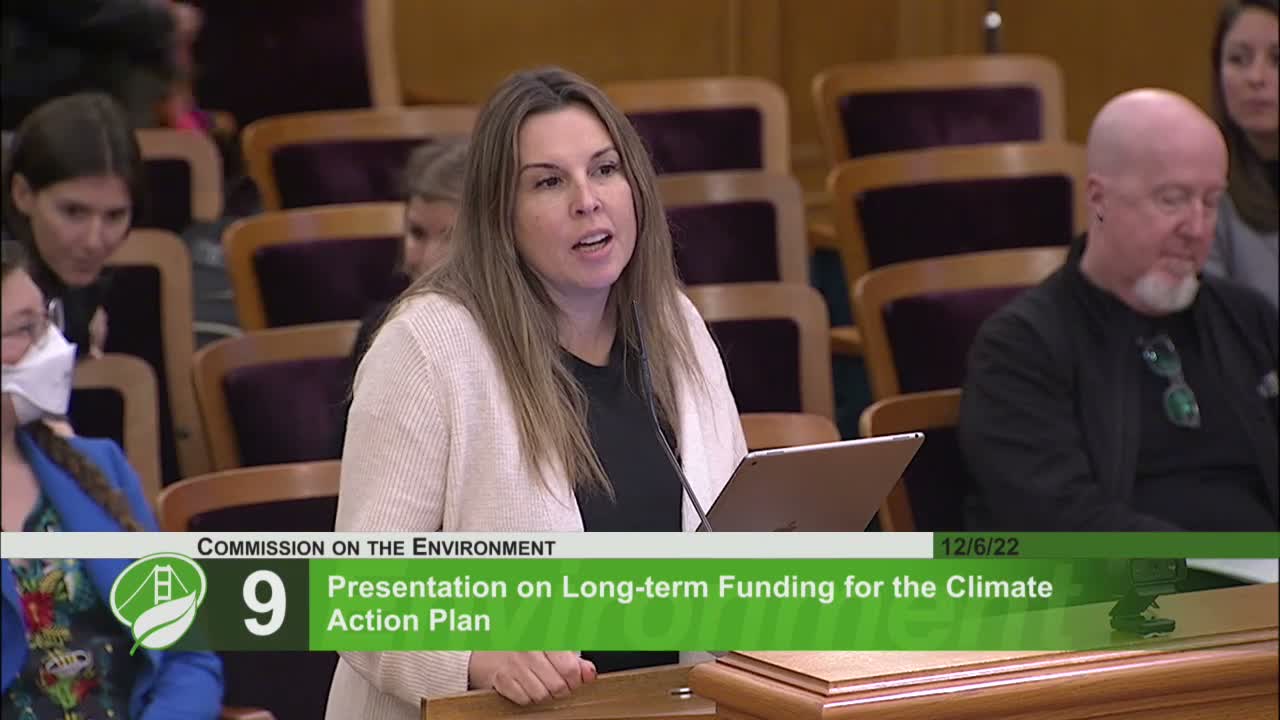
The San Francisco Department of the Environment presented findings from a UC Berkeley Center for Law, Energy, and the Environment report on Dec. 6 that mapped long‑term funding options to implement the city’s 2021 Climate Action Plan.
Cindy Comerford, climate program manager, summarized the report’s scope and recommendations. The report estimated implementation costs up to about $21 billion (a scoping figure the presenter called conservative) and recommended a mix of near‑term measures — general obligation (GO) bonds (examples proposed at $300 million to $500 million for building decarbonization, with a proposed $100 million add‑on to a planned affordable housing bond to fund retrofits), a parcel tax to raise $12–$25 million for parks and green infrastructure, and a gross‑receipts tax that could yield $25–$50 million directed to the Department of the Environment.
The presentation stressed equity and implementation measures: add workforce development funding into bond programs, create a green bank to leverage private capital and federal Inflation Reduction Act funds, and form an independent equity oversight council with racial equity assessments for investments. Staff said the study would guide outreach and that they will present to the Board of Supervisors in January.
Commissioners pressed for details: how the Board’s add‑back funding was allocated, the practical limits imposed by the City Charter (a 3% debt cap), ballot timing, and whether revenue pathways move fast enough to meet near‑term targets. Staff acknowledged the measures will not alone fully fund the plan, noted constraints and the need for layered funding (federal and state grants, private investment), and described next steps including advisory‑group feedback and additional analysis.
Next steps: staff will submit the report to the Board of Supervisors and continue advisory‑group engagement; commission discussion included referring bond development and equity design to the capital planning committee and further coordination with the mayor’s budget office.
Cindy Comerford, climate program manager, summarized the report’s scope and recommendations. The report estimated implementation costs up to about $21 billion (a scoping figure the presenter called conservative) and recommended a mix of near‑term measures — general obligation (GO) bonds (examples proposed at $300 million to $500 million for building decarbonization, with a proposed $100 million add‑on to a planned affordable housing bond to fund retrofits), a parcel tax to raise $12–$25 million for parks and green infrastructure, and a gross‑receipts tax that could yield $25–$50 million directed to the Department of the Environment.
The presentation stressed equity and implementation measures: add workforce development funding into bond programs, create a green bank to leverage private capital and federal Inflation Reduction Act funds, and form an independent equity oversight council with racial equity assessments for investments. Staff said the study would guide outreach and that they will present to the Board of Supervisors in January.
Commissioners pressed for details: how the Board’s add‑back funding was allocated, the practical limits imposed by the City Charter (a 3% debt cap), ballot timing, and whether revenue pathways move fast enough to meet near‑term targets. Staff acknowledged the measures will not alone fully fund the plan, noted constraints and the need for layered funding (federal and state grants, private investment), and described next steps including advisory‑group feedback and additional analysis.
Next steps: staff will submit the report to the Board of Supervisors and continue advisory‑group engagement; commission discussion included referring bond development and equity design to the capital planning committee and further coordination with the mayor’s budget office.
Don't Miss a Word: See the Full Meeting!
Go beyond summaries. Unlock every video, transcript, and key insight with a Founder Membership.
✓
Get instant access to full meeting videos
✓
Search and clip any phrase from complete transcripts
✓
Receive AI-powered summaries & custom alerts
✓
Enjoy lifetime, unrestricted access to government data
30-day money-back guarantee
