Commission backs resolution supporting updates to Chapter 7 (municipal green building code)
February 07, 2023 | San Francisco City, San Francisco County, California
This article was created by AI summarizing key points discussed. AI makes mistakes, so for full details and context, please refer to the video of the full meeting. Please report any errors so we can fix them. Report an error »
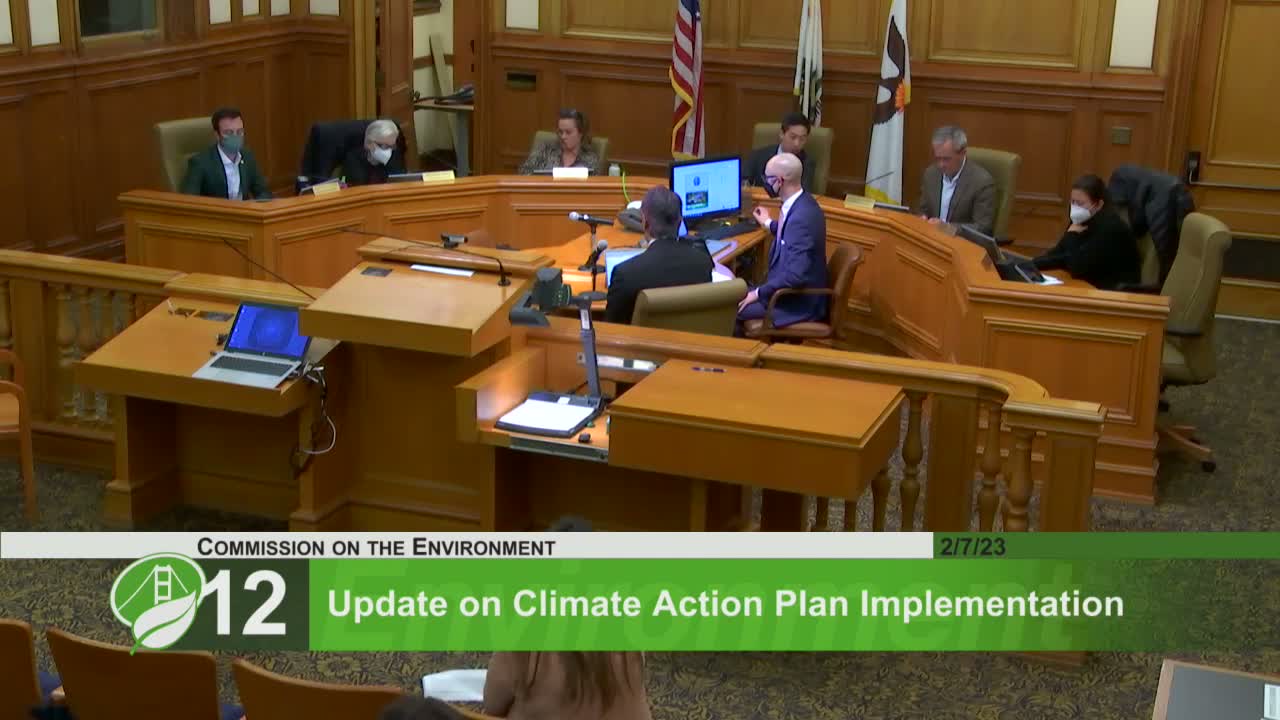
The Commission considered proposed updates to Environment Code Chapter 7, San Francisco's municipal green building requirements, presented by Eden Brookman (Senior Green Building Coordinator) and Cindy Comerford (Climate Program Manager).
Brookman and staff described a comprehensive restructure that collapses 15 existing sections into six (findings, definitions, roles and responsibilities, applicability, requirements and waivers). The proposed requirements are organized under five themes: high‑performance rating systems, energy optimization, responsible production and consumption, human and environmental health (including toxics reduction), and water conservation. The update would also require municipal project teams to adopt new metrics such as life cycle assessment (LCA) and incorporate embodied carbon reduction strategies.
Staff flagged three proposed requirements with the largest potential financial impact: 1) time‑of‑replacement electrification (requiring all‑electric equipment when gas equipment is retired or fails), which could trigger PG&E interconnection and primary switch gear upgrades; SFPUC estimated interconnection costs could add roughly $300,000–$2.5M per municipal project, and direct equipment/installation costs could range $160,000–$440,000 depending on building; 2) battery storage for new construction or major renovations of defined critical community institutions (estimated $160,000–$270,000 based on CEC analyses); and 3) required life cycle assessments (approx. $15,000–$20,000 per project estimated from local consultants).
Staff noted regional and state actions that will raise the regulatory floor, including a proposed BAAQMD rule phasing out certain gas equipment (water heaters 2027, furnaces 2029, large commercial heaters 2031) and CEC/CalGreen proposals to incorporate LCA and embodied carbon reduction into state building standards. Brookman described waiver processes for projects that cannot comply and support resources the Environment Department provides (LEED scorecard review, GS6 form and process checklist).
After questions from Commissioners about long‑term savings and cost messaging, Commissioner Kelvin moved and Vice President Stevenson seconded a motion to approve a resolution encouraging the Board to adopt the Chapter 7 updates. The Commission approved the resolution on roll call.
Brookman and staff described a comprehensive restructure that collapses 15 existing sections into six (findings, definitions, roles and responsibilities, applicability, requirements and waivers). The proposed requirements are organized under five themes: high‑performance rating systems, energy optimization, responsible production and consumption, human and environmental health (including toxics reduction), and water conservation. The update would also require municipal project teams to adopt new metrics such as life cycle assessment (LCA) and incorporate embodied carbon reduction strategies.
Staff flagged three proposed requirements with the largest potential financial impact: 1) time‑of‑replacement electrification (requiring all‑electric equipment when gas equipment is retired or fails), which could trigger PG&E interconnection and primary switch gear upgrades; SFPUC estimated interconnection costs could add roughly $300,000–$2.5M per municipal project, and direct equipment/installation costs could range $160,000–$440,000 depending on building; 2) battery storage for new construction or major renovations of defined critical community institutions (estimated $160,000–$270,000 based on CEC analyses); and 3) required life cycle assessments (approx. $15,000–$20,000 per project estimated from local consultants).
Staff noted regional and state actions that will raise the regulatory floor, including a proposed BAAQMD rule phasing out certain gas equipment (water heaters 2027, furnaces 2029, large commercial heaters 2031) and CEC/CalGreen proposals to incorporate LCA and embodied carbon reduction into state building standards. Brookman described waiver processes for projects that cannot comply and support resources the Environment Department provides (LEED scorecard review, GS6 form and process checklist).
After questions from Commissioners about long‑term savings and cost messaging, Commissioner Kelvin moved and Vice President Stevenson seconded a motion to approve a resolution encouraging the Board to adopt the Chapter 7 updates. The Commission approved the resolution on roll call.
View the Full Meeting & All Its Details
This article offers just a summary. Unlock complete video, transcripts, and insights as a Founder Member.
✓
Watch full, unedited meeting videos
✓
Search every word spoken in unlimited transcripts
✓
AI summaries & real-time alerts (all government levels)
✓
Permanent access to expanding government content
30-day money-back guarantee
