Environment commission authorizes renewal of household hazardous waste agreement with Recology
February 05, 2024 | San Francisco City, San Francisco County, California
This article was created by AI summarizing key points discussed. AI makes mistakes, so for full details and context, please refer to the video of the full meeting. Please report any errors so we can fix them. Report an error »
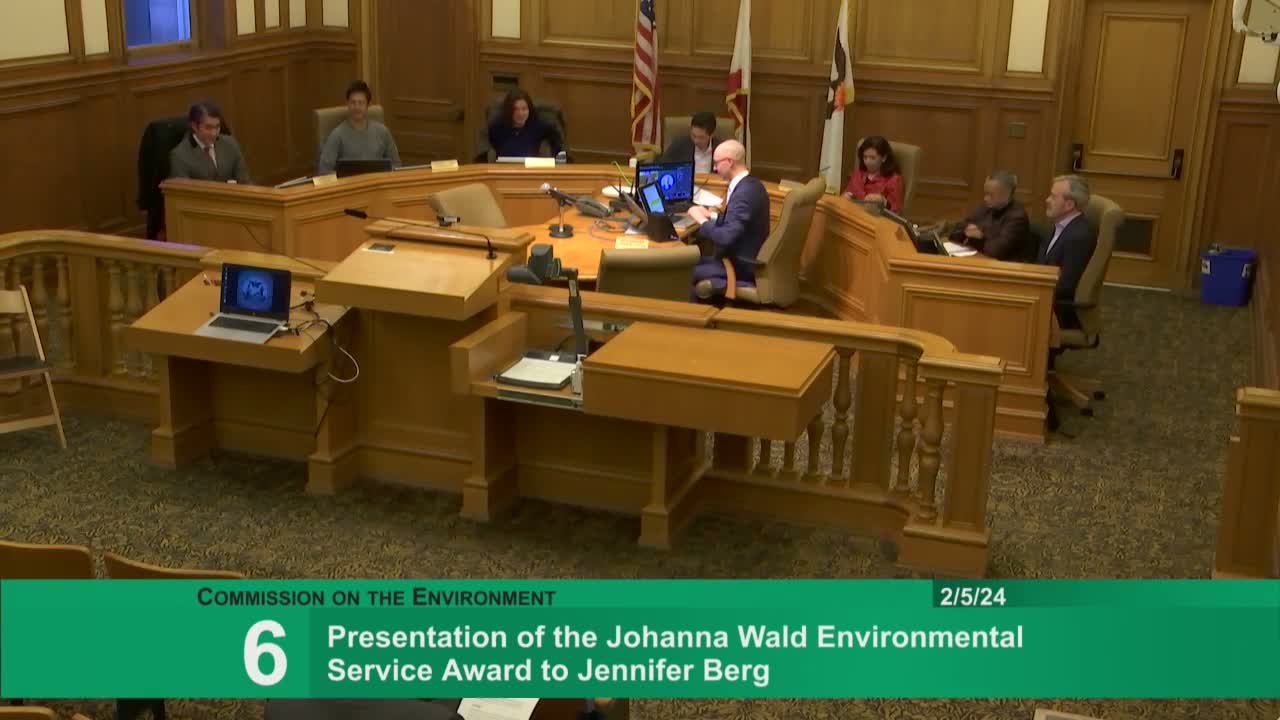
The San Francisco Commission on the Environment voted Feb. 5 to authorize renewal of the city's household hazardous waste (HHW) collection agreement with Recology, a contract the commission and staff say is central to the city's hazardous-materials management.
The agreement, which has been renewed every five years since 1987, allows Recology to operate the permanent HHW facility and a network of collection programs on the city's behalf. Palio Haya, program manager for the Toxics Reduction and Healthy Communities team, told commissioners the facility opened in 1988 and that the city remains the legal generator of material under state regulatory frameworks. "This program was intended to provide a disposal option for household hazardous waste that didn't belong in the landfill," Haya said.
Huey Lehi, the department's residential toxics reductions coordinator, presented program data and operations. Lehi said that, over the past decade, the city has collected roughly 1 million pounds of household hazardous waste per year (excluding e-waste), about 1.5 million pounds of e-waste annually, approximately 160,000 pounds of household batteries, and over 37,000 gallons of household paint. Lehi described a suite of collection channels: a permanent facility open Thursday–Saturday, retail drop-off partners (more than 70 stores), a door-to-door appointment service, an apartment bucket program, and curbside bin-top collection.
Commissioners questioned outreach and participation rates in multifamily housing. Lehi said the apartment bucket program accounts for about 8% of batteries collected while multifamily housing represents roughly 75% of the city's housing stock; staff described ongoing outreach with Recology to increase multifamily participation. Commissioners also asked about the program's safety checks and Recology's role in sorting and low-level checks when items appear in the landfill stream.
Commissioner Vermejo moved to advance the resolution authorizing the director to execute the renewal; Vice President Juan seconded the motion. With no public comment, the commission conducted a roll-call vote and the resolution passed.
Next steps: staff will finalize the agreement language with Recology and the city attorney and risk manager reviews already completed; the department indicated it had received Recology's comments and would incorporate them prior to execution.
The agreement, which has been renewed every five years since 1987, allows Recology to operate the permanent HHW facility and a network of collection programs on the city's behalf. Palio Haya, program manager for the Toxics Reduction and Healthy Communities team, told commissioners the facility opened in 1988 and that the city remains the legal generator of material under state regulatory frameworks. "This program was intended to provide a disposal option for household hazardous waste that didn't belong in the landfill," Haya said.
Huey Lehi, the department's residential toxics reductions coordinator, presented program data and operations. Lehi said that, over the past decade, the city has collected roughly 1 million pounds of household hazardous waste per year (excluding e-waste), about 1.5 million pounds of e-waste annually, approximately 160,000 pounds of household batteries, and over 37,000 gallons of household paint. Lehi described a suite of collection channels: a permanent facility open Thursday–Saturday, retail drop-off partners (more than 70 stores), a door-to-door appointment service, an apartment bucket program, and curbside bin-top collection.
Commissioners questioned outreach and participation rates in multifamily housing. Lehi said the apartment bucket program accounts for about 8% of batteries collected while multifamily housing represents roughly 75% of the city's housing stock; staff described ongoing outreach with Recology to increase multifamily participation. Commissioners also asked about the program's safety checks and Recology's role in sorting and low-level checks when items appear in the landfill stream.
Commissioner Vermejo moved to advance the resolution authorizing the director to execute the renewal; Vice President Juan seconded the motion. With no public comment, the commission conducted a roll-call vote and the resolution passed.
Next steps: staff will finalize the agreement language with Recology and the city attorney and risk manager reviews already completed; the department indicated it had received Recology's comments and would incorporate them prior to execution.
View the Full Meeting & All Its Details
This article offers just a summary. Unlock complete video, transcripts, and insights as a Founder Member.
✓
Watch full, unedited meeting videos
✓
Search every word spoken in unlimited transcripts
✓
AI summaries & real-time alerts (all government levels)
✓
Permanent access to expanding government content
30-day money-back guarantee
