Entertainment Commission hears plan to transition shared spaces and opens equity grants round
November 02, 2021 | San Francisco City, San Francisco County, California
This article was created by AI summarizing key points discussed. AI makes mistakes, so for full details and context, please refer to the video of the full meeting. Please report any errors so we can fix them. Report an error »
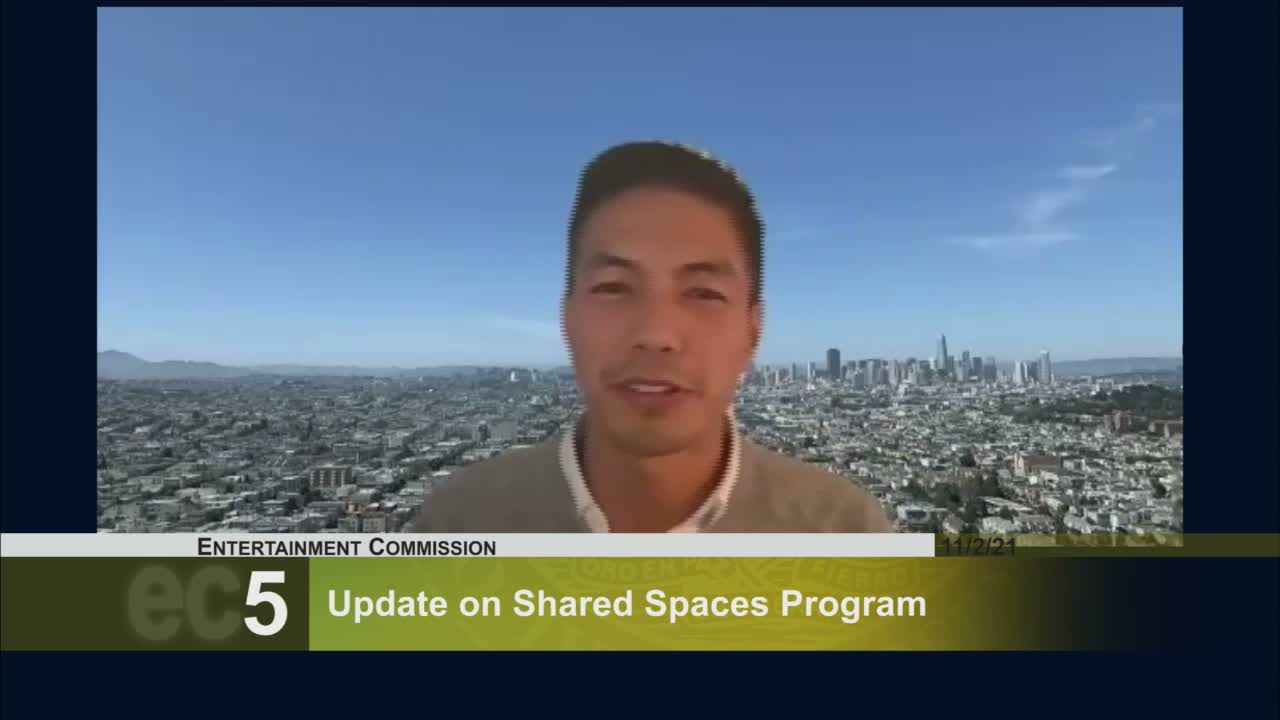
The San Francisco Entertainment Commission on Nov. 2 heard a detailed plan for the city's shared spaces program that aims to move temporary pandemic-era curb activations into a more permanent, regulated system while directing limited grant money to disadvantaged neighborhoods.
Robin Abad, program director for the city's shared spaces effort, told commissioners the Board of Supervisors has waived parklet fees through the end of calendar 2022 and extended the pandemic-version program through the end of the fiscal year in June 2022. Abad said operators must submit fresh permit renewals if they plan to operate after Dec. 31, 2021, and that the city will begin issuing annual permits in July 2022.
"As the current set of shared spaces pandemic permits expire on 12/31, we're asking everyone who intends to operate after 12/31 to go ahead and submit a permit renewal," Abad said. The renewals are intended to update site footprints and ensure the city has accurate data before moving to a permanent permit cadence.
Monica Munowich of the San Francisco Municipal Transportation Agency described a summer survey of curbside conditions and said SFMTA and partner departments will prioritize enforcement and notices for life-safety and emergency-access issues such as clear paths of travel, ADA-compliant setbacks and visibility around fire hydrants and exits. She said departments will coordinate notices and provide a single packet that explains which fixes are urgent and which can wait until the pandemic program ends.
"Some notices are about making sure sites are ADA accessible and making sure we have the appropriate clearances around fire hydrants and fire escapes," Munowich said.
Staff also announced grant funding efforts for shared spaces. Abad said round-two compliance grants (for furnishings and site reconfiguration) are open and that round three will focus on arts and culture activation grants intended for artists and performers rather than only business operators.
Commissioners pressed staff on the timing and the practicalities of required changes, including how much notice operators will receive to resize, relocate or remove parklets. Abad and Munowich said timelines will vary by the type of correction, with urgent life-safety items receiving faster notices and other curb-management changes phased over months to allow permit holders time to plan.
The presentation drew public comment from taxi driver Barry Toronto, who urged staff to consider transportation impacts where parklets limit curb or loading areas. Commissioners asked staff to refine outreach and to provide clear, coordinated notices and technical assistance for small operators.
The commission did not vote on new regulations during the meeting; staff said they will bring more detailed materials and proposed criteria for administrative versus commission review to future hearings. The city's shared spaces manual and an online application portal (sf.gov/sharedspacesequity) were cited as the places to apply for grants and renewals.
Robin Abad, program director for the city's shared spaces effort, told commissioners the Board of Supervisors has waived parklet fees through the end of calendar 2022 and extended the pandemic-version program through the end of the fiscal year in June 2022. Abad said operators must submit fresh permit renewals if they plan to operate after Dec. 31, 2021, and that the city will begin issuing annual permits in July 2022.
"As the current set of shared spaces pandemic permits expire on 12/31, we're asking everyone who intends to operate after 12/31 to go ahead and submit a permit renewal," Abad said. The renewals are intended to update site footprints and ensure the city has accurate data before moving to a permanent permit cadence.
Monica Munowich of the San Francisco Municipal Transportation Agency described a summer survey of curbside conditions and said SFMTA and partner departments will prioritize enforcement and notices for life-safety and emergency-access issues such as clear paths of travel, ADA-compliant setbacks and visibility around fire hydrants and exits. She said departments will coordinate notices and provide a single packet that explains which fixes are urgent and which can wait until the pandemic program ends.
"Some notices are about making sure sites are ADA accessible and making sure we have the appropriate clearances around fire hydrants and fire escapes," Munowich said.
Staff also announced grant funding efforts for shared spaces. Abad said round-two compliance grants (for furnishings and site reconfiguration) are open and that round three will focus on arts and culture activation grants intended for artists and performers rather than only business operators.
Commissioners pressed staff on the timing and the practicalities of required changes, including how much notice operators will receive to resize, relocate or remove parklets. Abad and Munowich said timelines will vary by the type of correction, with urgent life-safety items receiving faster notices and other curb-management changes phased over months to allow permit holders time to plan.
The presentation drew public comment from taxi driver Barry Toronto, who urged staff to consider transportation impacts where parklets limit curb or loading areas. Commissioners asked staff to refine outreach and to provide clear, coordinated notices and technical assistance for small operators.
The commission did not vote on new regulations during the meeting; staff said they will bring more detailed materials and proposed criteria for administrative versus commission review to future hearings. The city's shared spaces manual and an online application portal (sf.gov/sharedspacesequity) were cited as the places to apply for grants and renewals.
Don't Miss a Word: See the Full Meeting!
Go beyond summaries. Unlock every video, transcript, and key insight with a Founder Membership.
✓
Get instant access to full meeting videos
✓
Search and clip any phrase from complete transcripts
✓
Receive AI-powered summaries & custom alerts
✓
Enjoy lifetime, unrestricted access to government data
30-day money-back guarantee
