Entertainment Commission releases annual nightlife survey; staff flags state bills and new drink-testing requirement
April 02, 2024 | San Francisco City, San Francisco County, California
This article was created by AI summarizing key points discussed. AI makes mistakes, so for full details and context, please refer to the video of the full meeting. Please report any errors so we can fix them. Report an error »
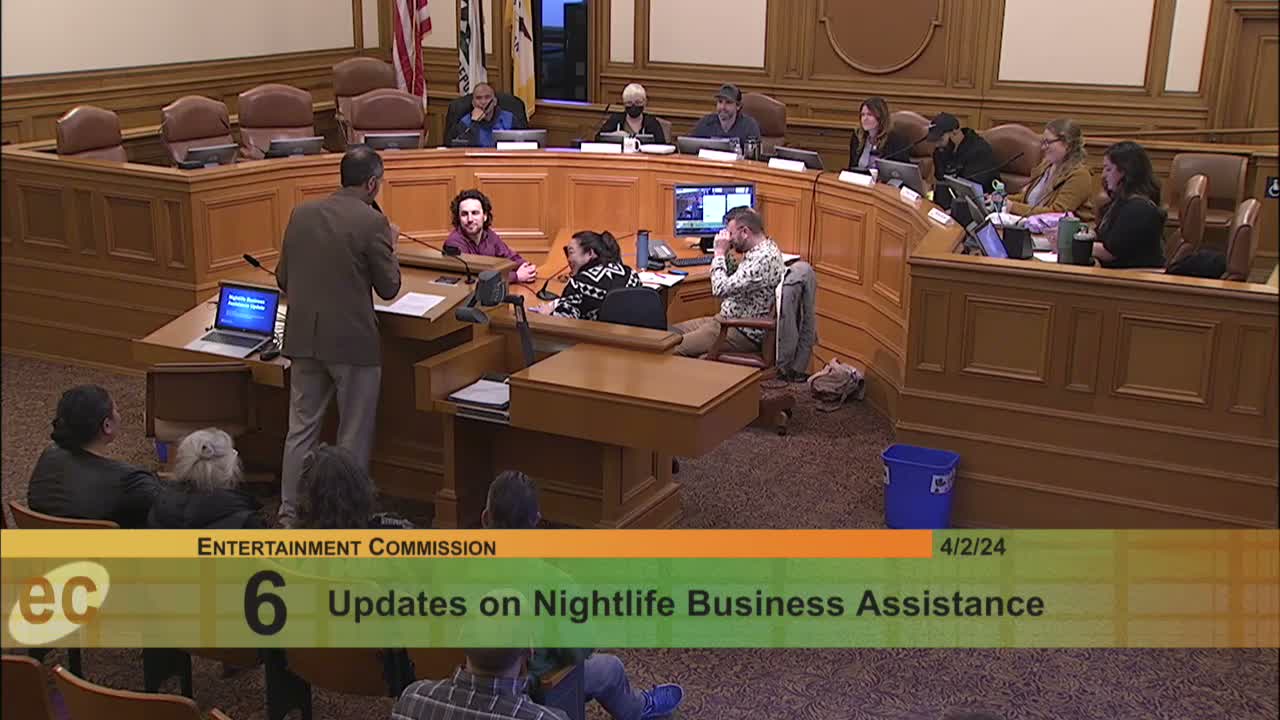
The San Francisco Entertainment Commission on April 2 received its fourth annual survey of nightlife and entertainment businesses and a state-policy update that could affect local nightlife operators.
Project and Communications Manager Dylan Rice presented the survey: 110 businesses responded during an eight-week field period. Respondents were primarily bars, live-music venues and restaurants concentrated in SoMa, Hayes Valley and the Tenderloin. Rice reported that 51% of respondents identified as minority owned; 66% said they held at least one City entertainment permit. On financial outlook, 70% of respondents said their business could operate beyond six months and 19% estimated a 3–6 month survival window; two respondents reported closure since the prior survey. Comparing 2023 to 2019, nearly 62% of respondents said sales were down 30% or more, and staffing averaged 61% of 2019 levels with a median of four full-time equivalents.
Rice summarized operational concerns: public-safety worries (68% agreed or strongly agreed that public-safety at their location is a concern), street cleanliness issues tied to homeless encampments and garbage (about 65% cited concerns), and rising costs including taxes, fees and rent. Respondents said the Commission’s e-newsletter and website were primary communication channels but that nearly 46% were not using the Commission’s online channels. Businesses’ top priorities for Commission and city action included more funding, streamlined permitting, cleaner and safer streets, and lower permit fees and taxes.
Staff also briefed commissioners on state legislation and regulatory changes that could affect nightlife operations. Ben Van Houten of Economic & Workforce Development noted:
• SB 969 (Sen. Wiener) — would expand the concept of "entertainment zones" (geographically designated areas where bars and restaurants may serve beverages for consumption in public spaces during permitted events) beyond San Francisco to other jurisdictions and remove some special-event requirements; the bill has passed an initial committee.
• AB 1775 (Asm. Haney) — described as expanding the ability of cannabis cafes/dispensaries to offer non-prepackaged food and ticketed live entertainment; staff said the bill cleared committee the same day.
• AB 2359 (Asm. Ting) — would expand the Neighborhood Liquor License (Type 87) program; currently 30 licenses cover seven commercial corridors in San Francisco, and the bill would add five licenses in the Bayview and Excelsior corridors.
Van Houten also flagged a state law effective July 1 requiring bars to make drink-testing devices (testing strips) available and to post prescribed signage; devices may be sold at cost or given away. Commissioners asked about device accuracy, cost and liability; staff noted ABC (Alcoholic Beverage Control) guidance and agreed to research products, potential liability carve-outs in state law and provide compliance guidance to local licensees before the July 1 effective date.
Commissioners said the survey and legislative updates will inform both the April 29 summit and the Commission’s outreach to the City Administrator and Mayor’s office; staff said they will circulate the findings more broadly to city leadership and media partners.
Provenance: Legislative update and nightlife assistance background (SEG 241–SEG 364); Dylan Rice survey presentation and Q&A (SEG 476–SEG 901).
Project and Communications Manager Dylan Rice presented the survey: 110 businesses responded during an eight-week field period. Respondents were primarily bars, live-music venues and restaurants concentrated in SoMa, Hayes Valley and the Tenderloin. Rice reported that 51% of respondents identified as minority owned; 66% said they held at least one City entertainment permit. On financial outlook, 70% of respondents said their business could operate beyond six months and 19% estimated a 3–6 month survival window; two respondents reported closure since the prior survey. Comparing 2023 to 2019, nearly 62% of respondents said sales were down 30% or more, and staffing averaged 61% of 2019 levels with a median of four full-time equivalents.
Rice summarized operational concerns: public-safety worries (68% agreed or strongly agreed that public-safety at their location is a concern), street cleanliness issues tied to homeless encampments and garbage (about 65% cited concerns), and rising costs including taxes, fees and rent. Respondents said the Commission’s e-newsletter and website were primary communication channels but that nearly 46% were not using the Commission’s online channels. Businesses’ top priorities for Commission and city action included more funding, streamlined permitting, cleaner and safer streets, and lower permit fees and taxes.
Staff also briefed commissioners on state legislation and regulatory changes that could affect nightlife operations. Ben Van Houten of Economic & Workforce Development noted:
• SB 969 (Sen. Wiener) — would expand the concept of "entertainment zones" (geographically designated areas where bars and restaurants may serve beverages for consumption in public spaces during permitted events) beyond San Francisco to other jurisdictions and remove some special-event requirements; the bill has passed an initial committee.
• AB 1775 (Asm. Haney) — described as expanding the ability of cannabis cafes/dispensaries to offer non-prepackaged food and ticketed live entertainment; staff said the bill cleared committee the same day.
• AB 2359 (Asm. Ting) — would expand the Neighborhood Liquor License (Type 87) program; currently 30 licenses cover seven commercial corridors in San Francisco, and the bill would add five licenses in the Bayview and Excelsior corridors.
Van Houten also flagged a state law effective July 1 requiring bars to make drink-testing devices (testing strips) available and to post prescribed signage; devices may be sold at cost or given away. Commissioners asked about device accuracy, cost and liability; staff noted ABC (Alcoholic Beverage Control) guidance and agreed to research products, potential liability carve-outs in state law and provide compliance guidance to local licensees before the July 1 effective date.
Commissioners said the survey and legislative updates will inform both the April 29 summit and the Commission’s outreach to the City Administrator and Mayor’s office; staff said they will circulate the findings more broadly to city leadership and media partners.
Provenance: Legislative update and nightlife assistance background (SEG 241–SEG 364); Dylan Rice survey presentation and Q&A (SEG 476–SEG 901).
Don't Miss a Word: See the Full Meeting!
Go beyond summaries. Unlock every video, transcript, and key insight with a Founder Membership.
✓
Get instant access to full meeting videos
✓
Search and clip any phrase from complete transcripts
✓
Receive AI-powered summaries & custom alerts
✓
Enjoy lifetime, unrestricted access to government data
30-day money-back guarantee
