Clean Power SF updates: 96% participation, new incentives for low‑income solar and heat‑pump water heaters
November 19, 2021 | San Francisco City, San Francisco County, California
This article was created by AI summarizing key points discussed. AI makes mistakes, so for full details and context, please refer to the video of the full meeting. Please report any errors so we can fix them. Report an error »
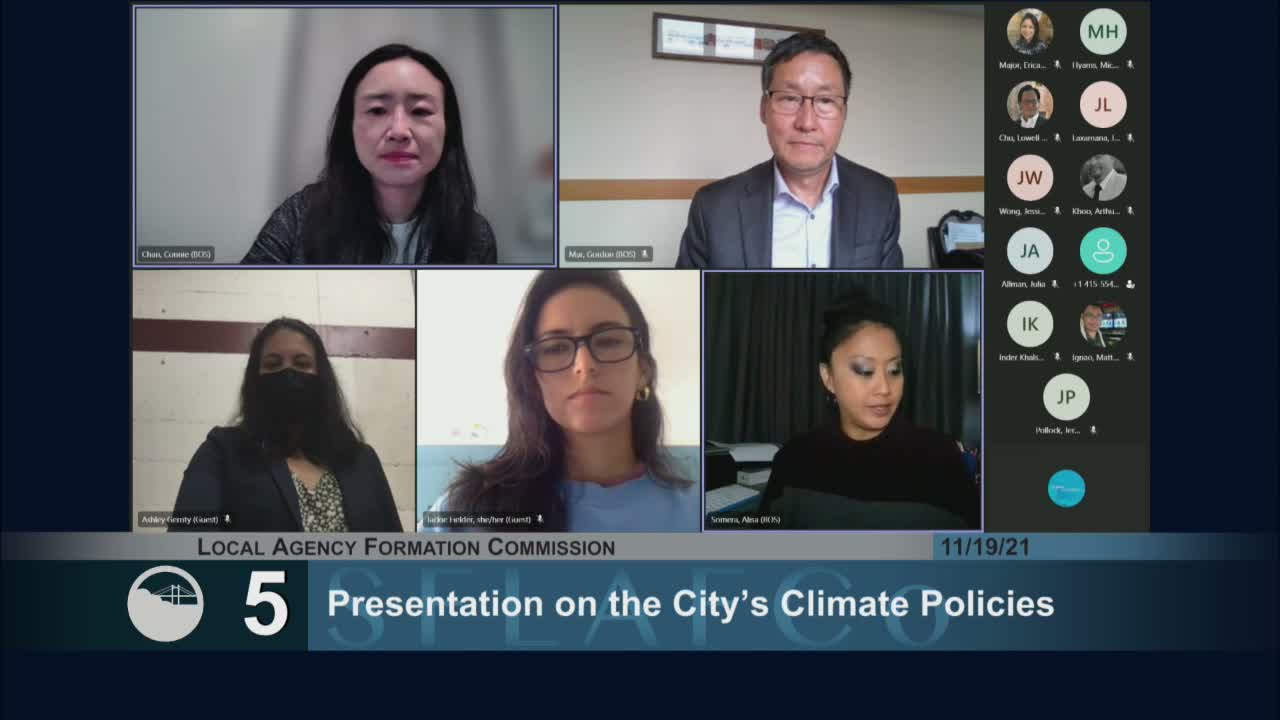
Clean Power SF staff briefed the Local Agency Formation Commission on enrollment, customer programs and the larger BayREN program landscape, reporting stable participation and new program launches intended to accelerate local decarbonization.
“Enrollment and participation in the Clean Power SF program remains stable. We continue to have a 96% participation rate,” said Mike Himes, director of the Clean Power SF program at the SFPUC power enterprise. Himes added that 2.1% of enrolled accounts have opted into the voluntary SuperGreen product, equal to more than 8,000 accounts and representing about 6% of Clean Power SF’s annual retail sales.
Julia Allman, manager of customer solutions for Clean Power SF, described three programs Clean Power SF is advancing: a low‑income inverter replacement program budgeted at about $1,000,000 over 10 years that will offer rebates up to $3,000 per qualifying customer; a workforce‑oriented heat‑pump water heater incentive (Clean Power SF contribution about $450,000 through March 2023) that, when layered with BayREN and statewide funds, could provide roughly $3,000 per unit; and a proposed food‑service energy‑efficiency program for which Clean Power SF has applied to the CPUC for $4,500,000 over three years, targeting audits and discounted improvements for grocery stores, restaurants and food‑access nonprofits.
Lowell Chu of the Department of the Environment explained the BayREN regional programs that complement Clean Power SF offerings, noting county allocations for the business program (about $1.3 million per year in his county) and multifamily pathways that include electrification funding and $750 per residential unit rebates under certain programs.
Commissioners asked about outreach and funding. Staff said these programs are funded by ratepayer funds — some collected through Clean Power SF generation rates and others through distribution/public‑purpose charges — and that Clean Power SF’s capital budget includes roughly $1–1.5 million per year for similar programs. Launch timelines noted: the low‑income inverter program will begin Dec. 1; the heat‑pump program is expected in early 2022; the food‑service program is contingent on CPUC approval and aims for spring 2023.
Public commenters supported prioritizing general‑fund support and larger financing strategies. Eric Brooks of Our City San Francisco urged the city to consider revenue bonds for a larger build‑out that could finance projects at scale without direct tax increases.
The commission took no action on the presentations; staff encouraged follow‑up meetings with commissioners to discuss program details and budgets.
“Enrollment and participation in the Clean Power SF program remains stable. We continue to have a 96% participation rate,” said Mike Himes, director of the Clean Power SF program at the SFPUC power enterprise. Himes added that 2.1% of enrolled accounts have opted into the voluntary SuperGreen product, equal to more than 8,000 accounts and representing about 6% of Clean Power SF’s annual retail sales.
Julia Allman, manager of customer solutions for Clean Power SF, described three programs Clean Power SF is advancing: a low‑income inverter replacement program budgeted at about $1,000,000 over 10 years that will offer rebates up to $3,000 per qualifying customer; a workforce‑oriented heat‑pump water heater incentive (Clean Power SF contribution about $450,000 through March 2023) that, when layered with BayREN and statewide funds, could provide roughly $3,000 per unit; and a proposed food‑service energy‑efficiency program for which Clean Power SF has applied to the CPUC for $4,500,000 over three years, targeting audits and discounted improvements for grocery stores, restaurants and food‑access nonprofits.
Lowell Chu of the Department of the Environment explained the BayREN regional programs that complement Clean Power SF offerings, noting county allocations for the business program (about $1.3 million per year in his county) and multifamily pathways that include electrification funding and $750 per residential unit rebates under certain programs.
Commissioners asked about outreach and funding. Staff said these programs are funded by ratepayer funds — some collected through Clean Power SF generation rates and others through distribution/public‑purpose charges — and that Clean Power SF’s capital budget includes roughly $1–1.5 million per year for similar programs. Launch timelines noted: the low‑income inverter program will begin Dec. 1; the heat‑pump program is expected in early 2022; the food‑service program is contingent on CPUC approval and aims for spring 2023.
Public commenters supported prioritizing general‑fund support and larger financing strategies. Eric Brooks of Our City San Francisco urged the city to consider revenue bonds for a larger build‑out that could finance projects at scale without direct tax increases.
The commission took no action on the presentations; staff encouraged follow‑up meetings with commissioners to discuss program details and budgets.
View the Full Meeting & All Its Details
This article offers just a summary. Unlock complete video, transcripts, and insights as a Founder Member.
✓
Watch full, unedited meeting videos
✓
Search every word spoken in unlimited transcripts
✓
AI summaries & real-time alerts (all government levels)
✓
Permanent access to expanding government content
30-day money-back guarantee
