Clean Power SF outlines long-duration storage deals, IRP timetable and local renewable targets
March 18, 2022 | San Francisco City, San Francisco County, California
This article was created by AI summarizing key points discussed. AI makes mistakes, so for full details and context, please refer to the video of the full meeting. Please report any errors so we can fix them. Report an error »
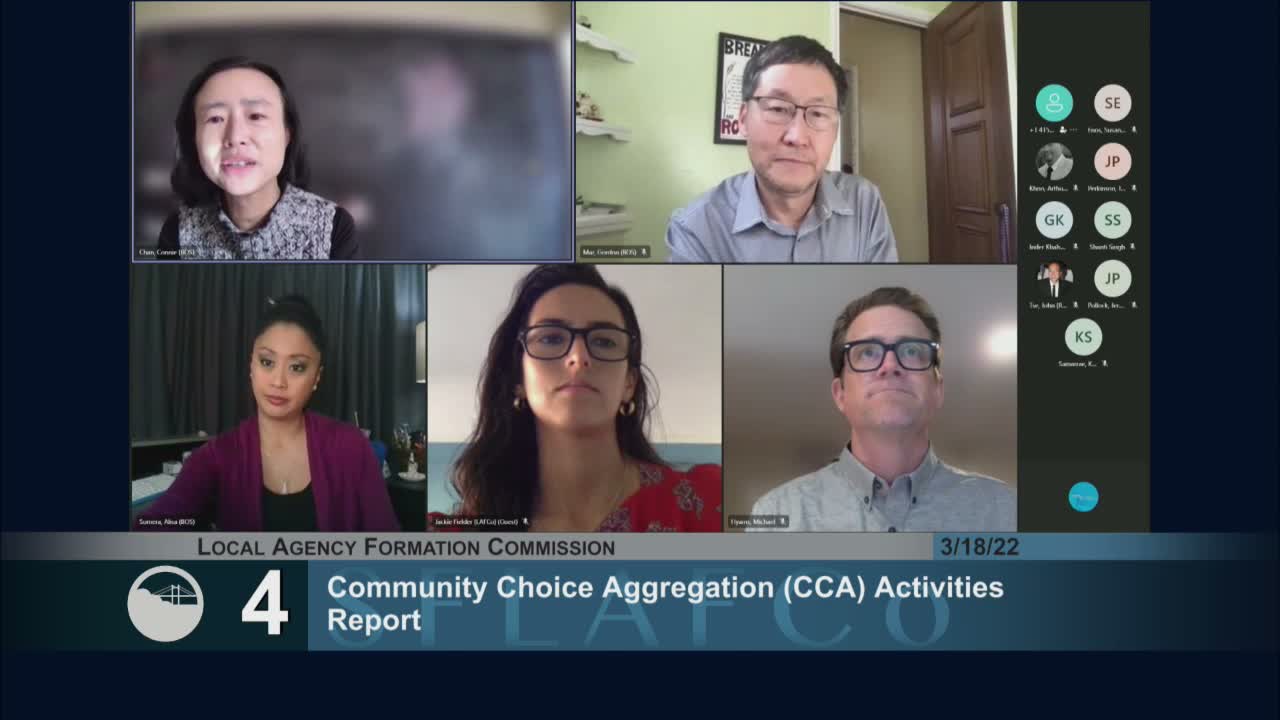
Clean Power SF executive director Mike Himes told the San Francisco Local Agency Formation Commission that the agency is moving forward with long-duration energy storage procurements and a new Integrated Resource Plan (IRP) schedule required by the California Public Utilities Commission.
Himes said Clean Power SF participated in CC Power's solicitation that yielded two projects: the Tumbleweed project, previously approved, and a second approved project called the Goal Line. "The goal line project will be a 50 megawatt lithium ion battery capable of storing 400 megawatt hours, and discharging that energy over an 8 hour period of time," Himes said, adding the project will be located near Escondido in Northern San Diego County and will be developed by Onward.
Why it matters: The CC Power procurements are intended to meet a CPUC mandate for long-duration resources that support statewide reliability. Himes said participating members have 90 days from March 1 to approve and execute agreements (making May 30 a key internal deadline) and that SFPUC staff will recommend the Goal Line project to the SFPUC commission on April 12 before seeking Board of Supervisors and mayoral approvals in April and May.
Himes also reviewed customer programs and local procurement priorities. Clean Power SF recently executed a cooperative agreement to join a regional heat pump water heater program and said it plans to launch a Disadvantaged Communities green tariff product branded "Super Green Saver" this spring. The agency will issue RFPs later in the year to hire energy services firms to support efficiency and disadvantaged community solar programs.
On the IRP, Himes said the CPUC requires Clean Power SF to submit its next IRP by Nov. 1. He outlined a timeline: staff will prepare local resource assessments through June, engage interested parties in June, conduct energy modeling in July and August, and aim to have initial results by September with a proposed plan presented for approval in October.
Commissioners asked how the agency will conduct community engagement and how feedback will be incorporated. Himes described a mix of "community power updates" with community-based organizations, outreach to the SFPUC Power Citizen Advisory Committee, and presentations to LAFCO; he acknowledged details on how feedback will be captured and used are still being defined. Asked about siting and proximity, Himes said CC Power's long-duration solicitation considered statewide offers to meet the CPUC operating requirement and that Clean Power SF's own solicitations aim to secure additional regional (Bay Area) projects. He confirmed a 9-megawatt initial target for local renewable projects drawn from a local resource assessment and said that forms part of larger IRP targets (about 110 MW of new renewables and 175 MW of 4-hour storage in the IRP adopted targets).
Public commenter Eric Brooks asked the SFPUC to provide a written "feedback-and-responses" document so the public can see how comments were addressed and to show maps of where utility-scale resources are sited. Himes and staff agreed to consider how to document and report public input as the engagement plan is developed.
Next steps: Clean Power SF will seek SFPUC commission authorization, then city approvals on the Goal Line project in April and May; the IRP process will continue through the summer with LAFCO updates planned in May, July and September.
Himes said Clean Power SF participated in CC Power's solicitation that yielded two projects: the Tumbleweed project, previously approved, and a second approved project called the Goal Line. "The goal line project will be a 50 megawatt lithium ion battery capable of storing 400 megawatt hours, and discharging that energy over an 8 hour period of time," Himes said, adding the project will be located near Escondido in Northern San Diego County and will be developed by Onward.
Why it matters: The CC Power procurements are intended to meet a CPUC mandate for long-duration resources that support statewide reliability. Himes said participating members have 90 days from March 1 to approve and execute agreements (making May 30 a key internal deadline) and that SFPUC staff will recommend the Goal Line project to the SFPUC commission on April 12 before seeking Board of Supervisors and mayoral approvals in April and May.
Himes also reviewed customer programs and local procurement priorities. Clean Power SF recently executed a cooperative agreement to join a regional heat pump water heater program and said it plans to launch a Disadvantaged Communities green tariff product branded "Super Green Saver" this spring. The agency will issue RFPs later in the year to hire energy services firms to support efficiency and disadvantaged community solar programs.
On the IRP, Himes said the CPUC requires Clean Power SF to submit its next IRP by Nov. 1. He outlined a timeline: staff will prepare local resource assessments through June, engage interested parties in June, conduct energy modeling in July and August, and aim to have initial results by September with a proposed plan presented for approval in October.
Commissioners asked how the agency will conduct community engagement and how feedback will be incorporated. Himes described a mix of "community power updates" with community-based organizations, outreach to the SFPUC Power Citizen Advisory Committee, and presentations to LAFCO; he acknowledged details on how feedback will be captured and used are still being defined. Asked about siting and proximity, Himes said CC Power's long-duration solicitation considered statewide offers to meet the CPUC operating requirement and that Clean Power SF's own solicitations aim to secure additional regional (Bay Area) projects. He confirmed a 9-megawatt initial target for local renewable projects drawn from a local resource assessment and said that forms part of larger IRP targets (about 110 MW of new renewables and 175 MW of 4-hour storage in the IRP adopted targets).
Public commenter Eric Brooks asked the SFPUC to provide a written "feedback-and-responses" document so the public can see how comments were addressed and to show maps of where utility-scale resources are sited. Himes and staff agreed to consider how to document and report public input as the engagement plan is developed.
Next steps: Clean Power SF will seek SFPUC commission authorization, then city approvals on the Goal Line project in April and May; the IRP process will continue through the summer with LAFCO updates planned in May, July and September.
View the Full Meeting & All Its Details
This article offers just a summary. Unlock complete video, transcripts, and insights as a Founder Member.
✓
Watch full, unedited meeting videos
✓
Search every word spoken in unlimited transcripts
✓
AI summaries & real-time alerts (all government levels)
✓
Permanent access to expanding government content
30-day money-back guarantee
