LAFCO counsel outlines options to change commission composition to add community voting seats
March 18, 2022 | San Francisco City, San Francisco County, California
This article was created by AI summarizing key points discussed. AI makes mistakes, so for full details and context, please refer to the video of the full meeting. Please report any errors so we can fix them. Report an error »
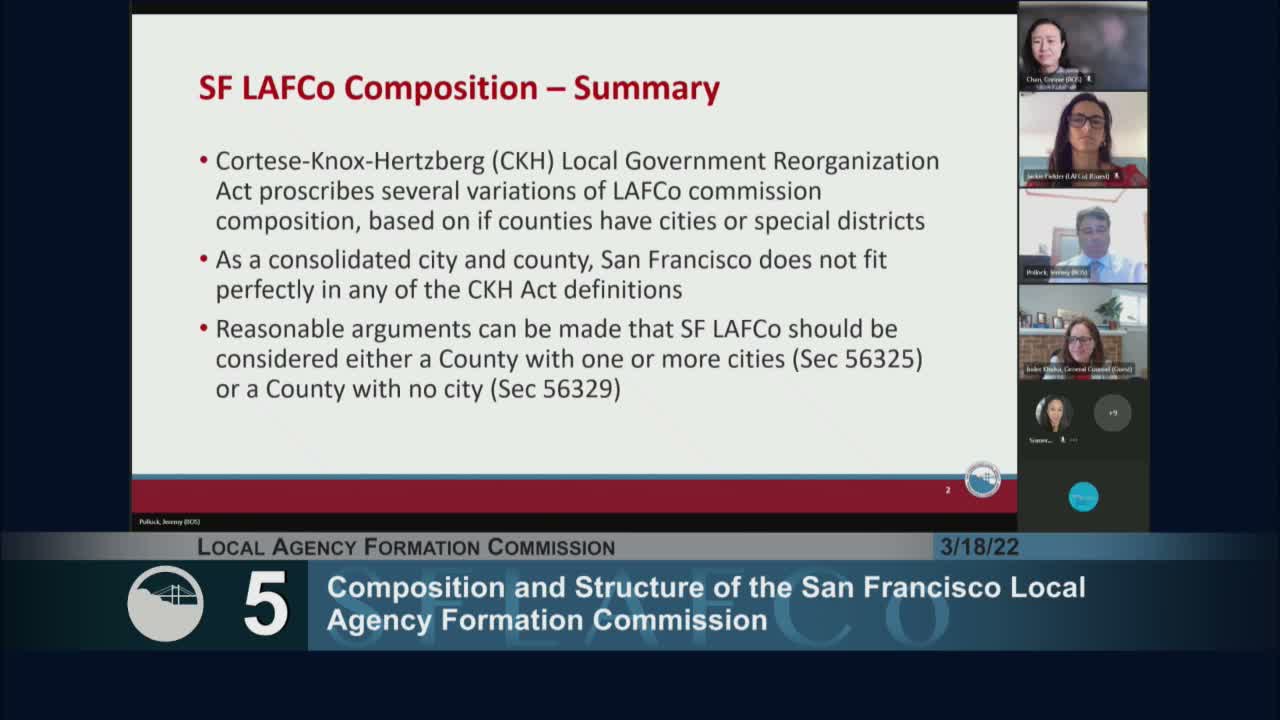
Legal counsel Inder Khalsa told the Local Agency Formation Commission that San Francisco's consolidated city-and-county status does not fit neatly into the Corte se Knox Hertzberg Act categories and presented options for how LAFCO could change its commission composition.
Counsel said the original LAFCO formation used a statute that was later repealed and that the city's unique status led staff to consider three possible classifications under state law. "San Francisco is truly unique in being the only consolidated city and county in the state of California," counsel said, and she described the practical implications of reclassifying the commission as a county with no cities, which would increase the number of public members and re-balance supervisor representation.
Why it matters: A structural change could add another voting community member to LAFCO and alter how appointments are made, which commissioners said would increase independence and bring more community expertise to complex issues such as Clean Power SF and public bank work.
Executive Officer Jeremy Pollock said the change can be pursued two ways: a short-term modification to LAFCO's policies and procedures by resolution, or a longer-term state legislative amendment to the Cortese Knox Hertzberg Act to prescribe a unique composition for San Francisco. Commissioners Chan, Maher (Marr in earlier roll calls) and others expressed support for adding community voting seats.
Public commenter Eric Brooks supported adding two community voting members and urged the commission to set specific rules for alternates and voting composition when moving forward.
Next steps: Item recorded as informational; staff offered to solicit further public feedback and to return with a formal proposal and potential resolution if the commission wants to pursue a policy-change route. A legislative approach would require state action.
Counsel said the original LAFCO formation used a statute that was later repealed and that the city's unique status led staff to consider three possible classifications under state law. "San Francisco is truly unique in being the only consolidated city and county in the state of California," counsel said, and she described the practical implications of reclassifying the commission as a county with no cities, which would increase the number of public members and re-balance supervisor representation.
Why it matters: A structural change could add another voting community member to LAFCO and alter how appointments are made, which commissioners said would increase independence and bring more community expertise to complex issues such as Clean Power SF and public bank work.
Executive Officer Jeremy Pollock said the change can be pursued two ways: a short-term modification to LAFCO's policies and procedures by resolution, or a longer-term state legislative amendment to the Cortese Knox Hertzberg Act to prescribe a unique composition for San Francisco. Commissioners Chan, Maher (Marr in earlier roll calls) and others expressed support for adding community voting seats.
Public commenter Eric Brooks supported adding two community voting members and urged the commission to set specific rules for alternates and voting composition when moving forward.
Next steps: Item recorded as informational; staff offered to solicit further public feedback and to return with a formal proposal and potential resolution if the commission wants to pursue a policy-change route. A legislative approach would require state action.
View the Full Meeting & All Its Details
This article offers just a summary. Unlock complete video, transcripts, and insights as a Founder Member.
✓
Watch full, unedited meeting videos
✓
Search every word spoken in unlimited transcripts
✓
AI summaries & real-time alerts (all government levels)
✓
Permanent access to expanding government content
30-day money-back guarantee
