LAFCO hears Climate Action Plan implementation update; Department of Environment cites staffing and funding gaps
July 15, 2022 | San Francisco City, San Francisco County, California
This article was created by AI summarizing key points discussed. AI makes mistakes, so for full details and context, please refer to the video of the full meeting. Please report any errors so we can fix them. Report an error »
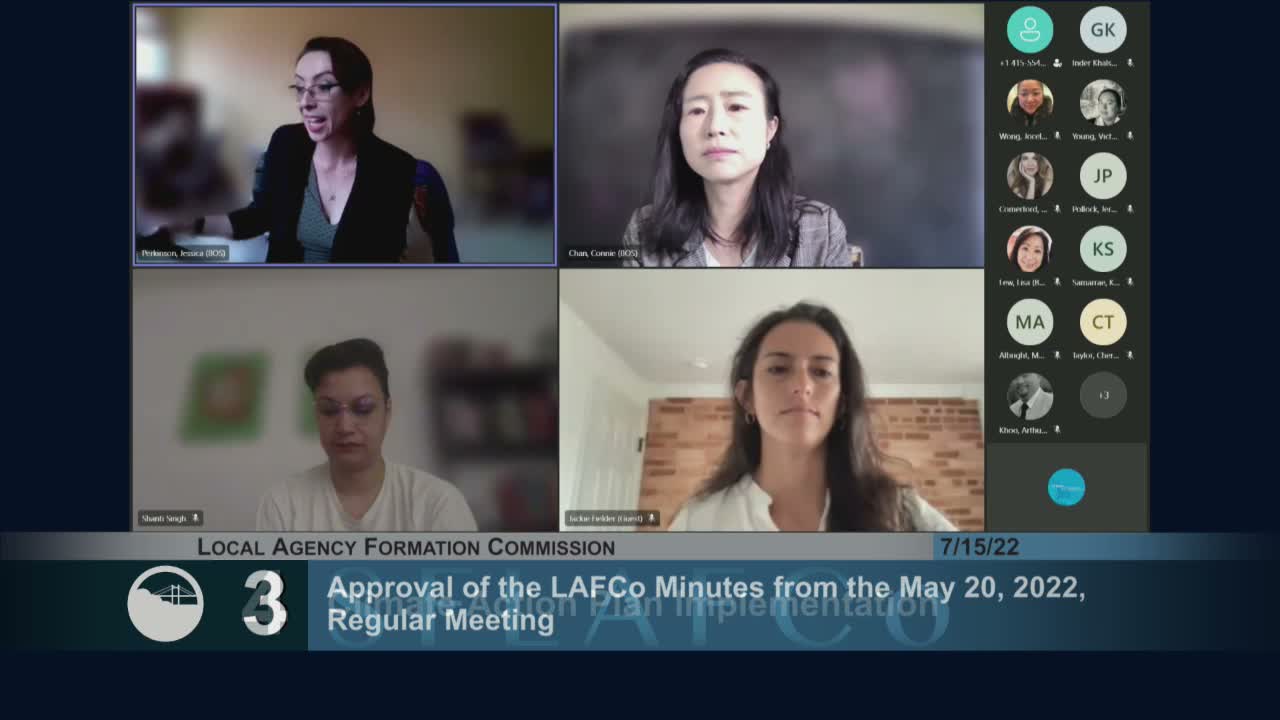
San Francisco’s Department of the Environment on July presented a progress report to the Local Agency Formation Commission on implementing the city’s Climate Action Plan, saying the plan is “a pathway for the city to reach net 0 emissions by 2040.” Cindy Comfort, the department presenter, told commissioners the plan contains 31 strategies and “over 170 different actions,” and summarized implementation status and recent accomplishments.
Comfort said one fully completed action was the city’s ban on natural gas in new construction (implemented in 2021) and cited early progress on transit projects and the Kitchen SF food‑recovery pilot. She said the city has initiated a city‑owned street‑tree nursery on Caltrans land and has begun an outreach contract and a tracking tool to monitor action progress. “Thus far, there’s about 40% of them on track, about 8% are delayed, and about 50% haven’t started,” she said.
The department identified two main barriers. Comfort said staffing shortages across city agencies have slowed implementation and that the failed ballot measure (referenced in discussion as Proposition A) reduced near‑term funding prospects. The department has secured a general‑fund allocation this year to support implementation but told commissioners it still needs a long‑term financing plan.
Vice‑Chair Jackie Fielder asked when the long‑term funding study would be ready. Comfort responded that the city has contracted UC Berkeley and CivicMakers for a long‑term funding study and expects an initial report in September, with further engagement next year. Commissioner Shanti Singh asked about decarbonizing existing rental housing; Comfort said staff plan to roll out municipal building retrofit legislation in the fall and aims to propose residential ‘‘time‑of‑replacement’’ and ‘‘time‑of‑sale’’ policies in the subsequent legislative cycle, subject to stakeholder outreach.
Comfort said staff will develop quarterly technical working groups, refine metrics, and publish a public reporting dashboard to provide transparent tracking of progress. David Pilpel, speaking during public comment, thanked staff and urged follow‑up at the Environment Commission and the full LAFCO schedule.
The presentation was informational only; no LAFCO action was taken. Commissioners requested continued quarterly updates and reiterated the importance of identifying durable funding sources and clearer timelines for retrofit and incentive programs.
Comfort said one fully completed action was the city’s ban on natural gas in new construction (implemented in 2021) and cited early progress on transit projects and the Kitchen SF food‑recovery pilot. She said the city has initiated a city‑owned street‑tree nursery on Caltrans land and has begun an outreach contract and a tracking tool to monitor action progress. “Thus far, there’s about 40% of them on track, about 8% are delayed, and about 50% haven’t started,” she said.
The department identified two main barriers. Comfort said staffing shortages across city agencies have slowed implementation and that the failed ballot measure (referenced in discussion as Proposition A) reduced near‑term funding prospects. The department has secured a general‑fund allocation this year to support implementation but told commissioners it still needs a long‑term financing plan.
Vice‑Chair Jackie Fielder asked when the long‑term funding study would be ready. Comfort responded that the city has contracted UC Berkeley and CivicMakers for a long‑term funding study and expects an initial report in September, with further engagement next year. Commissioner Shanti Singh asked about decarbonizing existing rental housing; Comfort said staff plan to roll out municipal building retrofit legislation in the fall and aims to propose residential ‘‘time‑of‑replacement’’ and ‘‘time‑of‑sale’’ policies in the subsequent legislative cycle, subject to stakeholder outreach.
Comfort said staff will develop quarterly technical working groups, refine metrics, and publish a public reporting dashboard to provide transparent tracking of progress. David Pilpel, speaking during public comment, thanked staff and urged follow‑up at the Environment Commission and the full LAFCO schedule.
The presentation was informational only; no LAFCO action was taken. Commissioners requested continued quarterly updates and reiterated the importance of identifying durable funding sources and clearer timelines for retrofit and incentive programs.
View the Full Meeting & All Its Details
This article offers just a summary. Unlock complete video, transcripts, and insights as a Founder Member.
✓
Watch full, unedited meeting videos
✓
Search every word spoken in unlimited transcripts
✓
AI summaries & real-time alerts (all government levels)
✓
Permanent access to expanding government content
30-day money-back guarantee
