Clean Power SF briefs LAFCO on IRP modeling, federal tax incentives and Diablo Canyon timeline
September 16, 2022 | San Francisco City, San Francisco County, California
This article was created by AI summarizing key points discussed. AI makes mistakes, so for full details and context, please refer to the video of the full meeting. Please report any errors so we can fix them. Report an error »
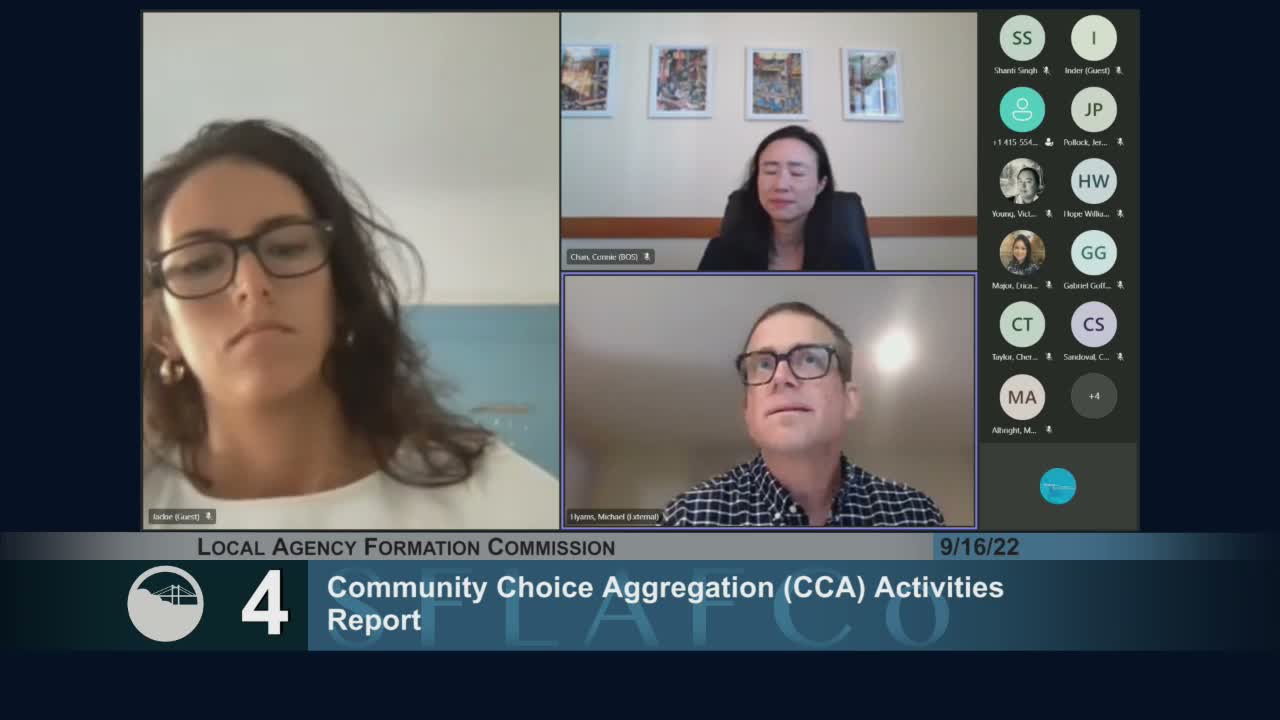
Mike Himes, deputy manager for the San Francisco Public Utilities Commission's (SFPUC) power enterprise, told the Local Agency Formation Commission (LAFCO) that Clean Power SF enrollment is stable and that outreach will target large building owners subject to the city's commercial renewable energy ordinance.
"Since our last report on enrollment statistics in May, enrollment has remained stable," Himes said during the commission's regular meeting. He noted the SuperGreen product represents about 2.1% of accounts and that staff are preparing outreach to buildings over 250,000 square feet that must purchase 100% renewable energy under the city ordinance.
Citlali Sandoval, regulatory and legislative affairs, summarized federal and state developments and said Clean Power SF is analyzing the Inflation Reduction Act (IRA) and incorporating its tax incentives into IRP modeling. Sandoval described four state bills staff is tracking, including AB 1279 (codifying a carbon-neutral-by-2045 goal), SB 1020 (interim clean-energy goals and affordability metrics), SB 905 (carbon-capture program authority for CARB) and SB 846 (authorized a possible extension of Diablo Canyon operations and included a $1.4 billion loan to the Department of Water Resources).
"We are continuing to analyze the Inflation Reduction Act, and we're going to be developing a strategy to leverage it to benefit clean power assets ratepayers," Sandoval said.
Mallory Albright, a utility specialist on Clean Power SF's operations team, presented initial IRP modeling. She described the planning requirement to submit an IRP to the California Public Utilities Commission (CPUC) by November 1 and framed the work in conforming and alternative portfolios. Albright said the base-case portfolio's illustrative results call for nearly 2,000 megawatts of total resource capacity in 2035, including about 300 MW of new solar, 60 MW of new geothermal and 150 MW of new standalone energy storage.
"The total base case resource portfolio that produces this projected energy supply in 2035 includes nearly 2,000 megawatts in total resource capacity," Albright said, adding that preliminary portfolio cost estimates are about 20% higher on a $/MWh basis than the Clean Power SF 10-year financial plan estimates.
On the question of the Diablo Canyon nuclear plant, Sandoval told commissioners the CPUC is required to issue an order by the end of 2023. Possible outcomes include ordering an extension of operations, leaving the current 2024/2025 retirement dates in place, or ordering earlier retirements depending on factors such as the availability of replacement zero-carbon resources, NRC licensing and independent safety reviews.
Commissioners pressed staff on the approval sequence and feedback channels. Staff said Clean Power SF will seek SFPUC approval before submitting the IRP to the CPUC, will post iterative modeling results on its website, open an approximately four-week public comment window and host listening sessions. Chair Connie Chan asked staff to send the results and a memo to LAFCO's clerk and executive officer so commissioners can review the materials promptly.
Public callers praised the process and urged staff to incorporate IRA tax-credit details that affect project costs, domestic-content requirements and refundable credits. Gabe Kaufman asked specifically whether the modeling accounted for domestic-content rules and refundable tax credits, which he said can significantly affect capital costs and the effective net cost of projects.
What happens next: Clean Power SF will continue modeling through September, post results for public comment, return to LAFCO in October with additional modeling results, and seek SFPUC approval prior to the November 1 CPUC filing.
"Since our last report on enrollment statistics in May, enrollment has remained stable," Himes said during the commission's regular meeting. He noted the SuperGreen product represents about 2.1% of accounts and that staff are preparing outreach to buildings over 250,000 square feet that must purchase 100% renewable energy under the city ordinance.
Citlali Sandoval, regulatory and legislative affairs, summarized federal and state developments and said Clean Power SF is analyzing the Inflation Reduction Act (IRA) and incorporating its tax incentives into IRP modeling. Sandoval described four state bills staff is tracking, including AB 1279 (codifying a carbon-neutral-by-2045 goal), SB 1020 (interim clean-energy goals and affordability metrics), SB 905 (carbon-capture program authority for CARB) and SB 846 (authorized a possible extension of Diablo Canyon operations and included a $1.4 billion loan to the Department of Water Resources).
"We are continuing to analyze the Inflation Reduction Act, and we're going to be developing a strategy to leverage it to benefit clean power assets ratepayers," Sandoval said.
Mallory Albright, a utility specialist on Clean Power SF's operations team, presented initial IRP modeling. She described the planning requirement to submit an IRP to the California Public Utilities Commission (CPUC) by November 1 and framed the work in conforming and alternative portfolios. Albright said the base-case portfolio's illustrative results call for nearly 2,000 megawatts of total resource capacity in 2035, including about 300 MW of new solar, 60 MW of new geothermal and 150 MW of new standalone energy storage.
"The total base case resource portfolio that produces this projected energy supply in 2035 includes nearly 2,000 megawatts in total resource capacity," Albright said, adding that preliminary portfolio cost estimates are about 20% higher on a $/MWh basis than the Clean Power SF 10-year financial plan estimates.
On the question of the Diablo Canyon nuclear plant, Sandoval told commissioners the CPUC is required to issue an order by the end of 2023. Possible outcomes include ordering an extension of operations, leaving the current 2024/2025 retirement dates in place, or ordering earlier retirements depending on factors such as the availability of replacement zero-carbon resources, NRC licensing and independent safety reviews.
Commissioners pressed staff on the approval sequence and feedback channels. Staff said Clean Power SF will seek SFPUC approval before submitting the IRP to the CPUC, will post iterative modeling results on its website, open an approximately four-week public comment window and host listening sessions. Chair Connie Chan asked staff to send the results and a memo to LAFCO's clerk and executive officer so commissioners can review the materials promptly.
Public callers praised the process and urged staff to incorporate IRA tax-credit details that affect project costs, domestic-content requirements and refundable credits. Gabe Kaufman asked specifically whether the modeling accounted for domestic-content rules and refundable tax credits, which he said can significantly affect capital costs and the effective net cost of projects.
What happens next: Clean Power SF will continue modeling through September, post results for public comment, return to LAFCO in October with additional modeling results, and seek SFPUC approval prior to the November 1 CPUC filing.
View the Full Meeting & All Its Details
This article offers just a summary. Unlock complete video, transcripts, and insights as a Founder Member.
✓
Watch full, unedited meeting videos
✓
Search every word spoken in unlimited transcripts
✓
AI summaries & real-time alerts (all government levels)
✓
Permanent access to expanding government content
30-day money-back guarantee
