City launches CEC‑funded e‑bike pilot for app‑based delivery workers
May 20, 2022 | San Francisco City, San Francisco County, California
This article was created by AI summarizing key points discussed. AI makes mistakes, so for full details and context, please refer to the video of the full meeting. Please report any errors so we can fix them. Report an error »
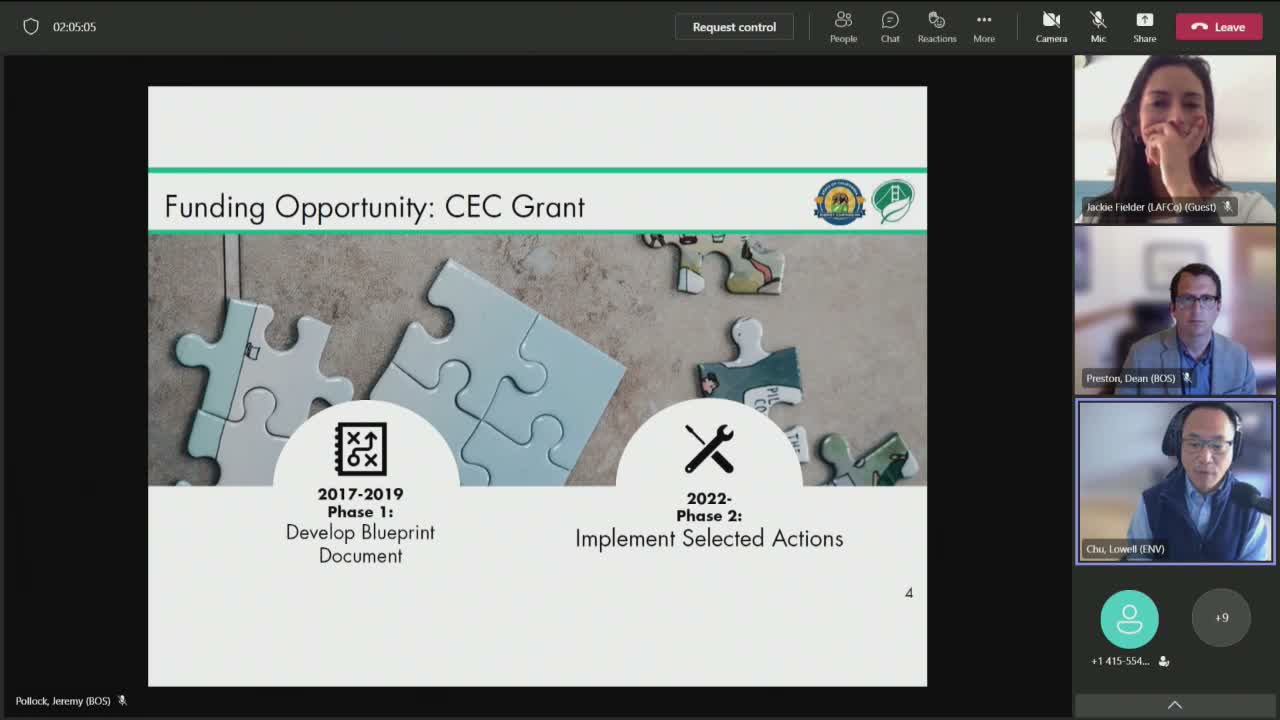
The San Francisco Department of the Environment presented details on a new electric‑bicycle pilot for app‑based delivery workers, funded in part by a $2.4 million grant from the California Energy Commission.
Lowell Chu said the grant supports four major elements — an online EV mapping tool, an EV ombudsperson, a charging hub in a disadvantaged community and the e‑bike pilot itself — and that the pilot’s allocated budget within the grant is $559,000. Under the pilot, two cohorts totaling 30 workers will participate; the program will deploy 35 e‑bikes (including five held in reserve for breakdowns or theft), provide training, helmets, rain gear and insurance, and facilitate maintenance through a local bike shop. At the end of the pilot participants will take ownership of their bikes, and the program will collect utilization and pre/post survey data to evaluate impacts on earnings, charging behavior and street safety.
Chu cited a UC Santa Cruz survey commissioned by LAFCO showing strong interest in e‑bikes: nearly 70% of delivery workers surveyed said they would be willing or might switch to e‑bikes if provided an incentive. Chu said incentives include provision of the bike and gear at program end and gift cards to compensate participants for time completing surveys; partners on the grant application include Grid Alternatives and the San Francisco Bicycle Coalition, which will provide safety and operational training.
Commissioners asked about recruitment criteria, scaling and funding. Commissioner Dean Preston and Commissioner Shanti Singh pressed staff on whether the pilot size was constrained by the grant and how the program could be scaled if additional funds become available; Chu said the pilot size is budget‑driven but the grant design allows savings from other grant components to be redirected to expand cohorts with CEC approval. Commissioners also urged collection of safety and earnings data to inform potential expansion.
Timeline and next steps: staff plans to kick off the grant process in April, launch the first cohort in September and complete the CEC grant closeout by April 2024. The department said it will report evaluation data back to the commission to inform possible scaling and to support requests for additional funding from state programs such as CARB and ARB allocations.
Lowell Chu said the grant supports four major elements — an online EV mapping tool, an EV ombudsperson, a charging hub in a disadvantaged community and the e‑bike pilot itself — and that the pilot’s allocated budget within the grant is $559,000. Under the pilot, two cohorts totaling 30 workers will participate; the program will deploy 35 e‑bikes (including five held in reserve for breakdowns or theft), provide training, helmets, rain gear and insurance, and facilitate maintenance through a local bike shop. At the end of the pilot participants will take ownership of their bikes, and the program will collect utilization and pre/post survey data to evaluate impacts on earnings, charging behavior and street safety.
Chu cited a UC Santa Cruz survey commissioned by LAFCO showing strong interest in e‑bikes: nearly 70% of delivery workers surveyed said they would be willing or might switch to e‑bikes if provided an incentive. Chu said incentives include provision of the bike and gear at program end and gift cards to compensate participants for time completing surveys; partners on the grant application include Grid Alternatives and the San Francisco Bicycle Coalition, which will provide safety and operational training.
Commissioners asked about recruitment criteria, scaling and funding. Commissioner Dean Preston and Commissioner Shanti Singh pressed staff on whether the pilot size was constrained by the grant and how the program could be scaled if additional funds become available; Chu said the pilot size is budget‑driven but the grant design allows savings from other grant components to be redirected to expand cohorts with CEC approval. Commissioners also urged collection of safety and earnings data to inform potential expansion.
Timeline and next steps: staff plans to kick off the grant process in April, launch the first cohort in September and complete the CEC grant closeout by April 2024. The department said it will report evaluation data back to the commission to inform possible scaling and to support requests for additional funding from state programs such as CARB and ARB allocations.
Don't Miss a Word: See the Full Meeting!
Go beyond summaries. Unlock every video, transcript, and key insight with a Founder Membership.
✓
Get instant access to full meeting videos
✓
Search and clip any phrase from complete transcripts
✓
Receive AI-powered summaries & custom alerts
✓
Enjoy lifetime, unrestricted access to government data
30-day money-back guarantee
