LAFCO working group recommends MFC as initial ‘green bank’ role; commissioners press for equity and governance safeguards
February 17, 2023 | San Francisco City, San Francisco County, California
This article was created by AI summarizing key points discussed. AI makes mistakes, so for full details and context, please refer to the video of the full meeting. Please report any errors so we can fix them. Report an error »
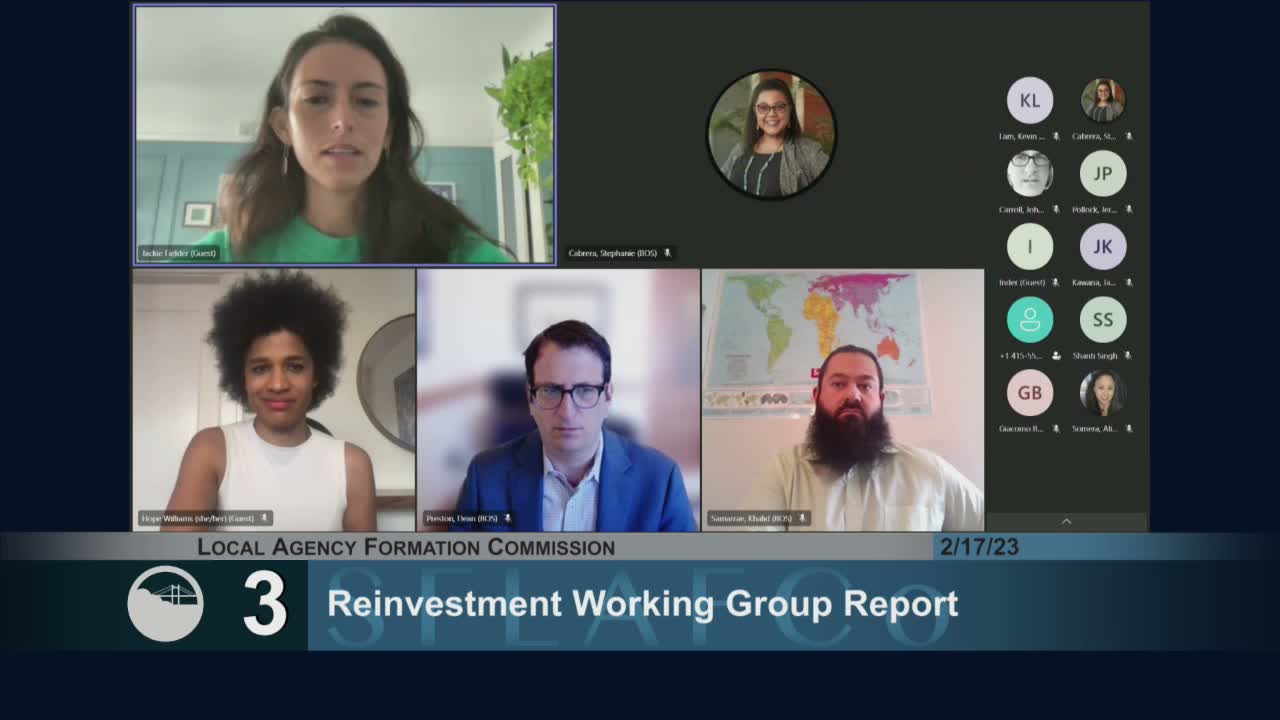
HRNA Advisors told the Local Agency Formation Commission on Wednesday that the city’s proposed Municipal Financial Corporation could serve the functions of a “green bank,” potentially allowing San Francisco to tap federal greenhouse‑gas funding that may be unavailable to a depository public bank.
The firm — represented in the meeting by Giacomo and policy analysts Kalid Samarai and Yakimo Bagarella — presented draft business, governance and financial models showing that an MFC could be capitalized with roughly $20,000,000 and reach profitability within about three years, while a full public bank was modeled at about $50,000,000 capitalization under current assumptions. Giacomo cautioned that federal and regulatory rules remain unsettled and recommended further legal review before any transition to a depository institution.
Why it matters: Commissioners framed the MFC/public‑bank work as a potential tool to finance large local priorities such as affordable housing and decarbonization, and as a remedy for long‑standing gaps in private‑sector lending to historically marginalized communities.
Commissioners pressed several policy and governance points. Vice Chair Jackie Fielder said the public bank’s purpose should not be profit‑maximization and urged that sustainability and community benefits be embedded across lending decisions. "The principle of being able to delineate that profit maximizing is obviously not the goal of the San Francisco public bank," Fielder said, urging standards that keep benefits in communities and ratepayers rather than private financiers.
Commissioner Hope Williams asked that the governance plan consider demographic representation and compensation for community board members, proposing seats for residents who do not bring corporate board experience. Williams argued that compensating BIPOC board members could broaden access to governance roles long dominated by wealthier individuals.
HRNA responded that its governance drafts call for board members to be San Francisco residents or representatives with community ties while balancing regulator expectations for banking expertise. The consultants also described a potential two‑tier governance model with a technical financial board and a separate top‑level oversight commission to represent community priorities.
Regulatory and funding uncertainties were a recurring theme: presenters pointed to AB 857 and FDIC insurance requirements as hurdles that could shape a future depository public bank’s structure, and said legal advice from the city attorney and outside counsel will be needed to clarify eligibility for specific federal funding streams.
Next steps: The consultants said they will deliver final business and governance plans for the MFC by March 31 and public‑bank deliverables by May 10, with ongoing review by city attorneys and further conversations with supervisors, SFPUC and community organizations. The commission asked for continued public feedback during the coming weeks and noted that regulatory approvals and implementation steps could take several additional years.
The firm — represented in the meeting by Giacomo and policy analysts Kalid Samarai and Yakimo Bagarella — presented draft business, governance and financial models showing that an MFC could be capitalized with roughly $20,000,000 and reach profitability within about three years, while a full public bank was modeled at about $50,000,000 capitalization under current assumptions. Giacomo cautioned that federal and regulatory rules remain unsettled and recommended further legal review before any transition to a depository institution.
Why it matters: Commissioners framed the MFC/public‑bank work as a potential tool to finance large local priorities such as affordable housing and decarbonization, and as a remedy for long‑standing gaps in private‑sector lending to historically marginalized communities.
Commissioners pressed several policy and governance points. Vice Chair Jackie Fielder said the public bank’s purpose should not be profit‑maximization and urged that sustainability and community benefits be embedded across lending decisions. "The principle of being able to delineate that profit maximizing is obviously not the goal of the San Francisco public bank," Fielder said, urging standards that keep benefits in communities and ratepayers rather than private financiers.
Commissioner Hope Williams asked that the governance plan consider demographic representation and compensation for community board members, proposing seats for residents who do not bring corporate board experience. Williams argued that compensating BIPOC board members could broaden access to governance roles long dominated by wealthier individuals.
HRNA responded that its governance drafts call for board members to be San Francisco residents or representatives with community ties while balancing regulator expectations for banking expertise. The consultants also described a potential two‑tier governance model with a technical financial board and a separate top‑level oversight commission to represent community priorities.
Regulatory and funding uncertainties were a recurring theme: presenters pointed to AB 857 and FDIC insurance requirements as hurdles that could shape a future depository public bank’s structure, and said legal advice from the city attorney and outside counsel will be needed to clarify eligibility for specific federal funding streams.
Next steps: The consultants said they will deliver final business and governance plans for the MFC by March 31 and public‑bank deliverables by May 10, with ongoing review by city attorneys and further conversations with supervisors, SFPUC and community organizations. The commission asked for continued public feedback during the coming weeks and noted that regulatory approvals and implementation steps could take several additional years.
Don't Miss a Word: See the Full Meeting!
Go beyond summaries. Unlock every video, transcript, and key insight with a Founder Membership.
✓
Get instant access to full meeting videos
✓
Search and clip any phrase from complete transcripts
✓
Receive AI-powered summaries & custom alerts
✓
Enjoy lifetime, unrestricted access to government data
30-day money-back guarantee
