Peninsula Clean Energy and Marin Clean Energy outline 24/7 renewables plan and Richmond virtual power plant pilot
April 21, 2023 | San Francisco City, San Francisco County, California
This article was created by AI summarizing key points discussed. AI makes mistakes, so for full details and context, please refer to the video of the full meeting. Please report any errors so we can fix them. Report an error »
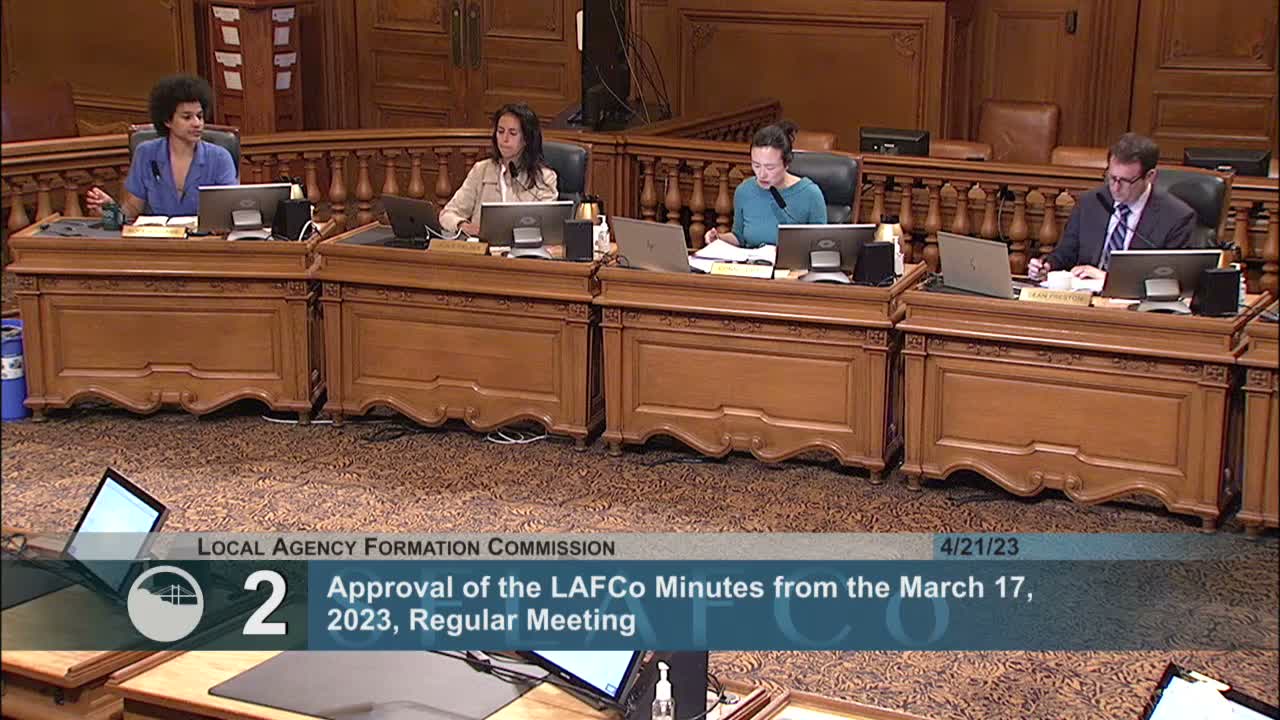
Peninsula Clean Energy and Marin Clean Energy presented joint briefings to the Local Agency Formation Commission on regional efforts to deepen renewable supply and to use customer-sited devices as grid resources.
Jan Pepper, chief executive of Peninsula Clean Energy, told commissioners the agency’s planning centers on diversifying generation and adding storage so daytime solar can be shifted to evening hours. Pepper said Peninsula’s load is “about 3,700 gigawatt hours,” that the agency’s default product is “50% renewable, 100% clean,” and that the CCA has saved customers “over $107,000,000 since we started in 2016.” She described an open-source “match model” (available on GitHub) that the agency uses to simulate portfolios and stochastic scenarios to evaluate costs and hourly emissions. Pepper cautioned that market volatility, supply-chain delays and CAISO interconnection timelines could push the agency’s 2025 timing for full hourly matching beyond the target.
“[W]e believe we can deliver 100% renewable energy for 99% of the hours, at cost competitive to today,” Pepper said during the presentation.
Marin Clean Energy’s Alexandra McGee described a pilot virtual power plant (VPP) in the city of Richmond funded through a California Energy Commission EPIC grant. The VPP aggregates distributed energy resources — rooftop solar, battery storage, smart thermostats and other smart devices — and creates a digital-control pathway that lets the aggregator shift customer load during system stress. McGee said the pilot emphasizes equity: participating low-income households can receive monthly bill credits (she described approximately $40–$50 per month for qualifying residential customers), while commercial credits are capped at higher levels depending on customer class.
McGee said MCE is starting with single-family customers and households that previously participated in low‑income solar installations (with partners such as GRID Alternatives) because CPUC meter‑arrangement rules make multifamily integration more complex; common-area approaches are the initial route for multifamily properties. She also said the program will rely on historical AMI/load-profile data and retained third‑party partners to send dispatch signals to enrolled devices.
Commissioners asked about participant selection, data access, and how the programs could translate to San Francisco’s denser housing stock. McGee and Pepper both recommended staged approaches: storage and hybrid solar+storage now, and broader load-shifting policies over time.
Public commenters urged the commission to favor strategic, area-based rollouts similar to MCE’s model rather than one-off grants. Remote commenter Eric Brooks (Our City SF / Californians for Energy Choice) encouraged LAFCO to use reinvestment tools to scale a citywide VPP rather than only distributing program funds by application.
The commission filed items 3 and 4 (the Peninsula and MCE presentations) for the record without further action.
Jan Pepper, chief executive of Peninsula Clean Energy, told commissioners the agency’s planning centers on diversifying generation and adding storage so daytime solar can be shifted to evening hours. Pepper said Peninsula’s load is “about 3,700 gigawatt hours,” that the agency’s default product is “50% renewable, 100% clean,” and that the CCA has saved customers “over $107,000,000 since we started in 2016.” She described an open-source “match model” (available on GitHub) that the agency uses to simulate portfolios and stochastic scenarios to evaluate costs and hourly emissions. Pepper cautioned that market volatility, supply-chain delays and CAISO interconnection timelines could push the agency’s 2025 timing for full hourly matching beyond the target.
“[W]e believe we can deliver 100% renewable energy for 99% of the hours, at cost competitive to today,” Pepper said during the presentation.
Marin Clean Energy’s Alexandra McGee described a pilot virtual power plant (VPP) in the city of Richmond funded through a California Energy Commission EPIC grant. The VPP aggregates distributed energy resources — rooftop solar, battery storage, smart thermostats and other smart devices — and creates a digital-control pathway that lets the aggregator shift customer load during system stress. McGee said the pilot emphasizes equity: participating low-income households can receive monthly bill credits (she described approximately $40–$50 per month for qualifying residential customers), while commercial credits are capped at higher levels depending on customer class.
McGee said MCE is starting with single-family customers and households that previously participated in low‑income solar installations (with partners such as GRID Alternatives) because CPUC meter‑arrangement rules make multifamily integration more complex; common-area approaches are the initial route for multifamily properties. She also said the program will rely on historical AMI/load-profile data and retained third‑party partners to send dispatch signals to enrolled devices.
Commissioners asked about participant selection, data access, and how the programs could translate to San Francisco’s denser housing stock. McGee and Pepper both recommended staged approaches: storage and hybrid solar+storage now, and broader load-shifting policies over time.
Public commenters urged the commission to favor strategic, area-based rollouts similar to MCE’s model rather than one-off grants. Remote commenter Eric Brooks (Our City SF / Californians for Energy Choice) encouraged LAFCO to use reinvestment tools to scale a citywide VPP rather than only distributing program funds by application.
The commission filed items 3 and 4 (the Peninsula and MCE presentations) for the record without further action.
View the Full Meeting & All Its Details
This article offers just a summary. Unlock complete video, transcripts, and insights as a Founder Member.
✓
Watch full, unedited meeting videos
✓
Search every word spoken in unlimited transcripts
✓
AI summaries & real-time alerts (all government levels)
✓
Permanent access to expanding government content
30-day money-back guarantee
