Clean Power SF reports steady participation, new e‑bike rebate and seeks credit authorization amid PG&E rate hikes
January 19, 2024 | San Francisco City, San Francisco County, California
This article was created by AI summarizing key points discussed. AI makes mistakes, so for full details and context, please refer to the video of the full meeting. Please report any errors so we can fix them. Report an error »
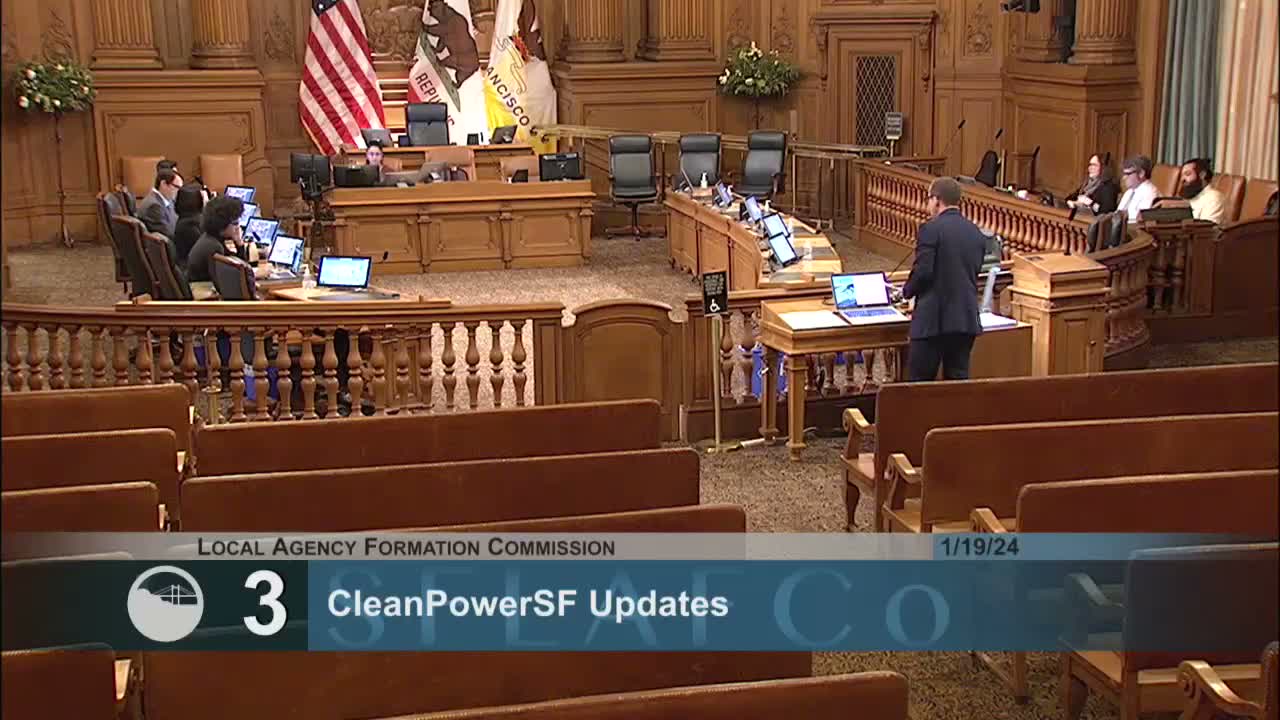
Michael Himes, deputy assistant general manager for the San Francisco Public Utilities Commission’s power enterprise, updated the Local Agency Formation Commission on Clean Power SF, describing steady customer enrollment and several program developments.
Himes said Clean Power SF’s opt‑out rate is about 4.4% and that Super Green energy sales now represent more than 12% of the program’s annual retail sales. He also announced an e‑mobility incentive launching later this quarter: qualifying low‑income customers in equity priority communities will receive a $1,000 coupon to apply toward the purchase of a new e‑bike at participating local retailers, with retailers reimbursed by Clean Power SF.
On finance, Himes said the SFPUC plans to bring legislation to the Board of Supervisors to extend authority for the general manager to enter bank credit agreements up to $150 million in capacity for 10 years. He described standby letters of credit as a common way the program posts collateral to cover power‑purchase obligations and noted that the largest bank agreement the program has used to date was about $75 million (an earlier facility had been reduced to $20 million).
Himes also discussed program development: an e‑bike incentive program, food‑service energy efficiency and disadvantaged‑community community solar programs are in various stages of design and procurement. He said the community solar program is awaiting decisions from the California Public Utilities Commission that will affect project eligibility and timing, and projected community solar operation in 2025–2026 if the regulatory and procurement processes proceed as expected.
Himes warned that a November 2023 CPUC rate decision for PG&E went into effect Jan. 1 and will raise bills for many customers. He said PG&E has estimated the typical residential bill could rise by more than $30 per month (electricity and gas combined) in 2024; Clean Power SF’s estimate is that the average residential customer will still see about an $8 per month savings on generation relative to PG&E.
Himes closed by pointing to an SFPUC webinar aimed at helping customers understand bills and savings strategies; the utility plans to record the session and post materials online.
The presentation prompted commissioner questions on net‑energy‑metering changes for multifamily properties, CPUC timing for community solar eligibility rules, how bank credit facilities are procured (Himes said an RFP process is used and named JP Morgan as the current participating bank), and whether PG&E provides outage and reimbursement information (Himes said PG&E does not reimburse Clean Power SF for outages and that the city receives outage notifications for events affecting at least 1,000 customer locations).
Himes said Clean Power SF’s opt‑out rate is about 4.4% and that Super Green energy sales now represent more than 12% of the program’s annual retail sales. He also announced an e‑mobility incentive launching later this quarter: qualifying low‑income customers in equity priority communities will receive a $1,000 coupon to apply toward the purchase of a new e‑bike at participating local retailers, with retailers reimbursed by Clean Power SF.
On finance, Himes said the SFPUC plans to bring legislation to the Board of Supervisors to extend authority for the general manager to enter bank credit agreements up to $150 million in capacity for 10 years. He described standby letters of credit as a common way the program posts collateral to cover power‑purchase obligations and noted that the largest bank agreement the program has used to date was about $75 million (an earlier facility had been reduced to $20 million).
Himes also discussed program development: an e‑bike incentive program, food‑service energy efficiency and disadvantaged‑community community solar programs are in various stages of design and procurement. He said the community solar program is awaiting decisions from the California Public Utilities Commission that will affect project eligibility and timing, and projected community solar operation in 2025–2026 if the regulatory and procurement processes proceed as expected.
Himes warned that a November 2023 CPUC rate decision for PG&E went into effect Jan. 1 and will raise bills for many customers. He said PG&E has estimated the typical residential bill could rise by more than $30 per month (electricity and gas combined) in 2024; Clean Power SF’s estimate is that the average residential customer will still see about an $8 per month savings on generation relative to PG&E.
Himes closed by pointing to an SFPUC webinar aimed at helping customers understand bills and savings strategies; the utility plans to record the session and post materials online.
The presentation prompted commissioner questions on net‑energy‑metering changes for multifamily properties, CPUC timing for community solar eligibility rules, how bank credit facilities are procured (Himes said an RFP process is used and named JP Morgan as the current participating bank), and whether PG&E provides outage and reimbursement information (Himes said PG&E does not reimburse Clean Power SF for outages and that the city receives outage notifications for events affecting at least 1,000 customer locations).
Don't Miss a Word: See the Full Meeting!
Go beyond summaries. Unlock every video, transcript, and key insight with a Founder Membership.
✓
Get instant access to full meeting videos
✓
Search and clip any phrase from complete transcripts
✓
Receive AI-powered summaries & custom alerts
✓
Enjoy lifetime, unrestricted access to government data
30-day money-back guarantee
